
“You Get to Work Out”
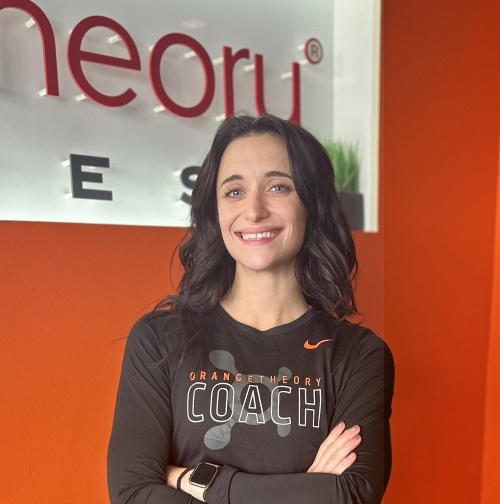
By Hunter Minné
When her father was diagnosed with a fatal neurological disease during her first year of college, Kaci Brisco became a cell and molecular neuroscience major to better understand his condition. Now a fitness coach in suburban Oak Park, she uses what she learned in school and in life to inspire her members to become the best versions of themselves.
Brisco, 25, from Cary, Illinois, a northwest suburb of Chicago, spent her first year at Florida State University as an exercise physiology major. After her father was diagnosed with amyotrophic lateral sclerosis (ALS) in winter 2019, she switched to neuroscience.
“I wanted to understand more,” Brisco said. “I already kind of had the idea of like, ‘Ooh, neuroscience is new, it's undergraduate, I could totally switch, and it's interesting.’ And now I have way more of a reason to make the change, so it was a pretty easy decision.”
Throughout her father's treatment for ALS or Lou Gehrig’s disease, Brisco used the neuroscientific knowledge she was gaining from her classes to act as an intermediary between the doctors treating her father and her family. Having at least a basic neurological understanding of her father’s situation and the progression of the disease enabled her to better prepare herself and her family for what to expect next.
The first sign of her father’s eventual diagnosis came when Brisco went home for Thanksgiving in November 2019. While they had yet to diagnose ALS, Brisco’s mother mentioned he was sick and had been suffering from nerve damage in his hands, which first led Brisco to worry he could have ALS.
“I started to backtrack and pray that it was anything but that,” Brisco said. “Like, I found myself praying that it was cancer, praying that it was multiple sclerosis, praying that it was Parkinson’s. Because, you know, depending on the type of cancer, all of those things are more treatable, or are treatable, depending on what it is, compared to ALS.”
When her father was first brought to a hospital, the doctors diagnosed him with pneumonia and prescribed a round of antibiotics. Listening to her gut and based on everything she was seeing, Brisco kept pushing for a second opinion from a different doctor, who eventually confirmed her worst fear. Her father was diagnosed with ALS.
According to the ALS Association, the illness is a progressive neurodegenerative disease where the motor neurons in the brain and spinal cord deteriorate and eventually die. This strips the brain of the ability to control muscle movements and, in turn, ruins the ability to do most actions, including eating, speaking, and breathing. Currently, there is no way to completely halt the fatal loss of muscle control caused by ALS.
The cause of ALS is still not entirely understood, but for those diagnosed, there are a number of treatments available to slow its progression or improve quality of life.
“There were things that I learned throughout my courses that definitely assisted with him elongating his life for the time that we had,” Brisco said. “Just different things to keep his myelin sheath more intact and different diet choices, lifestyle choices, to the best that we could, that would assist his brain health and overall function of his nervous system.”
Beyond her translation efforts, breaking down updates for her mother, Brisco also raised over $6,500 for her father’s second round of stem cell therapy by completing the Clearwater Running Festival Marathon in 2020.
“When he got that stem cell therapy, we believe that it gave him at least another six months to a year of life with us,” Brisco said. “The actual running of the marathon itself — there's no way that I could have ever related to what he was going through, but knowing the kind of pain that he was in, knowing what he was losing, it just flipped a switch in my mind that there was no saying, ‘I can't,’ because the reality is … I can.”
Tim Brisco died in 2022 at the age of 60.
Now, Kaci Brisco is back in Chicago’s suburbs, living in Elmwood Park and working in Oak Park as Head Coach for the Orangetheory Fitness franchise, using her neuroscientific knowledge to help others strengthen their bodies and minds.
Growing up, Brisco had been a swimmer, but during her freshman year in college, she came down with a case of mono that sidelined her for several months, causing significant muscle mass loss. After that initial year at FSU, in 2019, she first started working at Orangetheory. Getting into the gym helped her feel like herself again. She’s been coaching ever since.
While her original plan might have included medical school, tuition cost and new personal life goals are steering her away from a traditional medical or academic field for now.
“There was a side of it too where I just couldn't imagine myself working in a hospital after spending two and a half straight weeks with my dad, transitioning from being in regular hospital care to hospice, and seeing everything that I saw,” Brisco confessed. “The idea of working in a hospital was a little too traumatic for me at the time.”
Although she hasn’t ruled out eventually returning to medicine, she has no immediate plans to do so.
Even though she’s no longer in the medical field in the strict sense of the word, Brisco commented by coaching, she feels like she is still providing healthcare in a “preemptive way,” by inspiring people to move and to stay informed about fitness.
“Because I do have the knowledge to back it up, and then I have this degree that I worked really hard for, and I can break down the nitty-gritty science and tell our members why it's important,” Brisco said.
She even finds ways to throw a little bit of neuroscience into her coaching, like explaining the benefit of stretching for relieving strain on the central nervous system or providing nutritional advice.
The positive link between exercise and neurological health is well documented, with improved mental health, lower rates of anxiety and depression and improved memory being some of the possible benefits. Specific dietary choices can also have an impact on mental health and brain function, for instance, omega-3 fatty acid rich foods can support cognitive processing while people with diets high in saturated fats can potentially hinder their cognitive processing or be more likely to suffer neurological dysfunction.
Brisco encouraged anyone hesitant to begin their fitness journey to look outside of the gym and find a way to move their body that they enjoy, be it long runs, pilates or dance.
“Life is hard,” Brisco said. “Everything is going to be hard, but you can choose your hard. Do you want hard to look like getting off of the couch when you're 50, or do you want hard to be your workout for the day, you know? And then when people are really stubborn, that's when I do kind of fall on my dad and say, ‘Hey, you could have it all taken away one day.’ I mean, the fact that you get to move your body is a gift, and you don't have to work out, you get to work out.”