
‘Nursing is so much more’
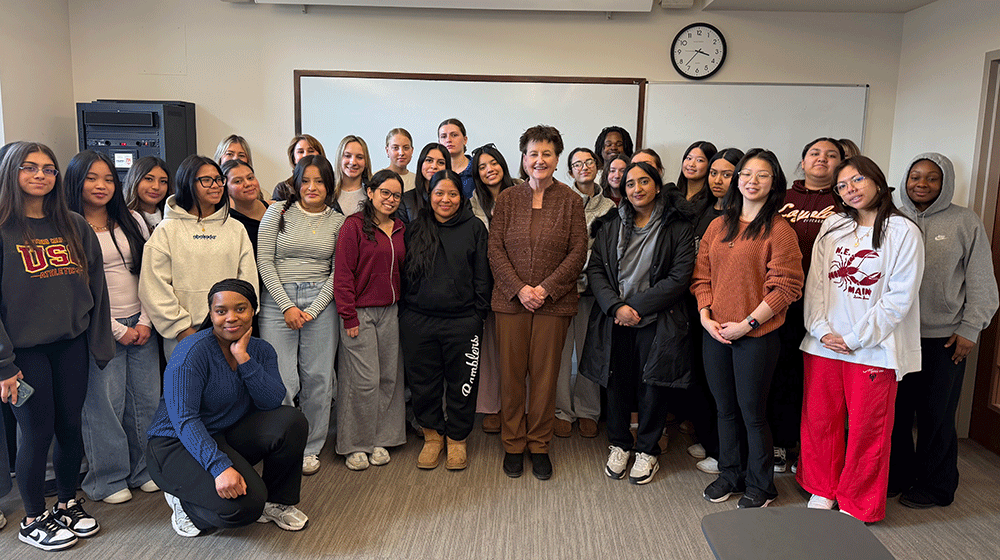
Dean Lorna Finnegan, center, stands with students in an Introduction to Professional Nursing class after speaking with them about leadership, healthy equity, and career development.
By Ashley Rowland
March 2, 2026
Even though they’re still learning the basics of anatomy and have yet to treat a patient, the dean of the Marcella Niehoff School of Nursing had a message for the school’s youngest students: You’re already leaders.
“If you weren’t a leader, you wouldn’t be here,” Dean Lorna Finnegan recently told a spring Introduction to Professional Nursing class, the first real introduction undergraduates have to the nursing profession in their coursework. “Leadership and nursing go hand in hand. Leadership and helping people go hand in hand.”
Finnegan’s talk—one of nearly a dozen she gives each year to first-year students in all General Nursing 102 sections—was meant to introduce students to the many career options available in nursing.
It was also meant to help students begin forming their professional identities – in other words, to begin thinking of themselves as nurses and understanding their potential to be changemakers.
Unexpected pathways
As nurses, Finnegan told them, their career paths would likely not be straight. And they would work in settings they never imagined.
“Most students envision nurses taking care of sick patients in a hospital,” she said. “But nursing is so much more.”
She shared her own professional journey as an example. After practicing as an intensive care nurse for several years, Finnegan was “tired of seeing people get sick and die. I wanted to know how I could keep them out of the ICU in the first place.”
She chose community health nursing, bringing preventive and routine care directly to underresourced communities in homes, schools, and other non-traditional settings. She became a family nurse practitioner and helped launch two community clinics, one of them at an elementary school, in West and South Chicago.
Along the way, she earned three degrees, including her PhD, while raising four children. She taught at several Chicago area universities and became dean at Loyola Nursing.
Those experiences, she said, taught her to be open to the unexpected.
“Embrace the opportunities,” she said. “If someone approaches you and asks you to lead, say yes. They see something in you and they recognize your potential.”
Much of Finnegan’s talk focused on how nurses should approach their work with a health equity lens, being aware of how systemic factors like poverty, inadequate housing, or lack of access to fresh foods contribute to poor health among individuals and populations. Nurses can take small steps, like helping a vulnerable patient find transportation to a medical appointment, to help address those disparities, along with broader efforts like engaging in political action and research.
“We’re advocates for our patients and we can use our influence to make changes at all levels,” she said.
A new perspective
In a busy and growing school, Finnegan’s talk was a rare chance for students to interact with a dean.
Students asked her questions at the end of class. Several lingered afterwards to speak with her one-on-one.
Among their questions: How did you pay for your education while supporting yourself and family? (Through tuition benefits at a hospital she worked at and nurse traineeships, options that Finnegan acknowledged are harder to come by for today’s students).
What was one experience that was a highlight? (Starting community clinics and practicing alongside her students from Saint Xavier University, where she was teaching, demonstrating firsthand how nurses can lead and serve in community settings.)
Student Scarlett Moriarty called the dean’s talk “motivational” and said learning about her career journey opened her eyes to the possibility of practicing community health nursing.
“I didn’t know about community health nursing, or how many different paths you can take in nursing,” Moriarty said. “There’s so much opportunity and it definitely opened my eyes.”
Clinical Assistant Professor Mary Heinz, class instructor, said that while some first-year students already have their sights set on earning an advanced nursing degree, many are still in the early stages of exploring the paths they can take within the profession.
Hearing the dean speak candidly about her own experiences in nursing gave students a new perspective on what they can accomplish.
“As a nurse, you have so many opportunities to have a positive impact on communities and influence people,” Heinz said. “This was a chance for them to hear about what leadership in nursing really means.”