
Q&A: Melissa Murphey
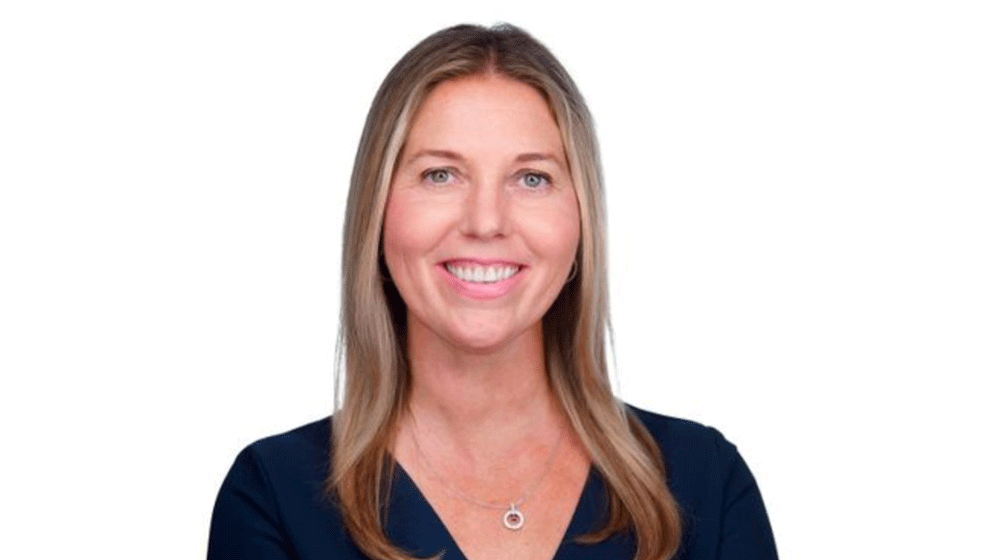
Melissa Murphey is Loyola Nursing's new assistant dean for graduate clinical programs.
Melissa Murphey, DNP, APRN, FPA, FNP-C, grew up on Chicago’s Northwest side, the daughter of Irish immigrants who emphasized the importance of education, hard work, and—in keeping with their Catholic faith—caring for those in need.
Today, she’s the Marcella Niehoff School of Nursing’s new assistant dean for graduate clinical programs, a role that puts her in charge of its nationally recognized Doctor of Nursing Practice and Master of Science in Nursing programs.
Murphey came to Loyola Nursing from Lewis University, where she was director of nursing. Describing herself as “deeply committed to the future of our profession,” she serves on the Board of the Illinois Society of Advanced Practice Nursing and is active in initiatives and legislative efforts to strengthen the nursing practice environment statewide.
One semester into her new position, Murphey spoke about why graduate students come to Loyola Nursing, the school’s new rural health initiative, and more.
Why did you decide to come to Loyola Nursing?
I was drawn by the school’s outstanding reputation, and the opportunity to work closely with graduate nursing students at a pivotal stage in their professional journeys.
I really enjoy working with graduate students; they’re usually very excited about this next part of their journey. I love meeting with students, and my goal is to ensure that every graduate student feels connected, supported, and empowered while they’re here.
What are your biggest takeaways about the school’s graduate programs so far?
I’m struck by how many programs we have and the uniqueness of those programs. Within our DNP program, for example, we have eight nurse practitioner tracks, three clinical nurse specialist tracks, and a systems leadership track. Almost anything that people want to go into, it’s available to them. And some of these tracks—like emergency or psychiatric mental health—are in demand and hard to find.
Our MSN in Healthcare Administration program is outstanding. It’s been around for many years and the relationships we’ve been able to build have led to opportunities for our students.
All our graduate students, including those in our post-graduate certificate programs, have so many opportunities for clinical experiences, for fellowships, and to be part of the broader nursing network in Chicago and beyond. The sky is the limit as far as what students can do at Loyola.
What’s surprised you during your time here?
It’s been eye-opening to find out how many of our graduate students are returning Loyola Ramblers. They had such a positive experience when they got their BSN that Loyola was absolutely their number one choice when they decided to go back to school.
I’m pleased to see that we’ve established tuition incentives with some of our primary practice partners in the Chicago market to assist students financially in obtaining their degree.
You attended Catholic schools from kindergarten through university, and now you’re working at a Catholic university. How does Loyola’s Jesuit mission resonate with you?
I’m a big believer in the importance of Catholic education, and the Catholic values that were instilled in me at a very young age come through in my nursing practice.
Loyola does an excellent job on cura personalis—care for the whole person—and we emphasize that when you’re caring for an individual, you’re also caring for their family. You learn to view patients as individuals and appreciate their uniqueness, their cultural and socioeconomic background.
Talk about your parents (shown below at Murphey's graduation from Resurrection College Prep High School) and especially your mother, who inspired you to become a nurse.
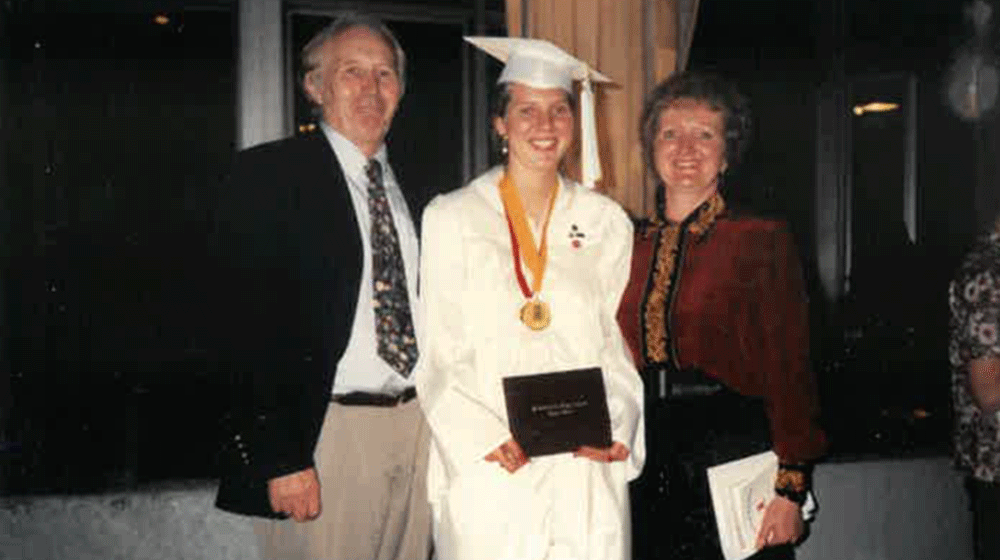
My parents met in Ireland, got married there and immigrated to Chicago in 1970. Their strong work ethic and desire to provide better opportunities for myself and my siblings influenced all aspects of my life.
My dad, who is now retired, worked for the City of Chicago in the Department of General Services; he was a painter and worked on many of the large buildings downtown.
My mom was a midwife and a nurse (who passed away while Murphey was a BSN student). Her love and passion for health care and helping others was instilled in me at a very young age. She knew I wanted to be a nurse and she was instrumental in guiding me toward nursing as a career. She helped me see that advanced practice nursing should be part of my plan.
She would be over the moon to know what I’m doing now at Loyola.
Tell us about Loyola Nursing’s new rural health education initiative, which will allow graduate students to fulfill some of their clinical requirements in rural settings.
I’m working with Loyola’s P. Ann Solari Twadell, who received a $3.8 million Nurse Education, Practice, Quality and Retention—Workforce Expansion Program grant. Through service immersions, our graduate students will gain hands-on experience in acute and long-term care for patients living in rural environments in Illinois, Indiana, Michigan, South Dakota and Wisconsin. Graduate students will have the opportunity to mentor BSN students on this grant.
In many of those areas, there aren’t enough advanced practice nurses and there’s such a need for nurse practitioners. It’s so important that Loyola students have an awareness of rural health, and we’re making sure they have a wide range of clinical opportunities so they’re prepared to work in a variety of settings.
As a native Chicagoan, what’s your ideal day in the city?
I grew up in Gladstone Park. I’d check out a lovely bakery in the neighborhood, meet a friend for a cup of tea, and take in the city sights. As a kid, I grew up around the Irish American Heritage Center, which is a little gem in the city, so maybe I’d go there. There are so many amazing restaurants in the city, so I’d go out to eat—I love Italian food and sushi.
I also love sports – so I’d catch a game at Wrigley Field or watch my own children at one of their games.
January 2026