
Vistria
Vistria Group
Scaling Success: Investing in Models That Matter
The Vistria Group ("Vistria", the Firm”) is a private investment firm with locations in Chicago, Dallas, and New York City, dedicated to driving strong value for all stakeholders. With $17 billion in AUM, Vistria focuses on delivering returns to investors, achieving impactful outcomes for the companies and communities in which it invests, and fostering lasting, positive societal change. Vistria received the Baumhart Center for Social Enterprise and Responsibility’s Parkinson Profit and Purpose Award at the 2025 Leading for Good Conference.
Introduction
Kip Kirkpatrick and Martin Nesbitt are co-chairmen and co-CEOs of Vistria, a private investment firm that works to reimagine a world where profit and purpose go hand in hand. Their founding thesis was, and remains to this day, to generate market-leading returns while achieving a significant positive social impact at scale. The Firm’s targeted industries, healthcare, knowledge & learning solutions, financial services and housing, lie at the nexus between the private and public sectors, where there is significant opportunity to drive strong financial returns and direct and indirect impact on society. As a leading impact investment firm, Vistria believes investors play a vital role in helping companies realize their impact potential and maximize value. Central to this strategy is the Vistria Optimal Impact (VOI) Model, a proprietary assessment method used to evaluate a company’s impact potential and identify opportunities to drive positive outcomes. These insights then guide the firm in optimizing positive impact throughout every stage of the investment cycle.
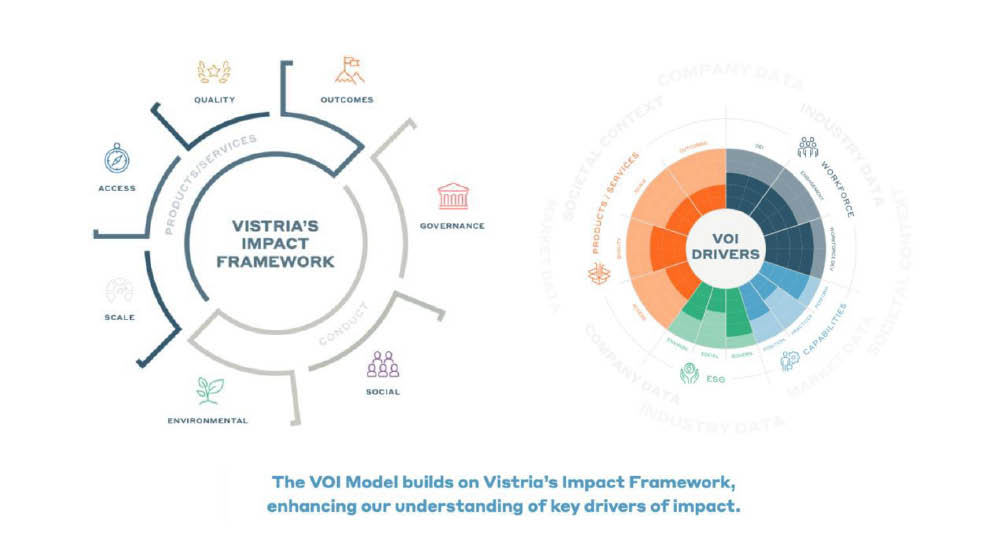
Recognizing that financial success and social progress are not mutually exclusive, the VOI Model evaluates companies based on four key drivers (Exhibit 1). Informing these core drivers, Vistria incorporates broader societal, market, and industry data to ensure that its investments are responsive to real-world conditions and needs.
Exhibit 1: The Vistria Group VOI Framework
Source: The Vistria Group, “2023 Impact Report”
Unlike traditional models that may assess impact after the fact, Vistria leverages the VOI Model to integrate impact into investment strategy from the outset, using it to inform and support sourcing, diligence, ownership, and exit. This ensures that portfolio companies are not only profitable but also actively advancing their impact in line with their broader investment strategy, to address systemic challenges in healthcare, education, and financial services. Vistria demonstrates that thoughtful investment can scale both economic value and equitable outcomes. In doing so, Vistria is proving that impact is a performance driver.
Measuring Performance
Vistria’s commitment to tangible impact is demonstrated through its focus on measurable and scalable outcomes, quality, and access across its portfolio companies. These organizations collectively enhance access to essential services for end stakeholders, and have expanded reach to 17,450,000 additional students[1], over 1,250,000 additional patients[2], and over 168,000 financial services clients between 2022 and 2023[3]. As part of the Firm’s Real Estate strategy, it has already acquired more than 7,000 units, over 90% of which are affordable to low-income residents.
Further to their emphasis on the impact of their portfolio’s products and services, the Firm understands the importance of environmental, social, and governance practices to ensuring companies are well-prepared for evolving standards and are leading actors in responsible business practices. This includes a robust focus on people – and ensuring the firm supports a strong and engaged workforce. These accomplishments highlight Vistria’s commitment to achieving measurable, positive changes above their peers across multiple dimensions, driving both social and environmental progress alongside financial success.
Proving Profit and Purpose: Investment Examples
Vistria’s investment in Penn Foster, a leading provider of online high school and career training programs, exemplifies its dual commitment to financial and societal impact. Through strategic support and integration with employer and community networks, Vistria helped expand Penn Foster’s reach to underserved adult learners seeking workforce credentials. The investment delivered a strong financial return, reportedly around 50% internal rate of return, while also addressing critical skills gaps and enhancing economic mobility for thousands of students.
Another example is Vistria’s role in the Haven at Long Grove affordable housing project in Naperville Township. By preserving and improving apartment units and ensuring that 50% remain affordable to families earning less than 80% of the area median income, Vistria protected access to quality housing in a high-opportunity school district.
The Legacy of Robert (Bob) L. Parkinson, Jr.
The Baumhart Center’s Parkinson Award for Purpose & Profit is named for Robert (Bob) L. Parkinson, Jr., an extraordinary individual who believed in the positive power of business. A longtime executive at Abbott Laboratories and former Dean at Loyola University Chicago’s business school, Parkinson left a lasting legacy, including the founding of Loyola’s Parkinson School of Health Sciences and Public Health.
His son, Robert Parkinson III, continues that legacy, as a Senior Advisor and former Senior Partner at Vistria, where he led investor relations until early 2025. With prior experience in private investment and asset management, Parkinson III helped drive Vistria’s growth and impact that helped build it into the firm it is today.
Conclusion
Vistria exemplifies how purpose and profit can be seamlessly aligned to create transformative outcomes for stakeholders and society. By embedding assessment methods like its VOI Model, Vistria demonstrates a robust commitment to impact that can scale. Their proactive alignment with impact principles mitigates risks associated with market unpredictability while enhancing resilience and investor confidence, solidifying Vistria’s role as a pioneer in impact-driven private equity.
Questions for Discussion
- What role do frameworks like the Task Force on Climate-Related Financial Disclosures (TCFD) and Vistria’s Impact Framework play in aligning investment strategies with societal and environmental goals?
- How does Vistria’s VOI (Vistria Optimal Impact) Model enhance their ability to measure and achieve meaningful outcomes?
- How does Vistria’s approach influence the broader private equity industry and the integration of ESG principles into mainstream investment strategies?
Prepared by Quinton R Arthur, Caitlin Osei, Shelby Volosin and Karen Weigert. Special thanks to co-CEO of The Vistria Group, Kip Kirkpatrick and Martin Nesbitt and Kate LeFurgy, Head of Communications and Marketing, The Vistria Group.
Funding for the development of this mini case was provided by the Baumhart Center for Social Enterprise and Responsibility at the Quinlan School of Business, Loyola University Chicago.
BAUM006: This article is part of a collection of mini-cases.
[1] Reflects change from CY22 to CY23 self-reported data as of 12/31/2023 from 8 of 9 reporting KLS companies from Vistria Flagship Funds
[2] Reflects change from CY22 to CY23 self-reported data as of 12/31/2023 from 19 of 22 reporting Healthcare companies from Vistria Flagship Funds
[3] Reflects change from CY22 to CY23 self-reported data as of 12/31/2023 from 2 of 4 reporting Financial Services companies from Vistria Flagship Funds
Sources
The Vistria Group ("Vistria", the Firm”) is a private investment firm with locations in Chicago, Dallas, and New York City, dedicated to driving strong value for all stakeholders. With $17 billion in AUM, Vistria focuses on delivering returns to investors, achieving impactful outcomes for the companies and communities in which it invests, and fostering lasting, positive societal change. Vistria received the Baumhart Center for Social Enterprise and Responsibility’s Parkinson Profit and Purpose Award at the 2025 Leading for Good Conference.
Introduction
Kip Kirkpatrick and Martin Nesbitt are co-chairmen and co-CEOs of Vistria, a private investment firm that works to reimagine a world where profit and purpose go hand in hand. Their founding thesis was, and remains to this day, to generate market-leading returns while achieving a significant positive social impact at scale. The Firm’s targeted industries, healthcare, knowledge & learning solutions, financial services and housing, lie at the nexus between the private and public sectors, where there is significant opportunity to drive strong financial returns and direct and indirect impact on society. As a leading impact investment firm, Vistria believes investors play a vital role in helping companies realize their impact potential and maximize value. Central to this strategy is the Vistria Optimal Impact (VOI) Model, a proprietary assessment method used to evaluate a company’s impact potential and identify opportunities to drive positive outcomes. These insights then guide the firm in optimizing positive impact throughout every stage of the investment cycle.
Recognizing that financial success and social progress are not mutually exclusive, the VOI Model evaluates companies based on four key drivers (Exhibit 1). Informing these core drivers, Vistria incorporates broader societal, market, and industry data to ensure that its investments are responsive to real-world conditions and needs.
Unlike traditional models that may assess impact after the fact, Vistria leverages the VOI Model to integrate impact into investment strategy from the outset, using it to inform and support sourcing, diligence, ownership, and exit. This ensures that portfolio companies are not only profitable but also actively advancing their impact in line with their broader investment strategy, to address systemic challenges in healthcare, education, and financial services. Vistria demonstrates that thoughtful investment can scale both economic value and equitable outcomes. In doing so, Vistria is proving that impact is a performance driver.
Measuring Performance
Vistria’s commitment to tangible impact is demonstrated through its focus on measurable and scalable outcomes, quality, and access across its portfolio companies. These organizations collectively enhance access to essential services for end stakeholders, and have expanded reach to 17,450,000 additional students[1], over 1,250,000 additional patients[2], and over 168,000 financial services clients between 2022 and 2023[3]. As part of the Firm’s Real Estate strategy, it has already acquired more than 7,000 units, over 90% of which are affordable to low-income residents.
Further to their emphasis on the impact of their portfolio’s products and services, the Firm understands the importance of environmental, social, and governance practices to ensuring companies are well-prepared for evolving standards and are leading actors in responsible business practices. This includes a robust focus on people – and ensuring the firm supports a strong and engaged workforce. These accomplishments highlight Vistria’s commitment to achieving measurable, positive changes above their peers across multiple dimensions, driving both social and environmental progress alongside financial success.
Proving Profit and Purpose: Investment Examples
Vistria’s investment in Penn Foster, a leading provider of online high school and career training programs, exemplifies its dual commitment to financial and societal impact. Through strategic support and integration with employer and community networks, Vistria helped expand Penn Foster’s reach to underserved adult learners seeking workforce credentials. The investment delivered a strong financial return, reportedly around 50% internal rate of return, while also addressing critical skills gaps and enhancing economic mobility for thousands of students.
Another example is Vistria’s role in the Haven at Long Grove affordable housing project in Naperville Township. By preserving and improving apartment units and ensuring that 50% remain affordable to families earning less than 80% of the area median income, Vistria protected access to quality housing in a high-opportunity school district.
The Legacy of Robert (Bob) L. Parkinson, Jr.
The Baumhart Center’s Parkinson Award for Purpose & Profit is named for Robert (Bob) L. Parkinson, Jr., an extraordinary individual who believed in the positive power of business. A longtime executive at Abbott Laboratories and former Dean at Loyola University Chicago’s business school, Parkinson left a lasting legacy, including the founding of Loyola’s Parkinson School of Health Sciences and Public Health.
His son, Robert Parkinson III, continues that legacy, as a Senior Advisor and former Senior Partner at Vistria, where he led investor relations until early 2025. With prior experience in private investment and asset management, Parkinson III helped drive Vistria’s growth and impact that helped build it into the firm it is today.
Conclusion
Vistria exemplifies how purpose and profit can be seamlessly aligned to create transformative outcomes for stakeholders and society. By embedding assessment methods like its VOI Model, Vistria demonstrates a robust commitment to impact that can scale. Their proactive alignment with impact principles mitigates risks associated with market unpredictability while enhancing resilience and investor confidence, solidifying Vistria’s role as a pioneer in impact-driven private equity.
Questions for Discussion
- What role do frameworks like the Task Force on Climate-Related Financial Disclosures (TCFD) and Vistria’s Impact Framework play in aligning investment strategies with societal and environmental goals?
- How does Vistria’s VOI (Vistria Optimal Impact) Model enhance their ability to measure and achieve meaningful outcomes?
- How does Vistria’s approach influence the broader private equity industry and the integration of ESG principles into mainstream investment strategies?
Prepared by Quinton R Arthur, Caitlin Osei, Shelby Volosin and Karen Weigert. Special thanks to co-CEO of The Vistria Group, Kip Kirkpatrick and Martin Nesbitt and Kate LeFurgy, Head of Communications and Marketing, The Vistria Group.
Funding for the development of this mini case was provided by the Baumhart Center for Social Enterprise and Responsibility at the Quinlan School of Business, Loyola University Chicago.
BAUM006: This article is part of a collection of mini-cases.
[1] Reflects change from CY22 to CY23 self-reported data as of 12/31/2023 from 8 of 9 reporting KLS companies from Vistria Flagship Funds
[2] Reflects change from CY22 to CY23 self-reported data as of 12/31/2023 from 19 of 22 reporting Healthcare companies from Vistria Flagship Funds
[3] Reflects change from CY22 to CY23 self-reported data as of 12/31/2023 from 2 of 4 reporting Financial Services companies from Vistria Flagship Funds