
Dr. Aqdas Aftab: Transgender Studies and Post-Colonial Literature
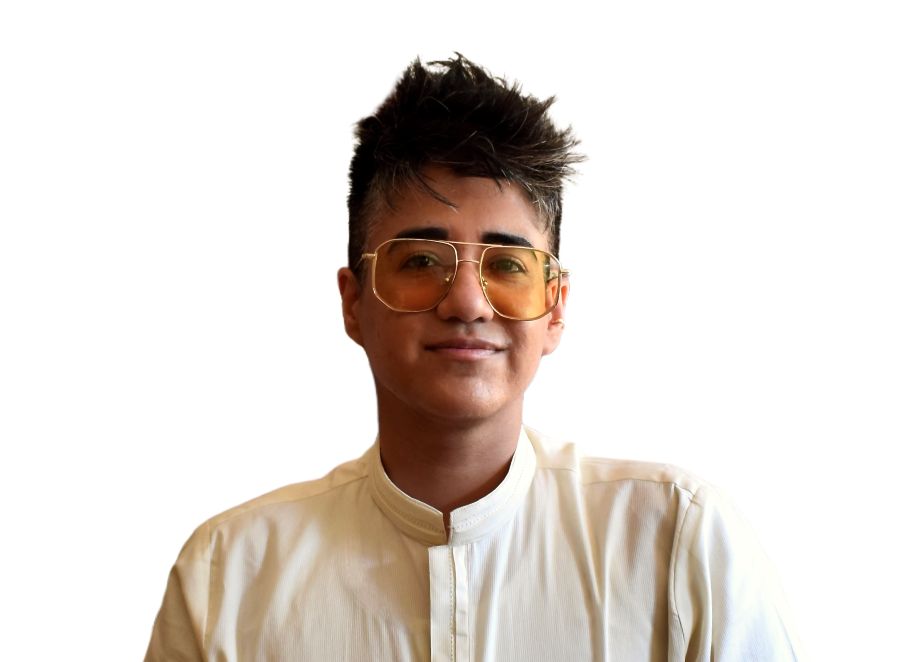
Dr. Aqdas Aftab
Assistant Professor Dr. Aqdas Aftab has been part of Loyola for four and a half years, operating as part of both the English and Women and Gender Studies Departments. They received their Ph.D. in English Literature with a Graduate Certificate in Women, Gender, and Sexuality Studies from the University of Maryland, honing their focus on the intersection of postcolonial literatures, decolonial thought, transgender studies, and Black and Dalit studies. Their aim is to show how the burden of the modern gender binary is central to the processes of racialization of colonialism. "I think of myself as an interdisciplinary scholar of transgender studies and post-colonial literary studies, but my method is extremely literary. I was really drawn to the University of Maryland because they are very strong in the African Diaspora. I wanted specifically to explore how Black Studies are talking about gender and sexuality. This exploration and questions of gender and sexuality I think I have been interested in because of my personal history as a queer and trans person. I think gender and sexuality just say so much about our power structures and the ways in which we are configured as human beings."
The position at Loyola felt like a customizable opportunity to deepen their research while building new pathways of thought for their students. "The main thing that bought me here was the encouragement of interdisciplinary research, the emphasis on social justice, and the students. When I came here, I didn't know too much about the students, but I think I have stayed here for the students. I taught in two other institutions of higher education before, but I think Loyola students are so unique. They engage so deeply with what they're studying, and they bring a lot of genuine, authentic questions and ideas. I feel like its really meaningful relational work that we do in the classroom." As for Chicago, they say "I love living in Chicago! I think it's a great city."
Outside of working with engaged and thoughtful students, Dr. Aftab noted that having an opportunity to explore and build knowledge in their field has been truly enjoyable. "I find it amazing because trans studies are still very new, and trans of color critique specifically is extremely small and still considered very niche. It can be hard to find other people in this field. But, I have found [here at Loyola] that there are so many scholars who may not be directly in my field, but who are engaging with questions of racialized gender, especially other junior faculty in my department. I think that has been extremely generative."
As I have talked with and interviewed much of the faculty here at Loyola, I have found that a theme has arisen in each conversation, and that is the open and ongoing collaboration between faculty here. I see that in order to bolster their knowledge, faculty look to and make connections with one another in the department, and Dr. Aftab is no exception. "[In terms of collaboration] I think Dr. Staidum is the main person I tend to work with most often. He and I have presented together, or rather he presented and I weas the respondent--for the Queer and Trans Studies Conference by Women's Studies & Gender Studies. We also have contributed to an anthology on trans literature together where we wrote separate papers/chapters. I feel that my work is very much in conversation with his theoretical framework, even though his focus is New Orleans and African American and mine is more post-colonial, but I think we think in similar ways."
Teaching in the classrooms of today means knowing that each class will require a period of "laying the groundwork", that is providing some history and context for the work ahead. "As I work in Global South literatures, I do have to give a lot of historical and geographical context on a lot of assumptions that students may not recognize as assumptions. I think one of the biggest challenges of teaching post-colonial or Global South literature is that students often want to see it as representation for that culture, but it is a novel, so I try to do a lot of groundwork in how I am approaching this novel as a representation. We try to focus on it as an artwork instead of, say, a documentary into this culture."
Building curious minds, means fostering creativity, something that Dr. Aftab is quite aware of. "When I was on sabbatical, I took improv to get really into Chicago performance and that world, and I have been trying to incorporate some improv into the classroom as a way to keep students engaged. Recently, we did an improvisational reading of a jazz novel, so I asked students to basically read a specific passage together in an improvisational style. The passage was written in a sort of rhythmic musical form, and so as they read in this style they repeated certain words and they bought in different sentences from other various parts of the passage. This exercise really showcased how the jazz aesthetic weas working. I try to use a lot of experimentation like that. And honestly, sometimes it fails, and sometimes it is great and those moments are fantastic."
"[As for other mediums] I like to bring in videos and I am trying to engage in bodies more, so I try to do some somatic work, even if it is just a small break in the class. I also like to incorporate personal writing, so often I will ask the students not just to write argumentatively about a text but also just reflect on their own lives. It is still writing, it still focuses on the text, but reflecting on themselves can open another understanding."
Dr. Aftab is no stranger to the struggle of navigating students away from AI, and their reason isn't simply to get them to do the work on their own, but rather to understand that using a tool to be faster doesn't always mean better. On top of obvious consequences, i.e. the environment, there are also deeper and sometimes more sinister reverberations. "For me, I do not use AI at all, and I don't want my students to, mostly because even if there weren't so many environmental impacts, students need to develop skills themselves so they can then use it (AI) as a valuable tool. My goal is to help students develop enough skills so that they are not overpowered by AI, this robot. They should understand what the robot is getting right and what it is getting wrong, and in what ways it can actually help. And that is what the classroom is for. I want us to be in control, and I think when we use AI in an uncritical way then this technology is taking over us. We also have to know that the technology is created by people in power, so when we're just using this thing, we are just giving into that power structure."
Outside of education Dr. Aftab is an active member of their community. "Right now, I am the Co-Creator of a transformative justice collective, which is a collective for transmasculine people of color; we specifically work with public education around prison abolition an transformative justice. I would like my second research project to derive from that and be in direct conversation with that. I feel this work can also support me in building more community connections in Chicago and our school, and also involve more of our students. Our department is so wonderfully diverse, I would love to deepen the community in the department as well, and not just for research, but a community that knows more about each other and what projects they are working on currently, what are they doing outside of work, what are they using to nourish their work, how can we support each other that way."
Dr. Aftab's next professional step is publication. Well, not their first publication, their bibliography is as diverse as their field, with work that spans speculative fictions, one-act plays, and translated works. However, currently they have been hard at work on a book that is nearly ready to see the light of publication. "My project is something I have been working on forever now. It is an argument for a way to understand trans interiority that is not reproducing a neo-liberal idea of the individual self. The work is arguing for the importance of looking at trans narratives in a way that can articulate trans-ness outside of individualism. Contemporary Western transgender identity has developed within frameworks of liberalism’s emphasis on individuality and visibility. But increased trans visibility has also led to a rise in violence against trans people of color and trans people in the global south. My book critiques discourses of trans individuality and visibility by focusing on interiority. It examines interiority in trans of color narratives to conceptualize transness as relational and spiritual."
As for published work outside of the classroom as curriculum, Dr. Aftab seeks work with complex unlikable characters. "Currently I am reading a strange book called Little Rot by Akwaeke Emezi. It is set in Nigeria and its a thriller. I am not quite finished with it yet, and I don't know what to think. It's very, very action-packed and it has complex and somewhat unlikable characters. They are unlikable in their actions and how they are. I think that is what makes a good writer, someone who can make me empathize with and root for a character who is doing all these actions that I disagree with."