
Dr. Frederick Staidum: Inciting Change Through Black History
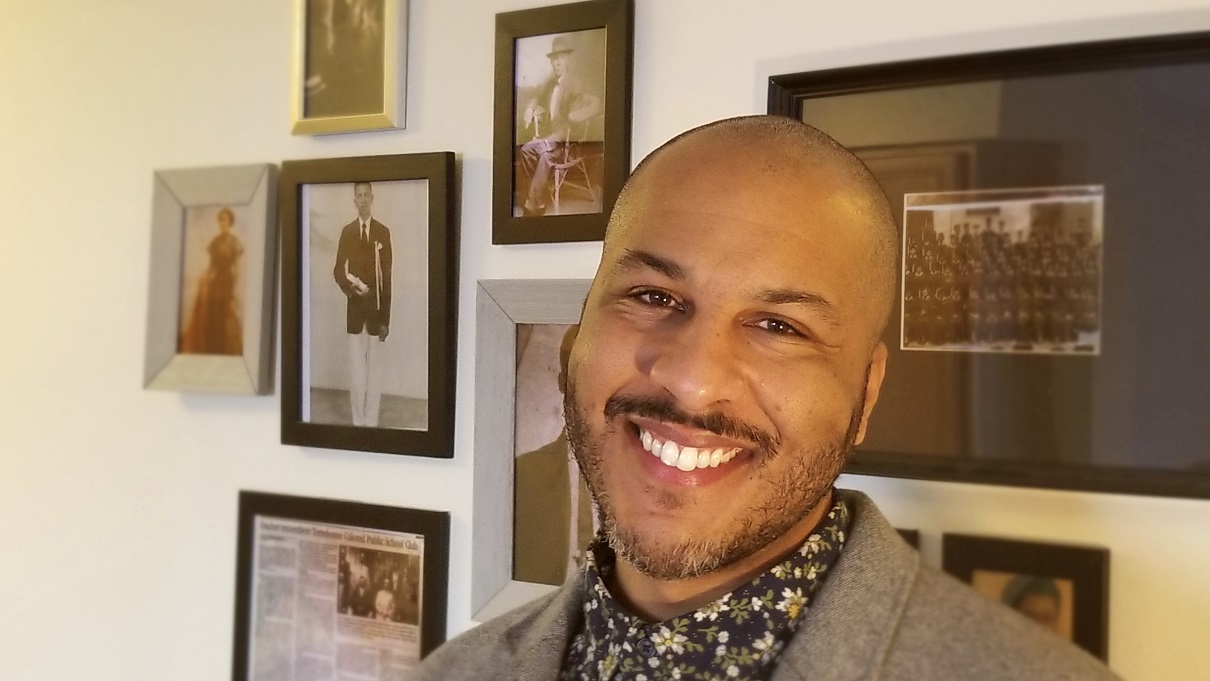
Dr. Staidum, whose research is centered in American literature and culture of the 19th century, especially African American and African Diaspora literatures and cultures has been with the English Department for about seven years. His work interrogates the symbioses of modernity and coloniality, liberalism, and racial capitalism, especially as these developments were shaped by the Atlantic world of the late 18th and 19th centuries.
As Dr. Staidum began to work on his doctoral program, New Orleans was hit by Hurricane Katrina. What struck him initially was the debate around the idea of whether or not the city should be rebuilt, followed by the thorny arguments of why such a tragedy happened in the first place. He was struck by the voices of the preachers who were trying to rationalize a disaster through the eyes of religion, that (to them) New Orleans was a city steeped in debauchery that actively participated in sinful acts therefore it was the punishment of their god. Additionally, Dr. Staidum felt the verbiage being used by the media was misleading; he found multiple outlets calling the survivors of Katrina “refugees”, as though saying these individuals weren’t of the US. They were othering them, creating a story of them “not belonging”. “It [the term refugees] was used to refer to black survivors of Katrina, similarly, the way that the news portrayed white survivors forging for food as people who are trying to survive, and black survivors forging for food as looters. I wanted to think about those two things together, the way in which New Orleans is represented as sexually debauched, and also the racial other. But I'm not a contemporary, so what can I do with this?” Dr. Staidum began to research the representations of New Orleans and American literature and culture from before the 19th century. His research quickly showed that those impressions of the city as outside the nation and debauched had been around since the Louisiana Purchase. “On the floor of the Congress when they were debating whether to ratify the treaty that purchased Louisiana from France, representatives got on the floor saying, 'These people are papists, they're going to be run by the Catholic Church or the Pope.' or 'They don't understand Republican ideals and Democratic freedoms because they've only ever lived under debauched Spanish and French monarchy.' or 'Oh, there's too many free blacks.' or 'They go to opera on Sundays [instead of church]', and then, very quickly, by the 1812 people were referring to New Orleans as the modern-day Sodom and Gomorrah. What I realized is that those impressions of the city as dangerous, as outside the nation as not quite belonging, had a long history, and so the next step for me was thinking about, well, what does it mean? Why? What function does it serve?”
This questioning thought and the digging deeper of why things are the way they are is something Dr. Staidum is bringing to his classes. “I find the students to be quite receptive to it. One thing I do is, I'm very explicit in my course descriptions, so they know what they're in store for. I try not to hide anything, I am honest about that there may be some difficult discussions, I just approach it very matter of factly, I feel that if you if you make too much about it, then it makes things like awkward and uncomfortable; but, but I try to model for them an ease by which we can discuss these issues."
“For the first two weeks of all of my courses, we actually don't read any literature. For the most part, we're reading history, some sociology, some philosophy, some theory to contextualize the project we're about to embark on in the course. Part of my goal there is to establish what's at stake. I tend to ask students at the beginning of class, ‘What made you want to take this course?’ And for the most part, they always say something about wanting to understand why things are the way they are. And so, part of what I do in those early weeks is start with students’ desire to be good people, to live a good life and to do good in the world. I basically make a promise to them that, okay, I know you're frustrated. You want to do good in the world, but you don't know how, and you are trying to figure out why aren’t things working? Well, if you trust me, I will take you on a journey to help you understand how; how did we get here? It’s what I sometimes call the “history of the now”, You're gonna learn the history of the now in this course. And I think, because I make that commitment with them, they're willing to take that and they're willing to go with it."
“I just try to give them the tools on how to think. And they make use of the tools. I also try not to insist that things are black and white and good and bad. I try to eschew any discussion of making sort of personality or ad hominem attacks on historical figures. This is a bad person. This is a good person. Or this is evil, and this is good. Because there might be somebody in their life that thinks like this historical character that's justifying the KKK or something. And to just say, “Oh, that person is evil”, that could be an indictment of say a family member, or maybe a way they used to think, and that's not helpful, that breaks down the community, that breaks down the camaraderie. I am inviting students in to be explorers and investigators, as opposed to judgers. Judging does not create a good classroom environment. It doesn't create a good environment in general. And I think that allows them to trust me, even though I'm saying some really, I think inside in some corners of the country, would be really radical stuff. Now that doesn't mean then, I am asking them to condone the behavior, but what I try to do is explain why the behavior. How did the behavior come about? I try to get the students to see that, no, we don't need to condone these attitudes, but we can work to understand it”.
Looking at both history and literature through an investigative rather than critical lens, is the foundation of what Dr. Staidum is working to bring to his students. “I think the minute we start asking ourselves why someone does something and how they do it we can gain a clear sense in order to better put that other analytical lens back on. I try to communicate a hopefulness with my students, with the history of race, for example, our current, modern conception of race didn't always exist. I have to debunk that for students and get them to understand that. Part of my goal is to show how race and racism was never initially about hating someone. Europeans had long known Africans, they had long engaged and traded with Africans. So, the idea that in the 1500s they just got a wild idea to start hating them and enslaving them doesn’t fully explain it. Why didn't it happen before, when they had 1000s of years of trade relationships and intercultural exchange with them? It was slowly created over time, specifically in the late Middle Ages, Early Modern period. That means race is a relatively new idea, and for students that can either feel like an alleviation or it can feel depressing, because we had a choice, there was a crossroad, and this is the way we went. But, what I'm showing them is that there we were many crossroads, and we had many choices. We have to do the work, we have to understand, we have to learn, because these choices were made and we don’t want to make them again”.
I asked Dr. Stadium if he feels that his work is having any impact on his students. "The powers that be would not be trying to stop us from teaching what we teach if it weren’t having an effect. And it's not just the content, right? They don't have a problem with us teaching the narrative and the Life of Frederick Douglass, but they have the problem with how we teach, right? It is the how, and the how is the consciousness. What I see myself doing is consciousness raising. Black Studies grew out of the activism of young people in the Bay Area who formed study groups because they understood that before you can create societal change, there has to be a mental change, right? They called them consciousness book clubs or consciousness study groups. And one of them actually grew into the Black Panther Party. And so those things are always connected to social change and changing the mindset, changing the world view. Another thing that I hold dearly is my own training in Black Studies. It unapologetically has the goal to change the world, to use knowledge to change the world. It calls to mind the scholar Manny Marable, whose essay "Black Studies in the Racial Mountain" articulates that Black Studies has three goals, to be descriptive, to tell the truth very explicitly. To be corrective, to correct any misrepresentations of history or descriptions of society, and to also be prescriptive, to offer you to use that knowledge to offer solutions."
“I was in conversation with a colleague and we felt that what we do does has an effect, because people, whether they learned it formally in a class or online, the way that they interpreted what they learned, the vocabulary and frameworks they are using to understand the world, diagnose problems, and then also prescribe solutions, very much uses the same vocabulary and frameworks as a field like Black Studies. And so that is proof. So, while I don't get to see the students who have taken classes with me go on and see what they have individually done, I get to see collectively what my field has contributed”.
At the heart of all this is that there is hope through learning Black History, that if we take the time to learn and understand where the choices were made and ask ourselves why these things happened we can begin to incite change. “As my grandfather once said,” Dr. Staidum notes, “If American History was taught correctly, there would be no need for Black History.”