
Loyola Law Magazine 2025 - A 360-degree approach to immigrant justice
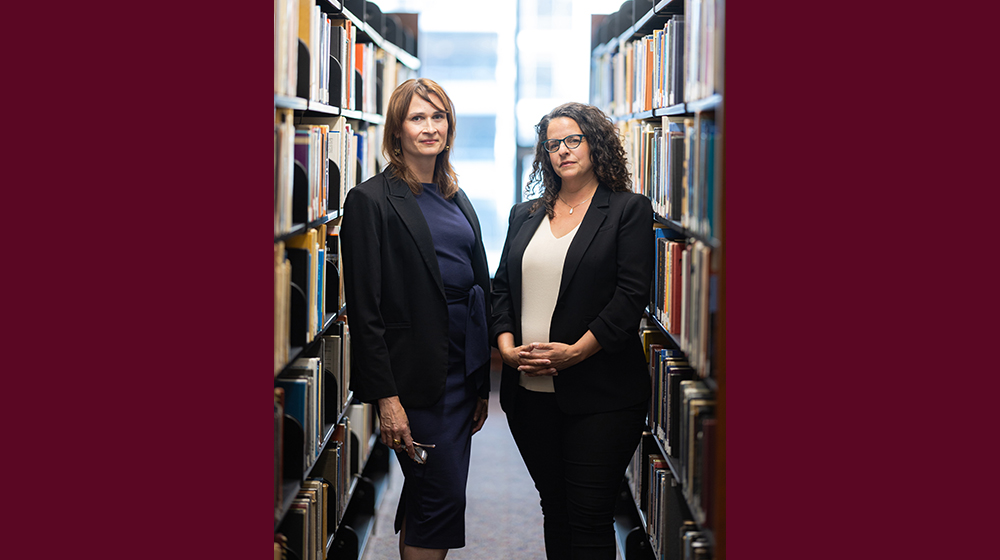
“With the Hub, we’re developing a larger pipeline of professionals who can significantly impact immigrants’ and migrants’ lives, in some cases in life-or-death situations.”
— Katherine Kaufka Walts, codirector of the Holistic Immigration Hub, left, with codirector Sarah Diaz
A 360-degree approach to immigrant justice
Loyola’s new Holistic Immigration Hub will prepare more effective immigration lawyers while working for systemic change
As a Loyola law student, Maggie Meza (JD’ 19) walked into a U.S. Immigration and Customs Enforcement detention center in Louisiana. What she saw and heard shocked her.
“It was like a high-security prison,” says Meza, who, along with other Loyola law students, volunteered to help the Southern Poverty Law Center gather information for asylum applications. “We couldn’t have cell phones, couldn’t bring anything in but paperwork for the clients we were meeting.” Through glass, Meza and her classmates listened to the harrowing stories of people who had fled to the U.S. to escape threats of harm from gangs or the governments of the countries they’d left.
Meza’s first hands-on experience with immigrants in detention was emotionally taxing and professionally frustrating. Had she and her fellow student volunteers been trained for the social, medical, and other facets of the detention system along with the legal aspects, they could have approached their task with a more complete understanding of the challenges their clients face.
10x
Represented detainees were over 10x more likely
to succeed in getting relief than those without counsel.
67%
Individuals in the U.S. facing deportation who lack an attorney.
For those in detention, attorney access is even more limited.
Since Meza’s time at Loyola, when only two immigration law courses were available, the School of Law has vastly expanded its classroom and clinical offerings in immigration law, largely at the impetus of students like her. Now, Loyola University Chicago is launching an ambitious new initiative supported by a $6 million anonymous gift to better prepare both students and professionals to more effectively meet the multifaceted challenges faced by immigrants in the U.S. and around the world.
The new Holistic Immigration Hub pilot brings together experts from law, health care, education, and social work to train future attorneys, judges, social workers, educators, and health practitioners while partnering with Chicago-based immigration organizations and advocating for widespread change in the immigration system. Building on the scope and approach of Loyola’s School of Law and Center for the Human Rights of Children (CHRC), which over the past decade has been active in immigration issues, the Hub will solidify Loyola’s standing as a national thought leader in immigration law.
Building bridges
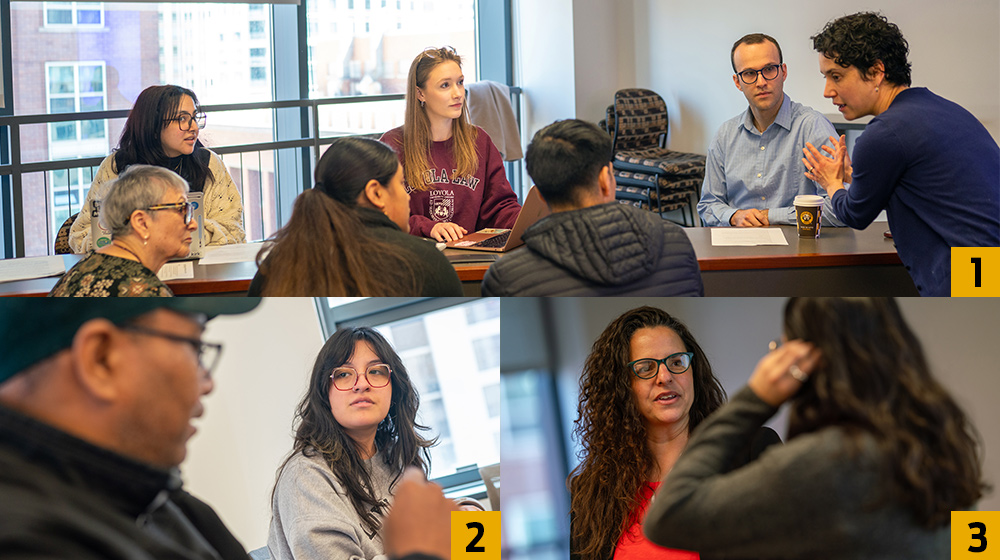
The Holistic Immigration Hub brings together experts from law and other disciplines to train future attorneys to advocate for widespread change in the immigration system.
1. Stephanie Spiro, managing attorney at the National Immigrant Justice Center, trains interpreters and Loyola law students, including Skylar Zimny (left), to work with asylum clients. 2. Loyola law student Elizabeth Martinez works with an asylum client. 3. Sarah Diaz directs the Immigration and Human Rights Clinic, which bridges seminar training and experiential learning.
Filling an urgent need
Unlike defendants in the criminal justice system, individuals in immigration proceedings are not provided court-appointed attorneys if they can’t afford counsel. Immigrants without representation—even small children—must navigate a complex legal system and face adversarial government attorneys alone, often with limited proficiency in English. Access to counsel makes a significant difference in outcomes: According to the American Immigration Council, nondetained immigrants with attorneys are five times more likely to win their cases, and detained immigrants with attorneys are twice as likely to obtain relief. Though legal representation is a game changer, a recent report from Syracuse University’s Transactional Records Access Clearinghouse found that the immigration court backlog is far outgrowing the rate of representation.
“Our community partners cannot keep up with the demand for legal services from immigrants and migrants, including people applying for asylum who’ve been trafficked or are victims of violence and other crime,” says Katherine Kaufka Walts, CHRC director, who’s codirecting the Hub alongside Sarah Diaz, CHRC associate director. “With the Hub, we’re developing a larger pipeline of professionals who can significantly impact immigrants’ and migrants’ lives, in some cases in life-or-death situations.”
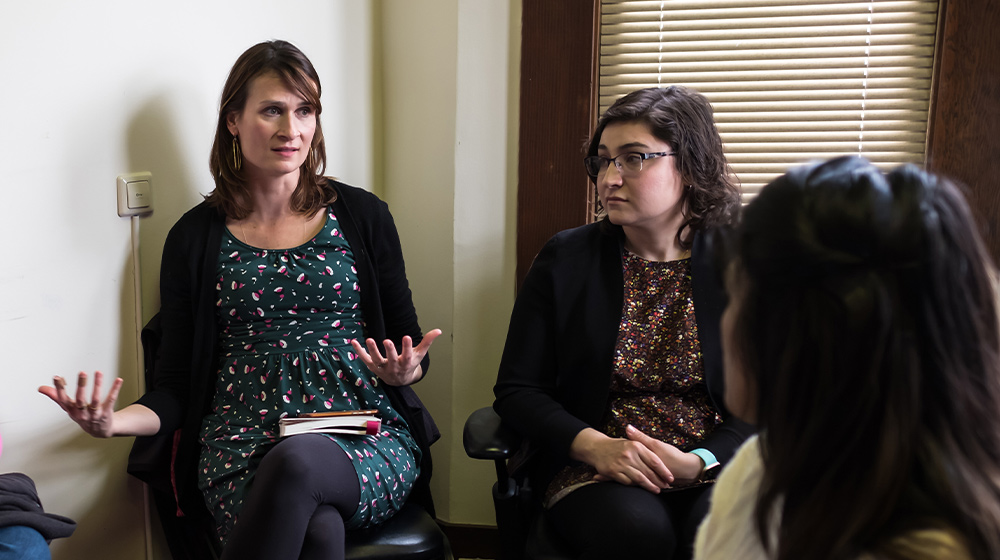
Innovation
A student-fueled movement
Students planted the seeds for the School of Law’s now blossoming immigration program, supported by faculty and administrators who, in a strong Loyola Law tradition, encouraged students to follow their interests and use their skills for social justice.
Read the full storyA fuller approach
Addressing the complex challenges of immigration goes beyond providing representation and other direct services to individuals, however, and the Hub is holistic in more than its approach to preparing lawyers and other professionals to help clients. Recognizing that piecemeal approaches to immigration issues have been ineffective, Kaufka Walts says, “The Hub’s intertwined goals are leadership, graduating the next generation of professional leaders; service, supporting Chicago organizations; and innovation, catalyzing visionary systemic change.”
Based in the law school, the Hub leverages powerful collaborations with several other schools and amplifies the School of Law’s top-ranked programs.
For its initial strategy, the Hub will prioritize three components: an interdisciplinary Immigration and Human Rights Clinic, an Immigration Law Lab, and an Immigration Innovation Incubator.
The first component, the Immigration and Human Rights Clinic, directed by Sarah Diaz, will bridge seminar training and experiential learning and infuse curricula for both with expertise from other Loyola schools, cross-training students on the needs of the client beyond legal representation.
“Examples of that training might include forensic medical and mental health evaluations conducted through the Stritch School of Medicine, case management services conducted through the School of Social Work, and colocation of legal services alongside School of Education graduate students in the Chicago Public Schools,” says Diaz.
Leadership
Addressing the challenge at both ends
Loyola's Holistic Immigration Hub is an example of combining “upstream” and “downstream” lawyering: taking aim at the root causes of legal problems while also dealing with the immediate, individual consequences of those problems. Using a popular public health parable, downstream lawyering focuses on rescuing people who are drowning, while upstream lawyering concentrates on fixing the dam causing the flooding.
Upstream is prevention: systemic reform, normative change, and narrative change. Key factors to address upstream include xenophobia—the tendency of many to see immigrants as criminals and job stealers, for example—as well as phenomena spurring increased migration, like the effects of climate change and conflict in the countries migrants have left. Downstream is intervention: direct services and rapid response provided by attorneys, social workers, and others to assist immigrants and migrants.
Each component of the Hub focuses on a different part of the “river.” The Immigration Innovation Incubator concentrates on upstream prevention and systemic change through research, partnerships, and advocacy. The chief role of the Immigration Law Lab is downstream intervention, responding directly to the immigrant community’s legal needs. The Immigration and Human Rights Clinic bridges prevention and intervention, cross-training lawyers and other professionals to provide direct services while using their knowledge, experience, and partnerships to help develop innovative approaches that will result in systemwide reform.
Mutual benefits between partners
The Immigration Law Lab, the second component of the Hub, will extend the resources of academia to colleagues working on immigration outside the University. A first-of-its-kind effort, the lab will coordinate and train law students across Chicago who are interested in volunteering with partner agencies.
Mary Meg McCarthy (JD ’89) is executive director of one of those partner organizations, the Chicago-based National Immigrant Justice Center (NIJC). “What I find most exciting about our partnership is the different strategies the Hub is using,” she says. “Loyola students will be interning and volunteering in client services at the NIJC, and they’ll also be doing research, here and at the law school, that will ultimately help us in our advocacy and with potential litigation issues. So whether they’re representing a client or doing research, they’ll be helping to identify and get involved with systemic issues.”
Katherine Greenslade (JD ’07) is director of the Immigrant Justice Legal Clinic at The Resurrection Project, another partner organization. She agrees with McCarthy on the value of the academic-nonprofit partnership in sharing information and expertise on both sides.
“There’s always more need than there are nonprofit legal service providers, so our partnership with Loyola is critical to meeting this need,” Greenslade says. “It’s a unique way for students to explore their interest in the field, build skills, and make connections. It’s also an opportunity for us to let Loyola know what we’re seeing on the ground and what issues might be ripe for further investigation and research.”
As part of the lab, Diaz and Greenslade coteach a seminar, keeping topics agile and adaptable to meet the current needs of those in the field. This year’s launch included interdisciplinary training on asylum applications.
The final component of the Hub, the Immigration Innovation Incubator, will address complex, thematic issues—such as climate migration, the treatment of unaccompanied children as adults in miniature, or the cost-benefit analysis of prolonged private detention—through an interdisciplinary lens. The incubator aims to bridge the gap between academia and practice by supporting development of statements, whitepapers, and other documents with and for partner organizations, as well as hosting annual interdisciplinary conferences. It’s also expanding the student-created spring break trip to provide direct services to immigrants at the border by including interdisciplinary faculty.
“In short, we want to change people’s beliefs, behaviors, and attitudes around migration, recentering the dignity of migrants in the conversation, the law, and policy,” Diaz says.
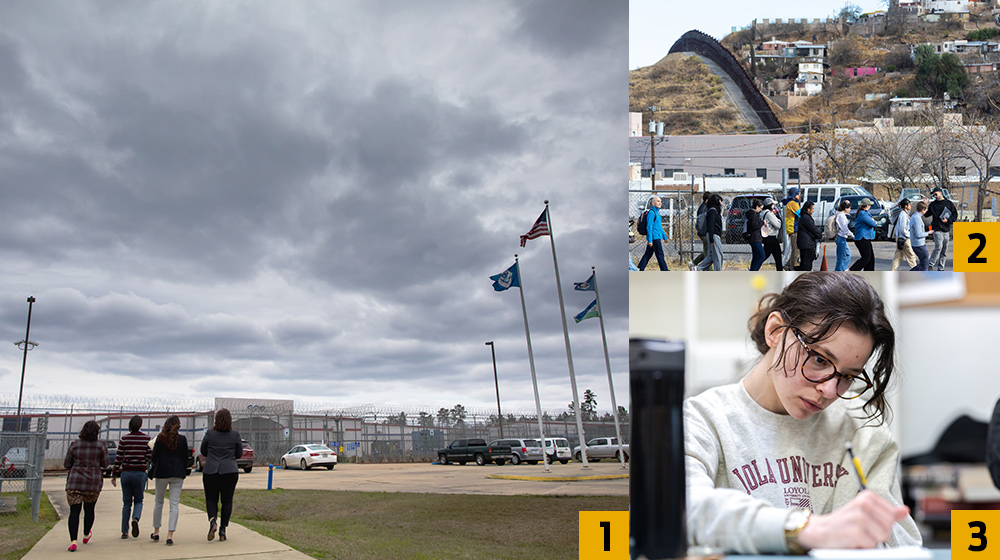
On the border
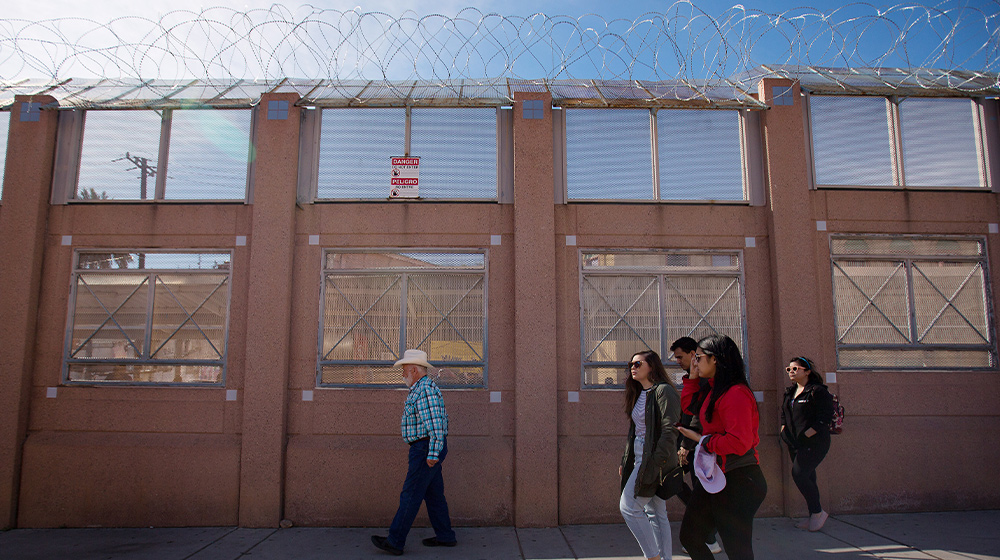
Each spring, law students can participate in an immersive border trip to experience the intersection of human rights, law, and policy.
1. In Jena, Louisiana, law students enter a detention facility to interview immigrants to determine if they are eligible for legal relief (2019). 2. Students tour the border wall in Nogales, Arizona (2025). 3. Student Jamie Wilson listens to a presentation by No More Deaths, a humanitarian organization working along the U.S.-Mexico border (2025).
The perfect fit
Loyola is an ideal base for an interdisciplinary, holistic center supporting immigrant justice because of its strong track record in the area—especially in the human rights element of immigration. Among the CHRC’s research projects are reports on labor trafficking of children in the U.S., unaccompanied children in federal custody, the inequitable impact of climate change on various migrant populations, and the difficulty faced by children who were victims of sex trafficking outside U.S. borders in obtaining immigration protections unless the trafficking also occurred within this country. The CHRC has submitted its research to multiple government agencies and nongovernmental organizations, including the United Nations Committee on the Rights of the Child, and has shared it with immigration organizations for use in advocacy efforts.
In keeping with the Hub’s emphasis on involving students in change-making, students play a role in almost all CHRC research. As a former CHRC fellow, law student Sierra Garcia worked on projects including a report on inappropriate use of juvenile criminal records in immigration proceedings—findings that were submitted to U.S. Citizenship and Immigration Services for consideration—and information gathering for a partnership designed to get immigrant and newcomer youths in Chicago schools legal help with immigration proceedings. Being part of a visit to Oakland, California, which already employs a similar partnership, “recharged me and made me realize how much this work really does impact people,” Garcia says.
But perhaps the most important reason the Hub belongs at Loyola is the University’s Jesuit mission, which emphasizes social justice, care for the whole person, and the dignity of every individual.
“The last message Pope Francis gave was about caring for people who are different from us,” McCarthy says. “Immigrants are defined as ‘the other’ right now, but Loyola has that commitment, institutionally and within the individuals it attracts, to be people for others and care for the least among us.
“Our country was founded by immigrants and is richer, stronger, and healthier because of immigrants,” McCarthy adds. “We need to change the narrative to reflect this—and lawyers have a lot of power to do that.”
Learn more about the Holistic Immigration Hub. –Gail Mansfield (August 2025)
Holistic Immigration Hub: The student experience
Law students can choose coursework and experiences that will provide solid grounding to serve as effective immigration attorneys and advocates for systemic change. The Hub prioritizes three components: Immigration and Human Rights Clinic, Immigration Law Lab, and Immigration Innovation Incubator.
Spring 1L
Immigration Law Lab
- Gain live client experience in a workshop setting
- Learn foundational immigration law related to emerging and immediate needs
- Enhance capacity of local partners embedding trained law students to support services
Fall and Spring 2L and 3L
Immigration and Human Rights Clinic
- Represent migrants seeking refugee protections and protection from human trafficking and other violent crimes
- Advance cases under domestic and international human rights mechanisms
- Address the holistic needs of the client by collaborating with faculty/students from medicine, public health, and social work
Fall and Spring 2L and 3L
Immigration Innovation Incubator
- Conduct interdisciplinary research to identify innovative solutions to contemporary immigration problems through directed study or capstone projects developed by students, faculty, and community partners
- Participate in an interdisciplinary immersion border trip exploring intersection of human rights, law, and policy (1L, 2L, 3L, Weekend JD—Spring only)
Loyola Law Magazine 2025
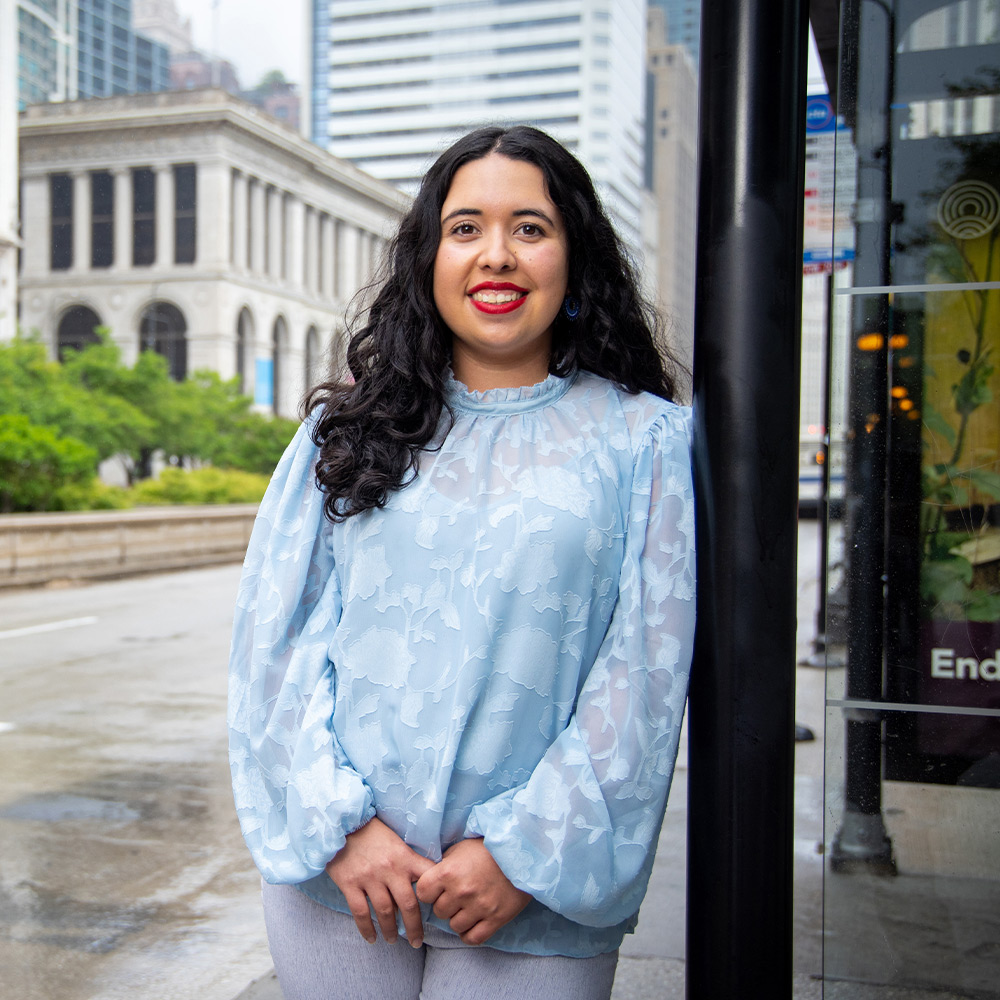
Prep school
Education Law and Policy Institute alumni make their way in a complex field
Read the story

Celebrating excellence
School of Law awards honor Megan Fahey Monty, Fred Lane, Mary Meg McCarthy, and Paul Vickrey
Read the story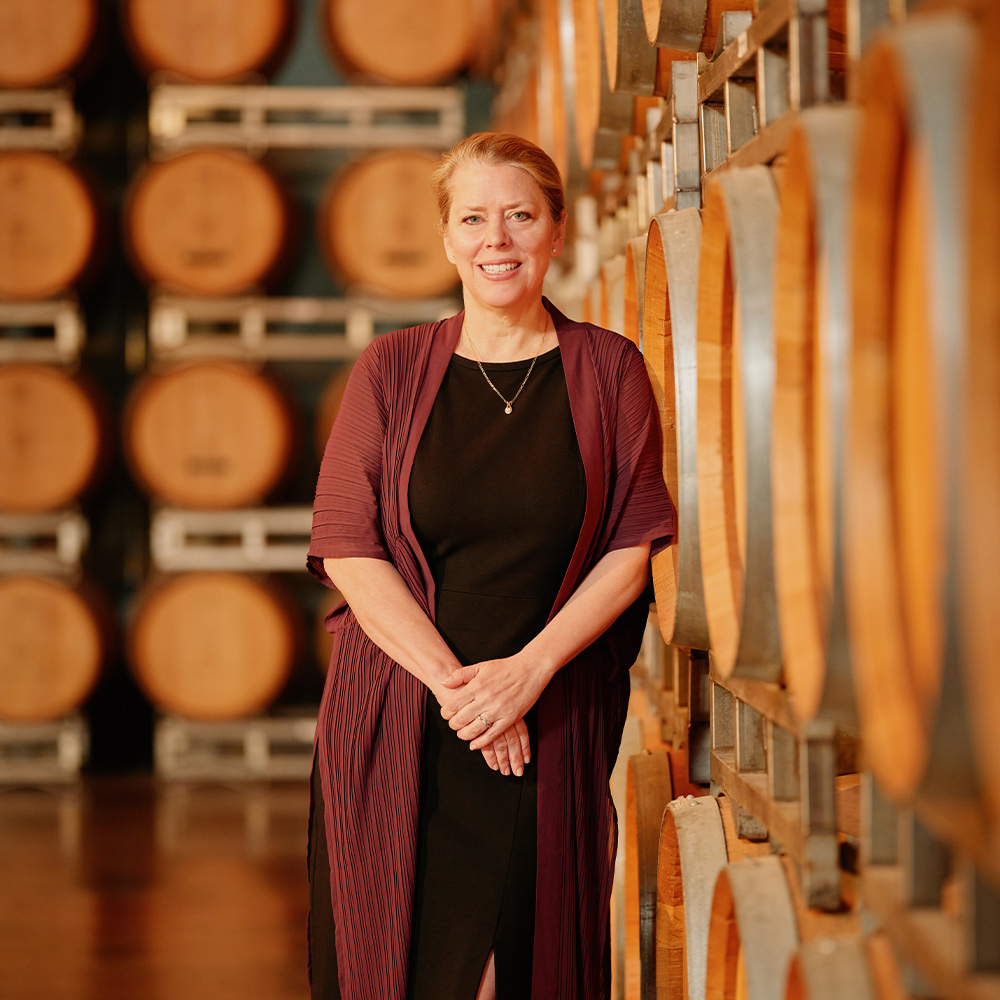
As a Loyola law student, Maggie Meza (JD’ 19) walked into a U.S. Immigration and Customs Enforcement detention center in Louisiana. What she saw and heard shocked her.
“It was like a high-security prison,” says Meza, who, along with other Loyola law students, volunteered to help the Southern Poverty Law Center gather information for asylum applications. “We couldn’t have cell phones, couldn’t bring anything in but paperwork for the clients we were meeting.” Through glass, Meza and her classmates listened to the harrowing stories of people who had fled to the U.S. to escape threats of harm from gangs or the governments of the countries they’d left.
Meza’s first hands-on experience with immigrants in detention was emotionally taxing and professionally frustrating. Had she and her fellow student volunteers been trained for the social, medical, and other facets of the detention system along with the legal aspects, they could have approached their task with a more complete understanding of the challenges their clients face.
Since Meza’s time at Loyola, when only two immigration law courses were available, the School of Law has vastly expanded its classroom and clinical offerings in immigration law, largely at the impetus of students like her. Now, Loyola University Chicago is launching an ambitious new initiative supported by a $6 million anonymous gift to better prepare both students and professionals to more effectively meet the multifaceted challenges faced by immigrants in the U.S. and around the world.
The new Holistic Immigration Hub pilot brings together experts from law, health care, education, and social work to train future attorneys, judges, social workers, educators, and health practitioners while partnering with Chicago-based immigration organizations and advocating for widespread change in the immigration system. Building on the scope and approach of Loyola’s School of Law and Center for the Human Rights of Children (CHRC), which over the past decade has been active in immigration issues, the Hub will solidify Loyola’s standing as a national thought leader in immigration law.
Filling an urgent need
Unlike defendants in the criminal justice system, individuals in immigration proceedings are not provided court-appointed attorneys if they can’t afford counsel. Immigrants without representation—even small children—must navigate a complex legal system and face adversarial government attorneys alone, often with limited proficiency in English. Access to counsel makes a significant difference in outcomes: According to the American Immigration Council, nondetained immigrants with attorneys are five times more likely to win their cases, and detained immigrants with attorneys are twice as likely to obtain relief. Though legal representation is a game changer, a recent report from Syracuse University’s Transactional Records Access Clearinghouse found that the immigration court backlog is far outgrowing the rate of representation.
“Our community partners cannot keep up with the demand for legal services from immigrants and migrants, including people applying for asylum who’ve been trafficked or are victims of violence and other crime,” says Katherine Kaufka Walts, CHRC director, who’s codirecting the Hub alongside Sarah Diaz, CHRC associate director. “With the Hub, we’re developing a larger pipeline of professionals who can significantly impact immigrants’ and migrants’ lives, in some cases in life-or-death situations.”
A fuller approach
Addressing the complex challenges of immigration goes beyond providing representation and other direct services to individuals, however, and the Hub is holistic in more than its approach to preparing lawyers and other professionals to help clients. Recognizing that piecemeal approaches to immigration issues have been ineffective, Kaufka Walts says, “The Hub’s intertwined goals are leadership, graduating the next generation of professional leaders; service, supporting Chicago organizations; and innovation, catalyzing visionary systemic change.”
Based in the law school, the Hub leverages powerful collaborations with several other schools and amplifies the School of Law’s top-ranked programs.
For its initial strategy, the Hub will prioritize three components: an interdisciplinary Immigration and Human Rights Clinic, an Immigration Law Lab, and an Immigration Innovation Incubator.
The first component, the Immigration and Human Rights Clinic, directed by Sarah Diaz, will bridge seminar training and experiential learning and infuse curricula for both with expertise from other Loyola schools, cross-training students on the needs of the client beyond legal representation.
“Examples of that training might include forensic medical and mental health evaluations conducted through the Stritch School of Medicine, case management services conducted through the School of Social Work, and colocation of legal services alongside School of Education graduate students in the Chicago Public Schools,” says Diaz.
Mutual benefits between partners
The Immigration Law Lab, the second component of the Hub, will extend the resources of academia to colleagues working on immigration outside the University. A first-of-its-kind effort, the lab will coordinate and train law students across Chicago who are interested in volunteering with partner agencies.
Mary Meg McCarthy (JD ’89) is executive director of one of those partner organizations, the Chicago-based National Immigrant Justice Center (NIJC). “What I find most exciting about our partnership is the different strategies the Hub is using,” she says. “Loyola students will be interning and volunteering in client services at the NIJC, and they’ll also be doing research, here and at the law school, that will ultimately help us in our advocacy and with potential litigation issues. So whether they’re representing a client or doing research, they’ll be helping to identify and get involved with systemic issues.”
Katherine Greenslade (JD ’07) is director of the Immigrant Justice Legal Clinic at The Resurrection Project, another partner organization. She agrees with McCarthy on the value of the academic-nonprofit partnership in sharing information and expertise on both sides.
“There’s always more need than there are nonprofit legal service providers, so our partnership with Loyola is critical to meeting this need,” Greenslade says. “It’s a unique way for students to explore their interest in the field, build skills, and make connections. It’s also an opportunity for us to let Loyola know what we’re seeing on the ground and what issues might be ripe for further investigation and research.”
As part of the lab, Diaz and Greenslade coteach a seminar, keeping topics agile and adaptable to meet the current needs of those in the field. This year’s launch included interdisciplinary training on asylum applications.
The final component of the Hub, the Immigration Innovation Incubator, will address complex, thematic issues—such as climate migration, the treatment of unaccompanied children as adults in miniature, or the cost-benefit analysis of prolonged private detention—through an interdisciplinary lens. The incubator aims to bridge the gap between academia and practice by supporting development of statements, whitepapers, and other documents with and for partner organizations, as well as hosting annual interdisciplinary conferences. It’s also expanding the student-created spring break trip to provide direct services to immigrants at the border by including interdisciplinary faculty.
“In short, we want to change people’s beliefs, behaviors, and attitudes around migration, recentering the dignity of migrants in the conversation, the law, and policy,” Diaz says.
The perfect fit
Loyola is an ideal base for an interdisciplinary, holistic center supporting immigrant justice because of its strong track record in the area—especially in the human rights element of immigration. Among the CHRC’s research projects are reports on labor trafficking of children in the U.S., unaccompanied children in federal custody, the inequitable impact of climate change on various migrant populations, and the difficulty faced by children who were victims of sex trafficking outside U.S. borders in obtaining immigration protections unless the trafficking also occurred within this country. The CHRC has submitted its research to multiple government agencies and nongovernmental organizations, including the United Nations Committee on the Rights of the Child, and has shared it with immigration organizations for use in advocacy efforts.
In keeping with the Hub’s emphasis on involving students in change-making, students play a role in almost all CHRC research. As a former CHRC fellow, law student Sierra Garcia worked on projects including a report on inappropriate use of juvenile criminal records in immigration proceedings—findings that were submitted to U.S. Citizenship and Immigration Services for consideration—and information gathering for a partnership designed to get immigrant and newcomer youths in Chicago schools legal help with immigration proceedings. Being part of a visit to Oakland, California, which already employs a similar partnership, “recharged me and made me realize how much this work really does impact people,” Garcia says.
But perhaps the most important reason the Hub belongs at Loyola is the University’s Jesuit mission, which emphasizes social justice, care for the whole person, and the dignity of every individual.
“The last message Pope Francis gave was about caring for people who are different from us,” McCarthy says. “Immigrants are defined as ‘the other’ right now, but Loyola has that commitment, institutionally and within the individuals it attracts, to be people for others and care for the least among us.
“Our country was founded by immigrants and is richer, stronger, and healthier because of immigrants,” McCarthy adds. “We need to change the narrative to reflect this—and lawyers have a lot of power to do that.”
Learn more about the Holistic Immigration Hub. –Gail Mansfield (August 2025)
Holistic Immigration Hub: The student experience
Law students can choose coursework and experiences that will provide solid grounding to serve as effective immigration attorneys and advocates for systemic change. The Hub prioritizes three components: Immigration and Human Rights Clinic, Immigration Law Lab, and Immigration Innovation Incubator.