
Rome Program
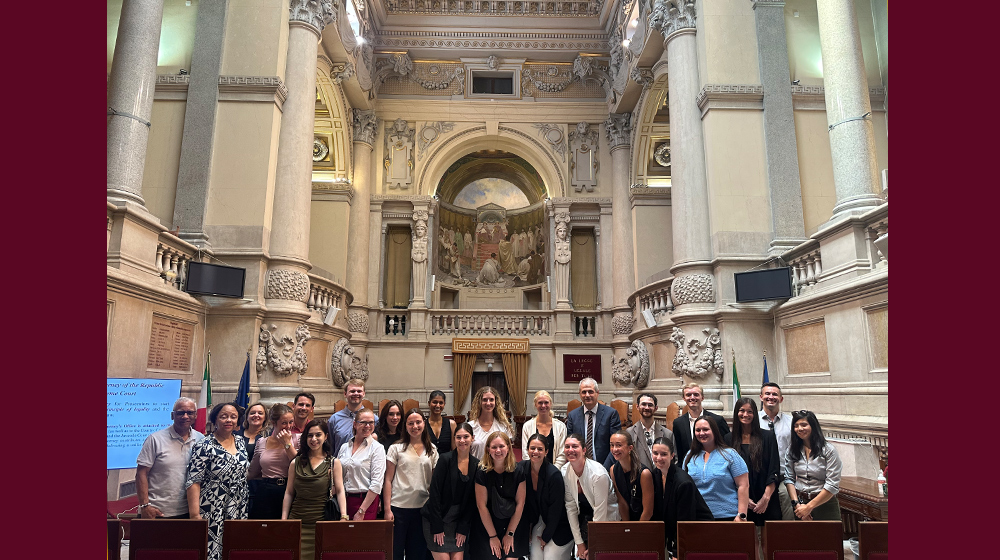
Rome today is the home of the Italian government and is the site of offices for the European Union, other international institutions, as well as private law firms, banks and corporations. Loyola's Study Abroad Program takes advantage of these facilities and institutions to introduce students to the study and practice of law in a foreign culture. It is expected that this introduction to comparative and international law will give students a deeper understanding of their own legal culture.
As the seat of power under Roman emperors, later the Papacy, and currently the capital of modern Italy, Rome displays its rich and varied history on every street and in every piazza. The Colosseum, the Pantheon, the Spanish Steps, the Trevi Fountain, the Tiber River, the Roman Forum, the Vatican - the splendors of Rome await the visitor.
Loyola Rome Center Campus: John Felice Rome Center
Loyola has operated the Rome Center of Liberal Arts since 1962. The present campus, used since 1978, is located on Monte Mario, the highest hill in present-day Rome, about twenty minutes from downtown Rome by public transportation. The landscaped campus contains classrooms, a library, student dormitories, faculty and administrative offices, a chapel, a cafeteria, recreation and exercise rooms, a coffee bar and a basketball court.
For more information about the Rome Center campus, visit the Loyola University Rome Center Website.
General Contact Information
Please direct all preliminary correspondence to:
Study Law Abroad Programs
Loyola University Chicago School of Law
25 East Pearson Street - Room 1236
Chicago, IL 60611
Program Director: Teresa Mastropieri
Email: tmastro@luc.edu
Phone: (312) 915-8669
Rome Center Campus
Loyola University Chicago
John Felice Rome Center
Via Massimi, 114-A
00136 Rome, Italy
Telephone: 011-39-06-355 881
Fax: 011-39-06-355 88 352
(Country code 39, City code 06)
Emergency Cell Telephone TBD within Italy; from elsewhere in Europe add the prefix 039; from the U.S. add the prefix 011-39.
Rome Summer 2026 Program - May 23 – June 6
Courses Offered
International Sales (required, 1 graded credit, PER ELEC)- Professor Lea Krivinskas Shepard
Students compare the CISG to domestic systems under the common law and learn about the general nature of an international sales transaction. Students would review and discuss the principles, scope, and substance of the CISG as they relate to basic contract issues including formation, performance, and remedies.
Students would debate the extent to which Western or Global North commercial practices may be overrepresented in the CISG, and whether the application of "universal" or "international" usages by arbitral tribunals or courts effectively privileges standards developed in Europe and North America while eclipsing trade customs from other regions.
International Family Law (required, 1 graded credit, PER ELEC)- Professor Theresa Ceko
The course will examine the following topics from a U.S. and international perspective: Divorce, Paternity, Child Support, Family Violence, Adoption, Guardianship, Hague Convention on International Child Abduction, Gender Equality /Convention on the Elimination of All Forms of Discrimination Against Women, Children’s Rights/UN Convention on the Rights of the Child.
International Human Rights in Rome: Field Study (optional, non-graded credit)- Professor Kalyani Robbins and Professor Siobhan Cafferty
This International Human Rights field study course will be co-taught by the School of Law and the School of Education to gain an interdisciplinary perspective on the advocacy work of international sites such as NGOs, schools, and international organizations in Rome. These sites are at the forefront of promoting and protecting human rights and fundamental freedoms of individuals or groups within the city of Rome, Italy and the Mediterranean.
This is a course that will be delivered with the materials covered asynchronously prior to May 25th followed by applied learning during specific site visits to be conducted on tentatively Sunday, May 24, the afternoons of May 26 and 28th. This course will have a paper requirement due after the Rome Program ends.
Other highlights of the program
- Visit to the Office of the Attorney General of Italy
- Visit to the Italian Supreme Court
- Rome Bus Tour
- Papal Audience
- Dinner, aperitivo, and community gatherings with students and faculty
What are the costs of the 2026 program?
- Tuition is $1,905.00 total for the two required 1 credit courses. If you also register for the optional 1-credit field study, tuition the tuition is an additional $952.50
- Housing is $840 for double occupancy room for 14 nights.
- Student Activities fee is $475. This is a non-refundable fee that is due with your application to hold your space in the program. In addition to the activities and group meals, this deposit includes a bus/metro pass and the university mandatory CISI international health insurance.
Rome Summer 2025 Program - May 24 – June 7
Courses Offered
Police Accountability-A Comparative Perspective (required, 1 graded credit, PER ELEC)- Professor Stephen Rushin
This course considers the differences between the approach to police accountability in the United States and countries in Europe. The course will discuss how the lack of centralization in police oversight in the United States substantially impairs our ability to respond to police misconduct as a national problem, as compared to many European counties. This course would include substantial discussion of the differing regulatory tools used to regulate police, as well as the differences in how these countries use police to respond to social problems.
International Legal Perspectives on Artificial Intelligence and Impacts (required, 1 graded credit, PER ELEC)- Professor Patricia Lee
Artificial intelligence (AI) is affecting a wide range of law, business, health and communication sectors. In light of this emerging technology, international and domestic lawmakers are reacting to this fast-growing phenomenon. This course will delve into several aspects of artificial intelligence and its impacts on law, business and the global environment to address the question: Is artificial intelligence a force for good and if not, how should it be changed? To help answer the fundamental question, the course will involve the following learning outcomes: 1) Understanding trends in international AI law and AI business development; 2) Assessing AI impacts on the law of intellectual property (copyright, trademark and patent); 3) Understanding the opportunities and challenges to the written word, communications, employment, contracting and drafting; 4) Reviewing international and domestic AI lawmaking that regulates, impacts and/or provides solutions; and 5) Inquiring into a thoughtful design of community based solutions to address social and economic justice with AI applications.
International Human Rights in Rome: Field Study (optional, 1 non-graded credit)- Professor Kate Mitchell and Professor Siobhan Caffrety
This 1-credit International Human Rights field study course will be co-taught by the School of Law and the School of Education to gain an interdisciplinary perspective on the advocacy work of international sites such as NGOs, schools, and international organizations in Rome. These sites are at the forefront of promoting and protecting human rights and fundamental freedoms of individuals or groups within the city of Rome, Italy and the Mediterranean.
This is a pass/no pass course that will be delivered with the materials covered asynchronously for a total of 8 hours prior to May 25th followed by applied learning during specific site visits to be conducted on tentatively Sunday, May 26, the afternoons of May 28 and 29th. This course will have a 5 pages or 2500 word paper requirement due 4 weeks after the Rome Program ends.
Other highlights of the program
- Visit to the Office of the Attorney General of Italy
- Visit to the Italian Supreme Court
- Rome Bus Tour
- Papal Audience
- Dinner, aperitivo, and community gatherings with students and faculty
What are the costs of the 2025 program?
- Tuition is $1,825 total for the two required 1 credit courses. If you also register for the optional 1-credit field study, tuition the tuition is an additional $912.50. Tuition for Law courses in Rome is half the price than it than the tuition cost for Law courses in Chicago. Courses are graded-credit (not P/NP)
- Housing is $840 for double occupancy room for 14 nights.
- Student Activities fee is $475. This is a non-refundable fee that is due with your application to hold your space in the program. In addition to the activities and group meals, this deposit includes a bus/metro pass and the university mandatory CISI international health insurance.
General FAQ
What activities/extras are included in the program?
- Visit to the Office of the Attorney General of Italy
- Visit to Italian Supreme Court
- Rome Bus Tour (gives a great overview of this magical city, with visits St. Paul Outside the Walls, the Coliseum, the Forum, Palatine Hill, the Pantheon, Piazza Navona, Trevi Fountain, and more)
- Papal Audience
- Dinner, aperitivo, and community gatherings with students and faculty
- Monthly bus pass for Rome city buses and local rail system.
What is the schedule like?
- Classes meet Monday-Thursday 8:45a.m. - 10:15 a.m. and 10:30 a.m - 12:00 p.m., except on the day of the Papal Audience or scheduled court tour. Class will then take place in the afternoon. Site visits will be scheduled for some afternoons; other afternoons are free to explore the city.
- Friday-Sunday is free time to explore Rome, as well as other cities in Italy and Europe. Favorite destinations in Italy include Florence, Venice, and the Amalfi Coast.
Is this program advisable with the pressures of work experience, externships, and other obligations?
Yes! It is totally doable to do this program and have a summer job or externship. Be up front with your employer, let them know that you will be participating in this educational experience. Most employers will allow you to start the position right after the spring semester starts, take the two weeks you need for study abroad, and return to the position for the remainder of the summer. If you are participating in an externship, ask if you can participate in the required weekly externship class via Zoom or through one-on-one meetings with your externship class professor.
Why should I study abroad?
- Gives you a 2-credit cushion going into 2L. Especially if you are a 1L going into 2L year, you will have a lot of things competing for your time 2L year, for example, classes, student activities, journals, etc. Your Academic Advisors will suggest that you take 12-14 credits during the fall so that you have time for the extra-curricular activities. Having the extra two credits from Rome will allow you to take the minimum required 12 credit hours during your fall 2L year without the pressure of having to take on more.
- Form close relationships with faculty members, administrators, and colleagues. You will be in much smaller classes than during your 1L year, and as a result, get to know your faculty very well. There are also extra-curricular opportunities to interact with faculty at dinners and tours.
- Study abroad in Rome is a transformative experience that you will carry with you for a lifetime. It also helps you stand out to employers – most students list study abroad on their resumes, and it is a great point of conversation in interviews.
What is expected of my time in Rome/Attendance Policy
Due to the intensive nature of these courses, all courses should adhere to the following attendance policy. Prompt attendance, preparation and active participation in course discussions are expected from any student. Any absence without a doctor’s note will impact the final grade. Students are also expected to participate in each extracurricular activity scheduled on the program calendar.
Where do we stay?
Live in and take classes at Loyola’s John Felice Rome Center. The campus spans more than five acres in the residential upper Balduina district of Monte Mario, Rome's highest hill. You'll have everything you need while living on a campus in the center of a lively neighborhood that isn't packed with tourists. The area is home to diplomats, senators, judges, and other distinguished families. It is very safe, quiet, and residential – you will see lots of locals walking their dogs and grocery shopping. There are lots of markets, shops, cafes, and restaurants in the area. The JFRC campus is very safe and secure, with a 24-hour security desk. The dorms are brand-new, and each 2-person room has a private bathroom and air conditioning in the evenings. There is an on-campus coffee/snack bar, work-out room, and laundry facilities, as well as air-conditioned computer labs, study rooms, and a library. Wifi is available throughout the entire campus. Your classrooms are state-of-the-art, with whiteboards and computer projectors.
Where can I find State Department travel advisory information on traveling to Italy?
Visit the State Department website.
Is financial aid available?
Yes, financial aid is available. Your current year FAFSA (2022-2023) is amended for summer 2023 courses. If awarded financial aid, funds are available 10 days prior to the start of the program. You must be registered for at least 2 credit hours to be eligible for summer financial aid.
When are course registration and withdrawal deadlines?
Students must register for both Rome courses at the start of summer registration. Course withdrawal and tuition deadlines will be listed in Locus and further information can be found on the Law Registrar’s webpage. *If students withdraw from the program after Feb 1st, they will not receive their $475 deposit.
When is the application deadline and how many spots are available?
Applications and the non-refundable deposit are due February 1st . Students are accepted on a first come, first-serve basis. There are approximately 24 spots available each year.
*If students withdraw from the program after February 1st, they will not receive their $475 deposit.
What are the circumstances under which the program is subject to cancellation?
The University reserves the right to rescind or amend this program for good cause, including but not limited to insufficient enrollment or loss of funding for the course(s), in the event of a pandemic or natural disaster. Should the program be cancelled by the University, students will receive their deposit and will not be charged tuition or housing costs. Please note: the cost of out-of-pocket airfare will not be reimbursed by the University. Students are encouraged to purchase their airfare with insurance, the ability to change or cancel their ticket.
In the event of a program cancellation, enrolled students will be notified as soon as possible.
Rome today is the home of the Italian government and is the site of offices for the European Union, other international institutions, as well as private law firms, banks and corporations. Loyola's Study Abroad Program takes advantage of these facilities and institutions to introduce students to the study and practice of law in a foreign culture. It is expected that this introduction to comparative and international law will give students a deeper understanding of their own legal culture.
As the seat of power under Roman emperors, later the Papacy, and currently the capital of modern Italy, Rome displays its rich and varied history on every street and in every piazza. The Colosseum, the Pantheon, the Spanish Steps, the Trevi Fountain, the Tiber River, the Roman Forum, the Vatican - the splendors of Rome await the visitor.
Loyola Rome Center Campus: John Felice Rome Center
Loyola has operated the Rome Center of Liberal Arts since 1962. The present campus, used since 1978, is located on Monte Mario, the highest hill in present-day Rome, about twenty minutes from downtown Rome by public transportation. The landscaped campus contains classrooms, a library, student dormitories, faculty and administrative offices, a chapel, a cafeteria, recreation and exercise rooms, a coffee bar and a basketball court.
For more information about the Rome Center campus, visit the Loyola University Rome Center Website.
General Contact Information
Please direct all preliminary correspondence to:
Study Law Abroad Programs
Loyola University Chicago School of Law
25 East Pearson Street - Room 1236
Chicago, IL 60611
Program Director: Teresa Mastropieri
Email: tmastro@luc.edu
Phone: (312) 915-8669
Rome Center Campus
Loyola University Chicago
John Felice Rome Center
Via Massimi, 114-A
00136 Rome, Italy
Telephone: 011-39-06-355 881
Fax: 011-39-06-355 88 352
(Country code 39, City code 06)
Emergency Cell Telephone TBD within Italy; from elsewhere in Europe add the prefix 039; from the U.S. add the prefix 011-39.