
What Do We Owe

Each year, Professor Jill Geisler, Loyola University Chicago’s former Bill Plante Chair in Leadership and Media Integrity, teaches several courses of her Master Class for Media Managers.
She was gracious enough to let me enroll in her most recent course, and while I am not myself a newsroom manager, I can already tell that the depth and breadth of what I learned in just one week will shape my approach to teamwork and management for the rest of my career.
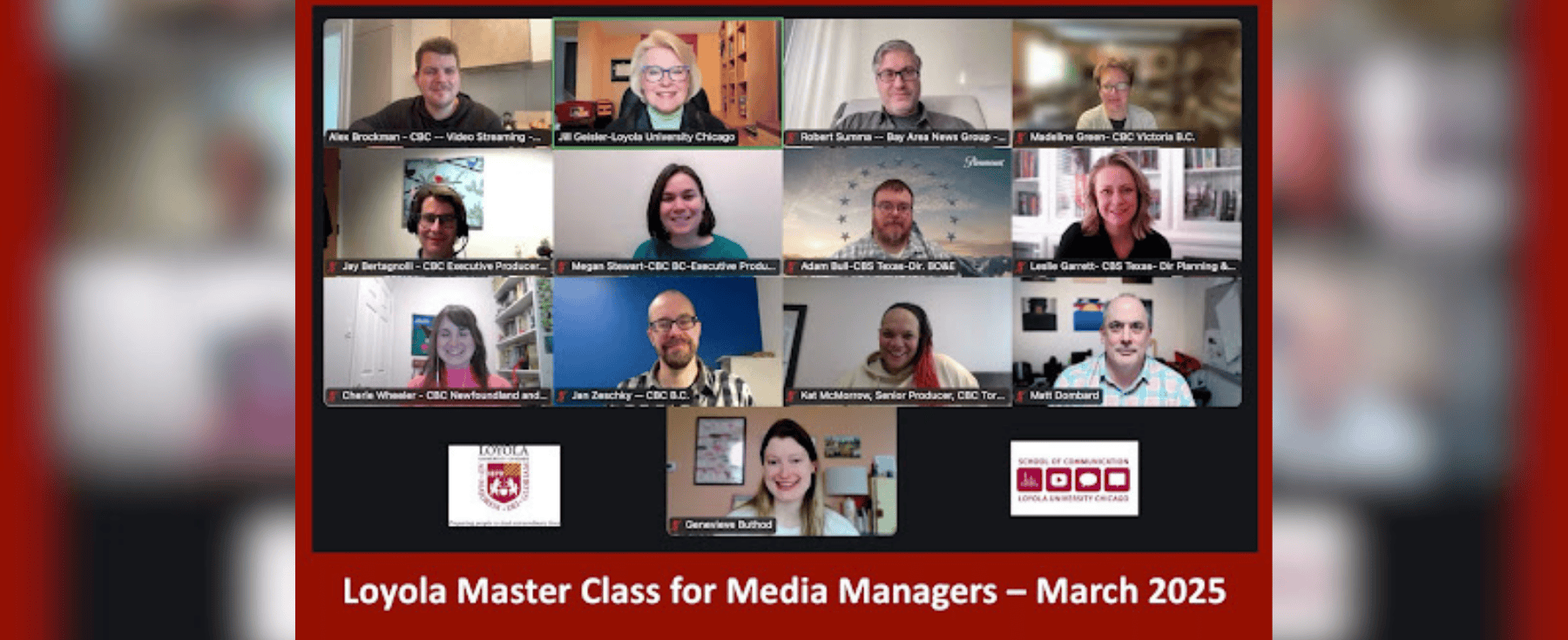
Professor Jill Geisler (top row, second from left) leads Loyola University Chicago’s March 2025 Master Class for Media Managers, joined by participants including Genevieve Buthod (bottom center).
Throughout the course, Geisler emphasized the fundamental importance of developing and nurturing our emotional intelligence quotient, or “EQ.” We use this type of intelligence when we pay attention to our own feelings and those of others, and then use our awareness of those feelings to guide our actions. While this can sometimes seem like an innate skill some people possess and others simply don’t, in her course we learned that we all have the ability to improve our EQ. And if we believe that the best workplace is one where people bring their best, fullest selves to work, then we have not just the ability but the duty to improve our EQ, not only for others, but also for ourselves.
If we can create a safe environment to fail, we will have created the necessary conditions for learning to thrive. Genevieve Buthod, Master Class for Media Managers Participant
At Loyola, I believe we all share this duty. We are called to embrace and live the Jesuit value of cura personalis every day at our university. These concepts fit so well together because they are both based on the premise that our full humanity is the greatest gift we have to offer to each other and to the world. And part of appreciating this gift is accepting the difficult aspects of it with open arms, right alongside the joyful aspects of it. Our weaknesses are just as much a part of our humanity as our strengths.
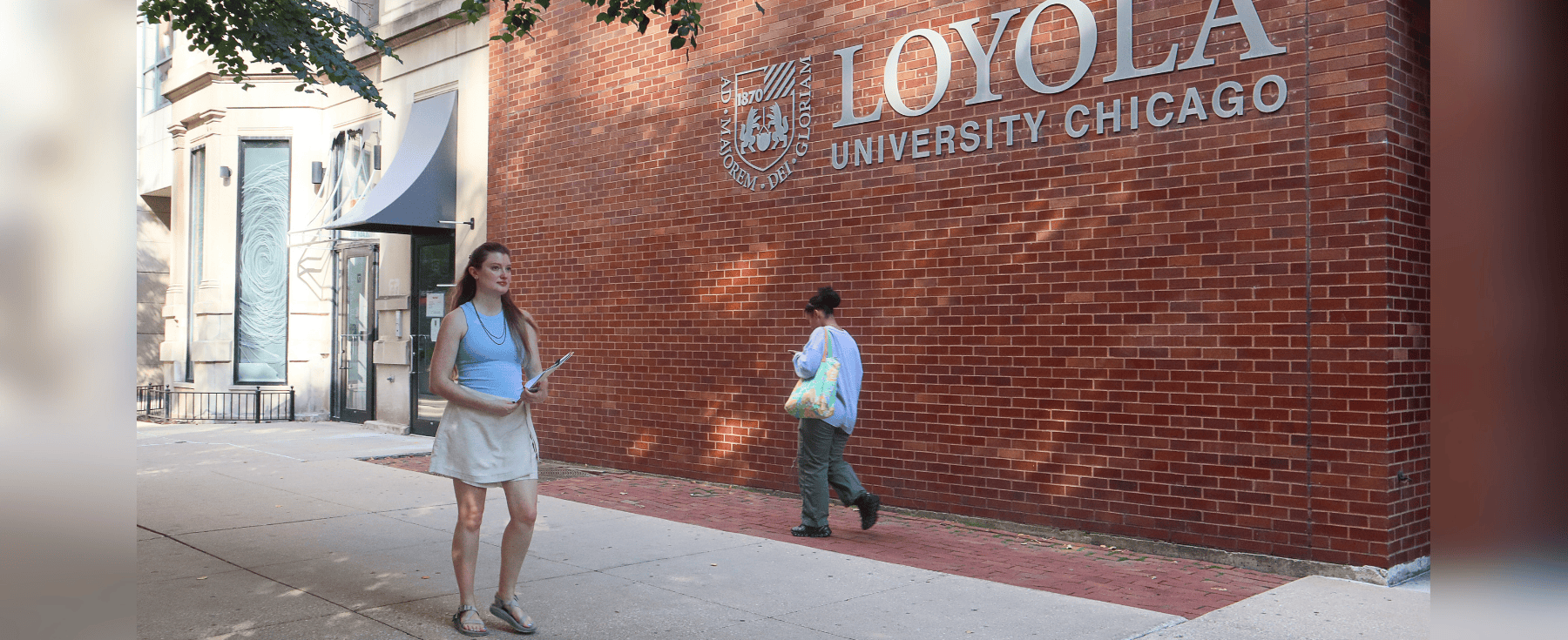
Genevieve Buthod stands outside Loyola University Chicago’s Water Tower Campus, home to the School of Communication.
A tangible example of living the value of cura personalis in the workplace is an openness to learning new skills. This openness may seem like a straightforwardly positive thing at first, but it necessitates a tolerance for mistakes made by ourselves and others, which aren’t typically rewarded in the workplace. In the class, Geisler referred to a paper by MIT Management Professor Edgar H. Schein, in which he emphasizes that learning requires, “…willingness on the part of the learner to be temporarily incompetent.” This willingness, Schein goes on to say, is only possible in workplaces that have intentionally created a “psychologically safe environment” for people to take risks, possibly fail, and get back up again.

Buthod shares a conversation with a fellow student at Loyola’s Water Tower Campus in downtown Chicago.
If we can create a safe environment to fail, we will have created the necessary conditions for learning to thrive. Emotional intelligence is key to understanding and embodying cura personalis, a connection that Geisler made so clear throughout her course that I came to understand it on the level of intuition, not just intellect. If this kind of deeply human approach to leadership training appeals to you, I highly recommend enrolling in her upcoming course. Keep an eye out for her classes returning in 2026. You can access the registration page by clicking here. If you have any questions, please reach out to Jill Geisler at jgeisler@luc.edu.
Throughout the course, Geisler emphasized the fundamental importance of developing and nurturing our emotional intelligence quotient, or “EQ.” We use this type of intelligence when we pay attention to our own feelings and those of others, and then use our awareness of those feelings to guide our actions. While this can sometimes seem like an innate skill some people possess and others simply don’t, in her course we learned that we all have the ability to improve our EQ. And if we believe that the best workplace is one where people bring their best, fullest selves to work, then we have not just the ability but the duty to improve our EQ, not only for others, but also for ourselves.
At Loyola, I believe we all share this duty. We are called to embrace and live the Jesuit value of cura personalis every day at our university. These concepts fit so well together because they are both based on the premise that our full humanity is the greatest gift we have to offer to each other and to the world. And part of appreciating this gift is accepting the difficult aspects of it with open arms, right alongside the joyful aspects of it. Our weaknesses are just as much a part of our humanity as our strengths.
A tangible example of living the value of cura personalis in the workplace is an openness to learning new skills. This openness may seem like a straightforwardly positive thing at first, but it necessitates a tolerance for mistakes made by ourselves and others, which aren’t typically rewarded in the workplace. In the class, Geisler referred to a paper by MIT Management Professor Edgar H. Schein, in which he emphasizes that learning requires, “…willingness on the part of the learner to be temporarily incompetent.” This willingness, Schein goes on to say, is only possible in workplaces that have intentionally created a “psychologically safe environment” for people to take risks, possibly fail, and get back up again.
If we can create a safe environment to fail, we will have created the necessary conditions for learning to thrive. Emotional intelligence is key to understanding and embodying cura personalis, a connection that Geisler made so clear throughout her course that I came to understand it on the level of intuition, not just intellect. If this kind of deeply human approach to leadership training appeals to you, I highly recommend enrolling in her upcoming course. Keep an eye out for her classes returning in 2026. You can access the registration page by clicking here. If you have any questions, please reach out to Jill Geisler at jgeisler@luc.edu.