
PhD Workshop: Advances in Operations Research Applied to Transportation and Logistics
The Quinlan School of Business at Loyola University Chicago is committed to developing supply chain academics and practitioners with the expertise and industry insight needed to meet today’s challenges and opportunities. As part of that commitment, Drs. Mike Hewitt and Maciek Nowak hosted a three-day workshop at Quinlan’s Schreiber Center for PhD students whose dissertation research focuses on supply chain management.
Made possible through funding from the National Science Foundation (NSF) and Uber, along with support from Quinlan, the workshop exposed students to the latest developments in supply chain management theory from leading research experts. Sessions also covered strategies for building and managing an academic career, as well as industry perspectives on the growing need for professionals with advanced analytical skills.
Funding from the National Science Foundation (NSF) provided scholarships to help cover lodging and meals for participating students. Of the 60 students who applied, 35 received scholarship support. In total, 42 students from 25 universities across four countries attended the workshop. Designed for PhD students pursuing either academic or industry careers, the program featured speakers who could speak to both paths, including Irina Dolinskava of the NSF; industry leaders from Amazon, Manhattan Associates, and Uber; and 13 members of the academic community.
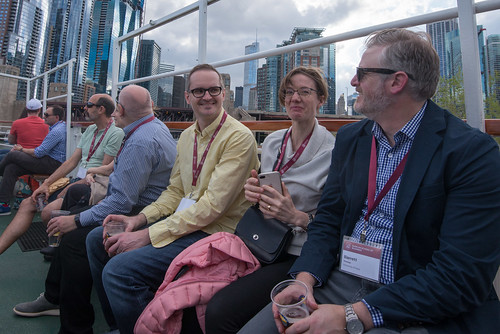
Given the scale and complexity of today’s supply chain challenges, many research questions are best addressed by teams of experts who understand how to translate theory into practice. With that in mind, a key objective of the workshop was to connect future academics and practitioners with the broader SCM research community. With support from Uber, Drs. Hewitt and Nowak organized social activities—including a conference dinner and a Chicago architectural river cruise—to foster those relationships.
Student feedback was highly positive:
“The testimonies and talks from experienced professors and practitioners from the industry were invaluable for prospective scholars.”
“The diversity of students provided us the opportunity to connect and get to know each other for future cooperation.”
Encouraged by this response, Drs. Hewitt and Nowak plan to organize a similar event in the near future. They credit the workshop’s success largely to the outstanding group of speakers—some of the leading minds in SCM practice and research—and to the efforts of the organizing committee, both of whom made the event possible.
The Quinlan School of Business at Loyola University Chicago is committed to developing supply chain academics and practitioners with the expertise and industry insight needed to meet today’s challenges and opportunities. As part of that commitment, Drs. Mike Hewitt and Maciek Nowak hosted a three-day workshop at Quinlan’s Schreiber Center for PhD students whose dissertation research focuses on supply chain management.
Made possible through funding from the National Science Foundation (NSF) and Uber, along with support from Quinlan, the workshop exposed students to the latest developments in supply chain management theory from leading research experts. Sessions also covered strategies for building and managing an academic career, as well as industry perspectives on the growing need for professionals with advanced analytical skills.
Funding from the National Science Foundation (NSF) provided scholarships to help cover lodging and meals for participating students. Of the 60 students who applied, 35 received scholarship support. In total, 42 students from 25 universities across four countries attended the workshop. Designed for PhD students pursuing either academic or industry careers, the program featured speakers who could speak to both paths, including Irina Dolinskava of the NSF; industry leaders from Amazon, Manhattan Associates, and Uber; and 13 members of the academic community.
Given the scale and complexity of today’s supply chain challenges, many research questions are best addressed by teams of experts who understand how to translate theory into practice. With that in mind, a key objective of the workshop was to connect future academics and practitioners with the broader SCM research community. With support from Uber, Drs. Hewitt and Nowak organized social activities—including a conference dinner and a Chicago architectural river cruise—to foster those relationships.
Student feedback was highly positive:
“The testimonies and talks from experienced professors and practitioners from the industry were invaluable for prospective scholars.”
“The diversity of students provided us the opportunity to connect and get to know each other for future cooperation.”
Encouraged by this response, Drs. Hewitt and Nowak plan to organize a similar event in the near future. They credit the workshop’s success largely to the outstanding group of speakers—some of the leading minds in SCM practice and research—and to the efforts of the organizing committee, both of whom made the event possible.