
CUREs
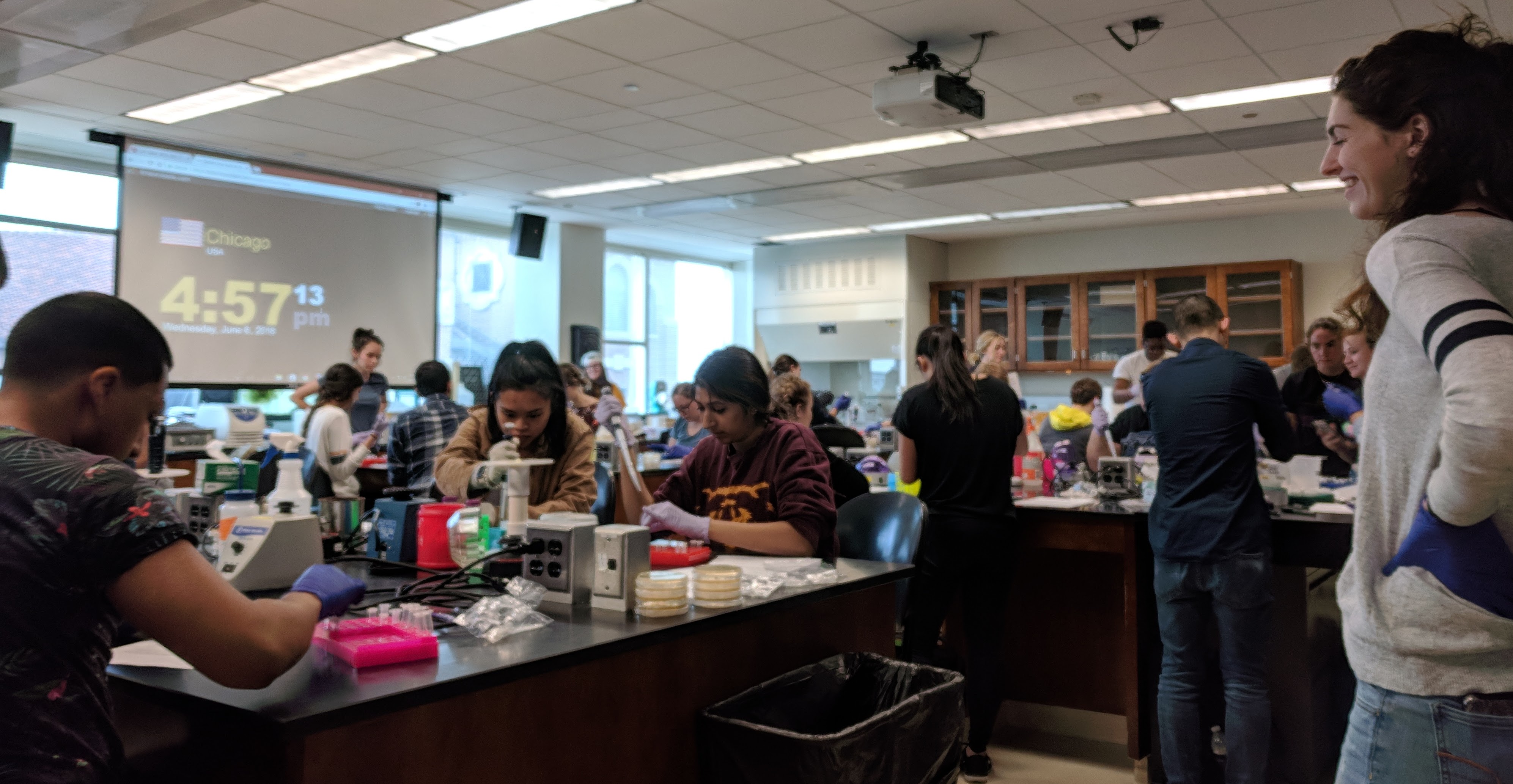
I’m really grateful that I had the chance to do hands-on, real-world research in this class. Megan Martinez, College of Arts & Sciences, '25
Summer 2026 CURE Courses
BIOL 373 01E - Laboratory in Neuroscience I
Hui Ye, Mo Tu We Th 11:00AM - 1:30PM, 05/18/2026-06/12/2026 (Early Session)
How does the nervous system organize and function in order to control animal behaviors such as locomotion, escaping and feeding? What are the ionic bases that control the single neuron’s excitability? How can one control neural activity by electric and magnetic stimulation? As a senior level neuroscience lab class, BIOL 373 provides a unique training opportunity to students to learn various techniques in the field of cellular neurobiology. Students will gain hands-on experience in biomedical instrumentation, signal processing, micro dissection of nervous system, extracellular and intracellular recording techniques from nerves, axons, and single neurons. Students will also be trained to simulate neural activity using the computational neuroscience platforms such as Neurons in Actions (NIA) and NEURON.
To appreciate the complexity of neural control of animal behavior, the model system Aplysia californica will be used for the study. Scientific publications related to the class will be introduced in the class.
BIOL 395L 01E - Clinical Microbiology
Alexander Kula, Tu Th, 12:00PM - 3:00PM, 05/18/2026-06/26/2026 (Session A)
Fall 2026 CUREs Courses
ANTH 317 1WE - Explore Chicago: Research in Culture and History
Noah Butler, Mo We Fr 1:40PM - 2:30PM
This course takes an Anthropological perspective on Chicago. It weaves together historical, social, and cultural perspectives, with attention to communities and neighborhoods as important parts of everyday life.
A central question orients the course: What makes a city “global”? The history, multi-culturalism, diversity, and inequality in Chicago present instructive opportunities to unwind themes of community, power, and social change. The course involves direct engagement with Chicago, including through a series of self-guided trips to different neighborhoods and discussions with community organizations, which culminate in a final poster presentation.
This is an Engaged Learning (Undergraduate Research) and Writing Intensive course.
ANTH 348 1WE - Museum & Material Culture Research
Catherine Nichols, Mo We Fri 1:40PM - 2:30PM
Museum and Material Culture Research invites students to learn and practice a variety of anthropological research methods with objects and archives in the May Weber Ethnographic Study Collection, located in Mundelein Center.
Each student contributes to the Collection’s ongoing curation by producing an in-depth research report for an object, which is added to the Collection’s permanent documentation files. Students are encouraged to disseminate their research through eCommons and the Undergraduate Research Symposium.
This is an Engaged Learning (Undergraduate Research) and Writing Intensive course.
BIOL 366L 01E - Cell Physiology & Biochemistry Lab
Emma Feeney, Mo 8:15AM - 11:00AM
This course introduces students to techniques commonly used to address questions of cellular physiology from a biochemical perspective. Our class is part of a national network of undergraduate labs participating in a research project headed by the Seigel lab at University of California – Davis called Design to Data (D2D). The “big picture” goal of this project is to generate a dataset that will be used to train artificial intelligence algorithms to make protein function predictions based on amino acid sequence and/or protein structure. You will be working on a semester-long primary research project where you will be generating mutant enzymes, characterizing their function, and uploading your data to a national database.
Over the course of this project, we will discuss specific laboratory methods and the types of data collected by each, along with learning how to calculate useful results from the data and to interpret the results with reference to molecular models and mechanisms. Finally, you will learn how to communicate novel research data in either written and oral formats. Laboratory techniques used in the lab are commonly used in a variety of research fields (medical, pharmaceutical, etc).
BIOL 366L 02E - Cell Physiology & Biochemistry Lab
Emma Feeney, Mo 11:30AM - 2:15PM
This course introduces students to techniques commonly used to address questions of cellular physiology from a biochemical perspective. Our class is part of a national network of undergraduate labs participating in a research project headed by the Seigel lab at University of California – Davis called Design to Data (D2D). The “big picture” goal of this project is to generate a dataset that will be used to train artificial intelligence algorithms to make protein function predictions based on amino acid sequence and/or protein structure. You will be working on a semester-long primary research project where you will be generating mutant enzymes, characterizing their function, and uploading your data to a national database.
Over the course of this project, we will discuss specific laboratory methods and the types of data collected by each, along with learning how to calculate useful results from the data and to interpret the results with reference to molecular models and mechanisms. Finally, you will learn how to communicate novel research data in either written and oral formats. Laboratory techniques used in the lab are commonly used in a variety of research fields (medical, pharmaceutical, etc).
BIOL 373 01E - Laboratory in Neuroscience I
Hui Ye, Tu Th 1:00PM - 4:00PM
How does the nervous system organize and function in order to control animal behaviors such as locomotion, escaping and feeding? What are the ionic bases that control the single neuron’s excitability? How can one control neural activity by electric and magnetic stimulation? As a senior level neuroscience lab class, BIOL 373 provides a unique training opportunity to students to learn various techniques in the field of cellular neurobiology. Students will gain hands-on experience in biomedical instrumentation, signal processing, micro dissection of nervous system, extracellular and intracellular recording techniques from nerves, axons, and single neurons. Students will also be trained to simulate neural activity using the computational neuroscience platforms such as Neurons in Actions (NIA) and NEURON.
To appreciate the complexity of neural control of animal behavior, the model system Aplysia californica will be used for the study. Scientific publications related to the class will be introduced in the class. In the 2nd half of the semester, students will work in the lab to acquire data, and generate final research papers. Research projects will be in the field of neural modulation using electromagnetic stimulation. More information can be found here: https://www.luc.edu/biology/aboutus/facultyresearch/huiye/”
BIOL 390 01EW - Molecular Biology Laboratory
James Lodolce, Mo We 1:40PM - 4:25PM
This course is an intensive laboratory course in the basic principles and techniques of molecular biology, including bacterial cloning, polymerase chain reaction, restriction mapping, agarose gel electrophoresis, and DNA sequencing.
The goal of this intensive laboratory course is to introduce you to the basic principles and techniques of molecular biology. During the first half of the semester, you will be introduced to and learn the basic techniques of molecular biology including bacterial cloning, polymerase chain reaction, restriction mapping, agarose gel electrophoresis, and DNA sequencing. In the second half of the course, you will apply these techniques to your own independent cloning projects. This is an Engaged Learning course, approved for the Undergraduate Research category, and thus satisfies Loyola’s Engaged Learning requirement. This course is also Writing Intensive; thus, we will be spending considerable time learning formal science writing skills.
BIOL 392 01E - Metagenomics
Michael Burns, Mo We 2:45PM - 4:00PM
Students will gain practical skills in metagenomic data analysis, utilizing R for processing, interpreting, and visualizing metagenomic datasets. The course emphasizes collaborative research projects and effective presentation of findings. This course provides valuable skills to contribute to metagenomic research, as well as a strong foundation for future work in data analysis.
BIOL 395L 01E - Special Topics Laboratory (Food Microbiology)
Jeremy Ritzert, Th 8:30AM - 11:15AM
This course is designed to expose students to aspects of Microbiology as it pertains to food production and preparation. General concepts of microbiology are covered but are focused specifically on how microbial-derived food products are produced and how production of food is prepared to limit contamination. Students will choose and adapt projects to address questions around key aspects or common myths of Food Microbiology. These research projects are intended to be student-designed with assistance of the instructor as they pertain to food production, preservation, and prevention. Students will be required to access the laboratory outside of classroom hours to work on their projects. Projects will be presented in class and outside of class to fulfill the engaged learning requirements.
BIOL 395L 02E - Special Topics Laboratory (Advanced Genetics Lab)
Christine Beatty, Tu Th 2:30PM - 3:45PM
In this class students will work with in teams to develop a novel research question in the model organism Drosophila melanogaster. The starting point for this work will be a set of DNA repair mutants. Previous students have investigated a wide range of topics including fertility, mutagen sensitivity, and longevity using classical and molecular genetic techniques. Over the course of the semester students will learn how to develop a viable research question, design experiments to address that question and communicate their results both orally and in writing through informal lab meetings and presentations
COMP 344 01E - Hands-on Approach to Security and Privacy
Eric Chan-Tin, TBA
In this hands-on course, you’ll dive into how systems are protected (and how they can be broken into), explore real cybersecurity challenges, and even take part in friendly (and competitive) competitions that put your skills to the test. Whether you're curious about hacking, digital safety, or just love solving puzzles, this class is for you!
Along the way, you’ll engage in research activities that introduce you to how cybersecurity questions are studied, tested, and verified - giving you a taste of what it’s like to contribute to an evolving field.
HIST 397 01WE - History Honors Tutorial
Alice Weinreb, Th 2:30PM - 5:00PM
PLSC 300B 02E - Contemporary Political Issues: Political Theory (Democratic Inst in Chicago)
Jennifer Forestal, Tu Th 10:00AM - 11:15AM
This is a special topics course; for Fall 2026, the topic is "Democratic Institutions in Chicago."
In recent years, many have expressed renewed concerns over the dangers that centralized power pose for the practices of freedom, democratic self-governance, and general human flourishing. There have been renewed calls to disperse power more broadly in society, including the use of decentralized technologies (e.g. federated social media, crypto) and participatory institutions (e.g. citizens’ assemblies) as ways of developing sources of countervailing power and facilitating local self-governance.
But even as empowering associational life can create new centers of power, these groups may also pursue—sometimes recklessly—supremacist goals at odds with a liberal democratic society. Federalism and other devolved state structures can serve as “laboratories for democracy,” but they also enable bad actors to perfect authoritarian politics or implement oppressive policies. Devolving power to local neighborhoods can facilitate feelings of autonomy and belonging within those spaces, but it can also generate unjust claims of “turf” as those same groups lock others out. Clearly, while arguments that equate the broad distribution of power with democratic ends may be correct, they are incomplete. So, under what conditions is local decision-making democratic?
In this CURE course, students will collect and analyze ethnographic data from local democratic institutions—specifically, Local School Councils (LSCs) in the wards surrounding Loyola—in order to answer this question. We will frame these empirical investigations by reading a variety of thinkers and texts who give us resources to think about the structure and design of democratic institutions, the kinds of outcomes they produce, and the ways these intentions can be thwarted.
PSYC 370 01E - Psychology Honors Research
Elizabeth Wakefield, Mo We Fr 8:15AM - 9:05AM
The PSYC 369/370 course sequence gives majors in Psychology the opportunity to complete an honors thesis project with a faculty mentor in the department. This fulfills the Capstone requirement for the Psychology Major, and is a great option for students who have been working in a research lab during their undergraduate career at Loyola and are looking to gain more experience designing, conducting and writing about a study of their own.
For more information about eligibility and the course, please reach out to Dr. Wakefield (ewakefield1@luc.edu).
SOCL 265 01E - Globalization & Society
Minwoo Jung, Tu Th 2:30PM - 3:45PM
This course offers an engaged learning and research-centered exploration of globalization, emphasizing the connection between sociological theory and real-world application. In the first part of the semester, students are introduced to key concepts and theoretical approaches that frame globalization’s political, economic, social, and cultural dimensions. Building on this foundation, the course then shifts toward applied learning, where students actively investigate how globalization unfolds across diverse contexts, including global media, migration, climate change, human rights, and transnational social movements, with particular attention to global Asia.
A central feature of the course is its emphasis on student-driven research and creative inquiry. Through workshops, in-class presentations, and iterative feedback, students develop original projects that apply course concepts to topics of their choice. These projects encourage students to think critically and creatively about how to communicate complex ideas to broader audiences.
By selecting from a range of multimedia formats (such as podcasts, short films, digital exhibits, or written narratives) students engage in hands-on research that integrates analytical rigor with innovative expression. This approach fosters not only a deeper understanding of globalization but also practical skills in research design, critical analysis, and public-facing scholarship.
SOCL 302 01E - Qualitative Research
Maria Akchurin, Tu Th 1:00PM - 2:15PM
This course allows students to practice major qualitative methods of social inquiry. We will cover historical analysis, interviewing, and ethnographic observation, as well as discussing ethical and practical issues of field research. Students will work on a semester-long Public Sociology Interviewing Project, applying lessons from the course to study a sociological question through in-depth interviewing. We will also read recent qualitative sociological works for insight and inspiration.
In Fall 2026, we will continue the class interviewing project on Mutual Aid Networks, Community Organizations, and Social Infrastructure for Recently Arrived Immigrants. Depending on class size, we may add another sociological topic alongside this one.
This is a hands-on course that combines elements of seminar-style teaching with applied methods exercises and collaborative discussion that treats students as part of a research team.
For more information, please contact Dr. Maria Akchurin at makchurin@luc.edu.
SPAN 272 01E - Introduction to Spanish American Literature and Culture (Latin American Gothic)
Ana Rodríguez Navas, Tu Th 11:30AM - 12:45PM
This section of Spanish 272 is conducted as a collaborative workshop and research group with the aim of creating a common project: a public-facing website focusing on Gabriel García Márquez’s short story collection, Doce cuentos peregrinos.
The website will be entirely in Spanish, and will introduce the collection to the general public. It will consist of several sections or modules, each discussing and analyzing key features or aspects of the stories, elucidating their contexts, developing close readings of key passages, etc. This class is taught fully in Spanish and, through its emphasis on literary research, meets Loyola’s Engaged Learning requirement.
THEO 280 02E - Religion & Interdisciplinary Studies (Faith, Science, Common Good)
Hans Svebakken, Mo We Fri 9:20AM - 10:10AM
Science denial threatens the common good by undermining public confidence in the ability of science to comprehend our world and create effective solutions for urgent social problems. This course explores the threat of science denial through a series of three questions. First, what exactly is science denial? Second, what motivates science denial? Third, what mitigates science denial?
Insofar as some science denial stems from the presumption of an inevitable conflict between faith and science (e.g., a presumed conflict between faith and evolutionary science), this course considers the merits of models that instead envision a peaceful co-existence between faith and science.
THEO 280 05E - Religion & Interdisciplinary Studies (Religion Alchemy Hist Science)
Josefrayn Sanchez-Perry, Mo We Fr 10:25AM - 11:15AM
Welcome to Religion, Alchemy, and the History of Science!! THEO 280 fulfills the Theological & Religious Knowledge and Inquiry Tier II core requirement. This course will will introduce you to the category religion and its historical encounter in materia medica (medicinal properties of plants, animals, and materials). You will learn the entangled histories of these domains in the late medieval and early modern periods, including the rise of Islamic medicine, European herbals, and the extraction of Indigenous and African knowledge in the Americas and Caribbean. These histories are entangled through the circulation of ideas and practices that intellectuals and practitioners assessed, compared, appropriated, and distorted across time and space.
Your research project will involve recreating an experiment based on a late medieval and early modern recipe. To this end, you will research original historical texts and material culture from archives and museums, such as the Rare Books Collection and the Weber Ethnographic Collection on campus, and the Newberry Library and Art Institute of Chicago in the downtown Chicago area.
THEO 344 01E - Theology and Ecology (Outdoor Spiritualities)
Colby Dickinson, Tu Th 1:00PM - 2:15PM
This course will focus on the study and personal development of spiritualities focused on the human being as a spiritual being immersed in the natural world. Through exploring readings and activities centered on hiking, camping, the natural environment and ecology, this course investigates what exactly a holistically and naturally conceived spirituality might look like today, especially as formed in dialogue with various Christian traditions (e.g. the Desert Fathers, mystical theologies, feminist and eco-spiritual theologies) and Native American spiritualities. In addition, we will be focusing on how these aforementioned topics relate to other concepts, such as technology, wilderness/wild-ness, landscape, mysticism, Gaia, prayer, solitude and spiritual retreat.
The course is an Engaged Learning (EL) course and will culminate with a semester-long research project presented or uploaded to the digital archive for the 2027 Undergraduate Research and Engagement Symposium.
In general, students will have ample opportunity to immerse themselves in nature and to write about their experiences, reflecting on the role of non-technologically based learning and humanity's direct relationship to nature in the forming of the self and our innate spirituality.
FALL 2026 Performance-Based CUREs
Dance (DANC)
| Course | Title | Instructor | Days | Times |
| DANC 212 10E | Ballet Dance II: Theory and Technique | Amy Wilkinson, Nataliya Kushnir | TuTh | 10:00am - 11:15am |
| DANC 213 10E | Ballet III: Advanced Continuing Ballet | Gina Hoch-Stall, Nataliya Kushnir | Tu Th | 8:30am - 9:45am |
| DANC 222 10E | Modern Dance II: Theory and Technique | Deborah Goodman, Kyle Nelson | Tu Th | 11:30am - 12:45pm |
| DANC 232 10E | Jazz Dance II: Theories and Techniques | Mari Jo Barker | Tu Th | 2:30pm - 3:45pm |
| DANC 323 10E | Rehearsal and Performance | Raúl Díaz-Maroto Casasola, Amy Wilkinson, Sarah Cullen Fuller, Tanji Harper, Jessica Kondrath, Robert Kuhn |
TBA | TBA |
| DANC 331 10E | Jazz Dance III: Intermediate Jazz Dance Theories and Techniques | Mari Jo Barker | Tu Th | 6:00pm - 7:30pm |
Music (MUSC)
| MUSC 105 10E | Symphony Orchestra | Colin Holman | Mo We | 4:30pm - 6:00pm |
| MUSC 107 10E | Chorus | Kirsten Hedegaard, Cody Bradley | Mo We | 4:15pm - 5:30pm |
| MUSC 107 12E | Chorus | Jennifer Budziak, Cody Bradley | Mo We | 2:45pm - 4:00pm |
| MUSC 108 10E | Litrugical Choir: Cantorum | Peter Morey | We | 5:30pm - 8:00pm |
| MUSC 109 10E | Jazz Ensemble | Christopher Madsen | Mo We | 2:45pm - 4:15pm |
| MUSC 110 10E | Wind Ensemble | Rick Lowe | Tu Th | 2:30pm - 4:00pm |
| MUSC 111 10E | Percussion Ensemble | John Corkill | Mo | 7:00pm - 9:30pm |
| MUSC 207 10E | Chamber Choir | Kirsten Hedegaard, Chungho Lee | Mo | 7:00pm - 9:30pm |
| MUSC 289 10E | Chamber Music | Haysun Kang, Sarah Kim, Janice MacDonald, Chungho Lee, Christopher Laughlin | TBA | TBA |
| MUSC 290 10E | Jazz Combo | Christopher Madsen, Lara Driscoll, Matthew Ulery, Alyssa Allgood | TBA | TBA |
| MUSC 320 10E | Rehearsal and Performance | Rick Lowe | TBA | TBA |
| MUSC 374 10E | Musical Theatre Repertoire | Ross Lehman, Cody Bradley | Mo We | 12:00am - 12:00am |
Theatre (THTR)
| THTR 323 10E | Rehearsal & Performance | Kelly Howe, April Browning, Miranda Anderson | TBA | TBA |
| THTR 323 12E | Rehearsal & Performance | Mark Lococo, April Browning, Miranda Anderson, Emily Hayman | TBA | TBA |
| THTR 323 13E | Rehearsal & Performance | Lee Keenan, April Browning, Emily Ritger | TBA | TBA |
| THTR 324D 102E | Applied Design | Lee Keenan, Rachel Healy, Timothy Mann | Fr | 10:00am - 11:15am |
| THTR 324M 10E | Applied Management | Miranda Anderson, Theresa Ham, April Browning | Fr | 9:20am - 11:15am |
This course not only taught me how to conduct and write ethnography but also solidified my understanding of the logistics and ethics involved in fieldwork. Throughout the semester, we received training in structured and unstructured interviewing, field notetaking, Qualtrics survey design and data analysis, and the use of Microsoft applications to produce academic papers and posters. River Preston-Gage, College of Arts & Sciences, '25
Spring 2026
| Subject Catalog # | Section | Course Title | Instructor | Days & Times |
|---|---|---|---|---|
| ANTH 348 | 01WE | Museum & Material Culture Research | Catherine Nichols | Mo We Fri 12:35PM - 1:25PM |
| BIOL 366L | 01E | Cell Physiology & Biochemistry Lab | Emma Feeney | Mo 11:30am - 2:15pm |
| BIOL 366L | 02E | Cell Physiology & Biochemistry Lab | Emma Feeney | Mo 2:45PM - 5:15PM |
| BIOL 373 | 01E | Laboratory in Neuroscience | Hui Ye | Mo We 12:35PM - 3:20PM |
| BIOL 390 | 01EW | Molecular Biology Laboratory | Emma Feeney | MoWe 8:15am - 11:00am |
| BIOL 390 | 01EW | Molecular Biology Laboratory | James Lodolce | Mo We 1:40pm - 4:25pm |
| BIOL 395 | 06E | Paleobiology Lab | Megan Whitney | Th 11:30AM - 2:15PM |
| BIOL 395 | 09E | Clinical Microbiology | Alexander Kula | Mo Fr 2:30PM - 4:15PM |
| BIOL 397E | 01E | Ecology of Plant Microbe Interactions | Michael Grillo | We 1:40PM - 4:25PM |
| BIOL 397M | 01E | Cancer Cell Culture | Helena Palka-Hamblin | Mo We 9:20AM - 10:35AM |
| BIOL 397M | 02E | Evolutionary Genomics | Jennifer Mierisch | Tu 2:30PM - 5:15PM |
| COMP 312 | 01E | Open Source Software Practicum | Peter Dordal | Mo We Fri 2:45PM - 3:35PM |
| HIST 300A | 01E | Research Seminar on Eating Disorders | Alice Weinreb | Tu 2:30PM - 5:00PM |
| HIST 375 | 01E | Digital History | Christopher Cantwell | Mo We 2:45PM - 4:00PM |
| INDS 380 | 01WE | Newberry Seminar | Tu Th 2:00PM - 5:00PM | |
| MATH 298/MATH 390 | 01E | Research Seminar in Mathematics | Carmen Rovi | Mo We 11:30AM - 12:45PM |
| PHY 126F | multiple | Freshman Projects | multiple | various |
| PLSC 311/SOCL 311 | 01E | Social Science Research Practicum: Cook County Community Survey | Dana Garbarski and David Doherty | Tu Th 11:30AM - 12:45PM |
| PSYC 370 | 01E | Psychology Honors Research | Elizabeth Wakefield | Mo We Fr 8:15AM - 9:05AM |
| STAT 370 | 01E | Data Science Consulting | Gregory Matthews | Mo We Fri 2:45PM - 3:35PM |
Performance-Based CUREs
Dance (DANC)
| Course | Title | Instructor | Days | Times |
| DANC 212 10E | Ballet Dance II: Theory and Technique | Deborah Goodman, Nataliya Kushnir |
TuTh | 10:00AM - 11:15AM |
| DANC 213 10E | Ballet III: Advanced Continuing Ballet | Gina Hoch-Stall, Nataliya Kushnir |
TuTh | 8:30AM - 9:45AM |
| DANC 222 10E | Modern Dance II: Theory and Technique | Deborah Goodman, Kyle Nelson |
TuTh | 11:30AM - 12:45PM |
| DANC 232 10E | Jazz Dance II: Theories and Techniques | Mari Jo Barker | TuTh | 2:30PM - 3:45PM |
| DANC 331 10E | Jazz Dance III: Intermediate Jazz Dance Theories and Techniques | Mari Jo Barker | TuTh | 6:00PM - 7:00PM |
| DANC 370 10E | Dance Composition | Amy Wilkinson | TuTh | 1:00PM - 2:15PM |
Fine Arts (FNAR)
| Course | Title | Instructor | Days | Times |
| FNAR 398 10E | Fine Arts Capstone (Studio Art focus) | Betsy Odom | We | 4:15PM - 7:55PM |
| FNAR 398 12E | Fine Arts Capstone (Vis. Comm focus) | Jennifer Bowman | We | 4:15PM - 7:55PM |
Music (MUSC)
| MUSC 105 10E | Symphony Orchestra | Colin Holman | MoWe | 4:30PM - 6:00PM |
| MUSC 107 10E | Chorus | Kirsten Hedegaard | MoWe | 4:15PM - 5:30PM |
| MUSC 107 12E | Chorus | Jennifer Budziak, Cody Bradley |
MoWe | 2:45PM - 4:00PM |
| MUSC 108 10E | Liturgical Choir: Cantorum | Peter Morey | We | 5:30PM - 8:00PM |
| MUSC 109 10E | Jazz Ensemble | Christopher Madsen | TBA | TBA |
| MUSC 110 10E | Wind Ensemble | Rick Lowe | TBA | TBA |
| MUSC 111 10E | Percussion Ensemble | John Corkill, Haysun Kang |
Mo | 7:00PM - 9:30PM |
| MUSC 207 10E | Chamber Choir | Kirsten Hedegaard | Mo | 7:00PM - 9:30PM |
| MUSC 246 10E | Composition I | Dongryul Lee | TuTh | 10:00AM - 11:15AM |
| MUSC 289 10E | Chamber Ensemble | Haysun Kang, Chungho Lee |
TBA | TBA |
| MUSC 290 10E | Jazz Combo | Christopher Madsen | TBA | TBA |
| MUSC 320 10E | Rehearsal and Performance | Rick Lowe | TBA | TBA |
| MUSC 388 10E | Lecture/Recital: MUSC Capstone | Rick Lowe | TBA | TBA |
Theatre (THTR)
| THTR 204 1WE | Playwriting | Sandra Delgado | TuTh | 4:15PM - 5:30PM |
| THTR 323 11E | Rehearsal & Performance | Mark Lococo, Miranda Anderson, April Browning, Ross Lehman, Robert Kuhn |
TBA | TBA |
| THTR 323 12E | Rehearsal & Performance | Deron Williams, April Browning, Miranda Anderson, Cody Bradley, Tanji Harper, Theresa Ham, Robert Kuhn |
TBA | TBA |
| THTR 323 13E | Rehearsal & Performance | Lee Keenan, April Browning, Miranda Anderson |
TBA | TBA |
| THTR 324D 10E | Applied Design | Lee Keenan, Timothy Mann, Rachel Healy |
Fr | 10:30AM - 12:45PM |
| THTR 324M 101E | Applied Management | Miranda Anderson, Theresa Ham, April Browning |
Fr | 9:20AM - 11:15AM |
BIOL 390 02EW - Molecular Biology Laboratory
James Lodolce, Mo We 1:40pm - 4:25pm
This course is an intensive laboratory course in the basic principles and techniques of molecular biology, including bacterial cloning, polymerase chain reaction, restriction mapping, agarose gel electrophoresis, and DNA sequencing.
The goal of this intensive laboratory course is to introduce you to the basic principles and techniques of molecular biology. During the first half of the semester, you will be introduced to and learn the basic techniques of molecular biology including bacterial cloning, polymerase chain reaction, restriction mapping, agarose gel electrophoresis, and DNA sequencing. In the second half of the course, you will apply these techniques to your own independent cloning projects. This is an Engaged Learning course, approved for the Undergraduate Research category, and thus satisfies Loyola’s Engaged Learning requirement. This course is also Writing Intensive; thus, we will be spending considerable time learning formal science writing skills.
BIOL 395L 06E - Paleobiology Lab
Megan Whitney, Th 11:30AM - 2:15PM
This course is an introduction to research into how life has evolved in deep time. As a part of this course, students will partake in independent research in a Late Cretaceous (66 million years ago) ecosystem to document the final days of non-avian dinosaurs and the rise of mammals. Using real fossils students will gain skills in anatomical identification, ecosystem statistics, microscopy, and geology. Students will present their research during a final poster presentation symposium and practice their skills in science communication to a general audience.
BIOL 397E 01E - Ecology of Plant Microbe Interactions
Michael Grillo, We 1:40PM - 4:25PM
Mutually beneficial species interactions, termed mutualisms, are ubiquitous in nature, contributing to numerous ecological processes and playing profound roles in ecosystem functioning. A striking feature of plant-microbe mutualisms is the high degree of variation maintained for both partner choice (i.e. the symbiotic partners a plant forms associations with) and partner quality (the fitness benefits a plant receives from a particular symbiont). The mutualism between plants in the legume family (Fabaceae) and rhizobia (nitrogen-fixing bacteria) is one of the most economically and ecologically important interactions on the planet.
In this CURE students will examine symbiotic interactions between native legumes in the Chicago region and their microbial symbionts, particularly as it pertains to partner choice and partner quality. Through this experience students will gain experience with basic laboratory skills in microbiology and genetics.
BIOL 397M 01E - Cancer Cell Culture
Helena Palka-Hamblin, Mo We 9:20AM - 10:35AM
The Cancer Cell Culture CURE is designed with the main objectives to promote understanding of the flow of biological research and promote mastery of cell culture techniques. Students will first investigate the effects of culture conditions (2D versus 3D) on gene expression, cell growth, proliferation, and metabolic rates. Once students have completed these preliminary experiments and determined any differences, students will work in pairs to design their own experiments to investigate what biological processes might be impacted by the different culture conditions. Students will read and critically evaluate primary literature and develop a formal experimental plan and write a grant-like proposal.
Once approved, students will conduct their experiments and collect and analyze data. During the semester students will give progress reports in class and discuss experimental designs, new data, and work collaboratively with the rest of the class to trouble shoot any problems. At the end of the semester students will submit a final report highlighting project activities completed, results and data collected, challenges encountered and future directions.
BIOL 397M 02E - Evolutionary Genomics
Jennifer Mierisch, Tu 2:30PM - 5:15PM
Cell signaling controls many basic cellular functions from cell growth and proliferation to survival and migration. On a tissue level, cell signaling coordinates the response of the tissue to stimuli. Interestingly, the same signaling pathways are used for the a variety of purposes across species. While many signaling pathway components are conserved, pathways do evolve over evolutionary time with some molecules lost, gained, or altered in sequence, thereby affecting pathway function.
Study of signaling pathways across species is critical for understanding the keys players in these pathways and how pathway structure has changed. In this course we still study gene structure and function and explore how genes have evolved across species in the context of signaling pathways. These projects are in collaboration with the Genomics Education Partnership (thegep.org).
COMP 312 01E - Open Source Software Practicum
Peter Dordal, Mo We Fri 2:45PM - 3:35PM
HIST 300A 01E - Research Seminar on Eating Disorders
Alice Weinreb, Tu 2:30PM - 5:00PM
Students will engage in intensive, primary-source based research individually and in small groups, contributing to the same larger question: How and why did eating disorders become so prevalent in the United States and around the world during the late twentieth century?
Students will carry out archival research building off of a shared pool of sources; they will read secondary and theoretical literature in history and psychology; they will develop an original research question; and complete an analytic, primary-source-based history paper of 10-15 pages.
HIST 375 01E - Digital History
Christopher Cantwell, Mo We 2:45PM - 4:00PM
In this class students will gain an introductory technical knowledge of digital tools or methods, learn to apply technical knowledge about digital history tools to historical questions, and acquire experience contributing to a team-based digital humanities project called “Remember My Church.”
The project will have students partner with Catholic parishes in the Rogers Park area impacted by the Archdiocese of Chicago’s “Renew My Church” initiative, which has merged or closed churches, and then document their histories using a variety of digital research methods.
INDS 380 01WE - Newberry Seminar
TBA, Tu Th 2:00PM - 5:00PM
Every Spring, five Loyola students have the chance to be a part of a research seminar at the Newberry Library, located near the Water Tower Campus. Over the course of their semester at the library, students attend seminar meetings with students from DePaul, Roosevelt, and UIC. The seminar allows students to combine an intensive classroom experience with independent research carried out in the Newberry Library, one of the country's richest archives of primary source materials on history and culture.
The seminar is open to qualified students in all disciplines, counts as both Writing Intensive and Engaged Learning, and culminates in a major research paper and presentation.
MATH 298/MATH 390 01E - Research Seminar in Mathematics
Carmen Rovi, Mo We 11:30AM - 12:45PM
The Research Seminar in Mathematics (Math 298) is a seminar-style course that introduces students to the process of mathematical research through hands-on projects and close mentorship from faculty. Students will explore how to formulate questions, develop methods, and communicate results in mathematics and its applications.
Each student will work on an individual or team-based research project, either launching a new idea or continuing an existing project. They will also gain experience in writing, presenting, and sharing their work with peers and faculty. Projects will be presented in class and potentially outside of class to fulfill the engaged learning requirements.
The Advanced Research Seminar in Mathematics (Math 390) is a seminar-style course that provides students with the opportunity to develop their research and presentation skills, covering both familiar topics from the curriculum and more unconventional topics not typically included in the undergraduate curriculum.
Students will engage in research projects and will participate in the research culture of the department by attending research seminars and colloquia. They will have opportunities to present their research findings both in class and to audiences outside of class to fulfill the engaged learning requirements.
PHYS 126F - Freshman Projects
Physics majors enrolled in PHYS 126F work in small groups on a semester-long research project under the supervision of a faculty member. Each group proposes a research project, studies the underlying physics, designs and builds an experimental apparatus or computational framework, collects and analyzes data, then presents their results at an end-of-semester research symposium. This hands-on experience teaches students how to plan, collaborate on, and communicate scientific research – essential skills that can't be taught in the classroom.
Each section of PHYS 126F is led by a faculty member who guides their group through the process of identifying and planning a project, and no two sections are alike. Students might develop numerical simulations of galactic dark matter halos, model and test "Chladni patterns" formed by sand on a vibrating plate, construct an acoustic levitation device, or build a cosmic ray detector. These projects may turn into long-term collaborations and have even led to peer-reviewed publications.
Sections and faculty:
| Section | Instructor | Days | Times | Location |
| 01E-LAB | Jon Bougie | Mo | 4:15pm - 6:05pm | LSC |
| 02E-LAB | Robert McNees | Tu | 4:15pm - 6:05pm | LSC |
| 03E-LAB |
Rasha Abbasi
|
We | 4:15pm - 6:05pm | LSC |
| 04E-LAB | Irina Craita | Th | 4:15pm - 6:05pm | LSC |
| 05E-LAB | Walter Tangarife | Fri | 4:15pm - 6:05pm | LSC |
| 06E-LAB | David Klinger | Mo | 12:35pm - 2:30pm | LSC |
PLSC 311/SOCL 311 01E - Social Science Research Practicum: Cook County Community Survey
Dana Garbarski and David Doherty, Tu Th 11:30AM - 12:45PM
Each January, Professors David Doherty (Political Science) and Dana Garbarski (Sociology) field a survey of Cook County residents to see how people in the area feel about matters including crime and safety, local politics, municipal services, schools, local politics, and more. In Spring 2026, students will have an opportunity to participate in an engaged learning course focused on analyzing data from this survey. Participants will be some of the first people on earth to work with the new data and gain insights into how the local community feels about the issues of the day.
Students will prepare press releases and presentations to share findings with the public, as well as produce rigorous analyses that will improve our understanding of the forces that shape people’s attitudes about local issues. Success completing Political Numbers (PLSC 216) or SOCL 301 (or, in special cases, a comparable social science course in quantitative methods) is a pre-requisite. Instructor permission will be required to register. Learn more about the CCCS and explore data from past years here: www.cccs.sites.luc.edu.
STAT 370 01E - Data Science Consulting
Gregory Matthews, Mo We Fri 2:45PM - 3:35PM
Students will work on a research project with a client acting as a consultant on the statistical and computational aspects of the project. Students are required to meet with a client, develop a strategy for addressing their problem, and present their results to the client (and their classmates).
Spring 2026 Performance-Based CUREs
Dance (DANC)
| Course | Title | Instructor | Days | Times |
| DANC 212 10E | Ballet Dance II: Theory and Technique | Deborah Goodman, Nataliya Kushnir |
TuTh | 10:00AM - 11:15AM |
| DANC 213 10E | Ballet III: Advanced Continuing Ballet | Gina Hoch-Stall, Nataliya Kushnir |
TuTh | 8:30AM - 9:45AM |
| DANC 222 10E | Modern Dance II: Theory and Technique | Deborah Goodman, Kyle Nelson |
TuTh | 11:30AM - 12:45PM |
| DANC 232 10E | Jazz Dance II: Theories and Techniques | Mari Jo Barker | TuTh | 2:30PM - 3:45PM |
| DANC 331 10E | Jazz Dance III: Intermediate Jazz Dance Theories and Techniques | Mari Jo Barker | TuTh | 6:00PM - 7:00PM |
| DANC 370 10E | Dance Composition | Amy Wilkinson | TuTh | 1:00PM - 2:15PM |
Fine Arts (FNAR)
| Course | Title | Instructor | Days | Times |
| FNAR 398 10E | Fine Arts Capstone (Studio Art focus) | Betsy Odom | We | 4:15PM - 7:55PM |
| FNAR 398 12E | Fine Arts Capstone (Vis. Comm focus) | Jennifer Bowman | We | 4:15PM - 7:55PM |
Music (MUSC)
| MUSC 105 10E | Symphony Orchestra | Colin Holman | MoWe | 4:30PM - 6:00PM |
| MUSC 107 10E | Chorus | Kirsten Hedegaard | MoWe | 4:15PM - 5:30PM |
| MUSC 107 12E | Chorus | Jennifer Budziak, Cody Bradley |
MoWe | 2:45PM - 4:00PM |
| MUSC 108 10E | Liturgical Choir: Cantorum | Peter Morey | We | 5:30PM - 8:00PM |
| MUSC 109 10E | Jazz Ensemble | Christopher Madsen | TBA | TBA |
| MUSC 110 10E | Wind Ensemble | Rick Lowe | TBA | TBA |
| MUSC 111 10E | Percussion Ensemble | John Corkill, Haysun Kang |
Mo | 7:00PM - 9:30PM |
| MUSC 207 10E | Chamber Choir | Kirsten Hedegaard | Mo | 7:00PM - 9:30PM |
| MUSC 246 10E | Composition I | Dongryul Lee | TuTh | 10:00AM - 11:15AM |
| MUSC 289 10E | Chamber Ensemble | Haysun Kang, Chungho Lee |
TBA | TBA |
| MUSC 290 10E | Jazz Combo | Christopher Madsen | TBA | TBA |
| MUSC 320 10E | Rehearsal and Performance | Rick Lowe | TBA | TBA |
| MUSC 388 10E | Lecture/Recital: MUSC Capstone | Rick Lowe | TBA | TBA |
Theatre (THTR)
| THTR 204 1WE | Playwriting | Sandra Delgado | TuTh | 4:15PM - 5:30PM |
| THTR 323 11E | Rehearsal & Performance | Mark Lococo, Miranda Anderson, April Browning, Ross Lehman, Robert Kuhn |
TBA | TBA |
| THTR 323 12E | Rehearsal & Performance | Deron Williams, April Browning, Miranda Anderson, Cody Bradley, Tanji Harper, Theresa Ham, Robert Kuhn |
TBA | TBA |
| THTR 323 13E | Rehearsal & Performance | Lee Keenan, April Browning, Miranda Anderson |
TBA | TBA |
| THTR 324D 10E | Applied Design | Lee Keenan, Timothy Mann, Rachel Healy |
Fr | 10:30AM - 12:45PM |
| THTR 324M 101E | Applied Management | Miranda Anderson, Theresa Ham, April Browning |
Fr | 9:20AM - 11:15AM |
Fall 2025
| Section | Course Title | Instructor | Days & Times | |
|---|---|---|---|---|
| ANTH 348 | 01WE | Museum & Material Culture Research | Catherine Nichols | Mo We Fri 1:40pm - 2:30pm |
| BIOL 366L | 01E | Cell Physiology & Biochemistry Lab | Emma Feeney | Mo 11:30am - 2:15pm |
| BIOL 366L | 03E | Cell Physiology & Biochemistry Lab | Emma Feeney | Mo 8:15am - 11:00am |
| BIOL 373 | 01E | Laboratory in Neuroscience | Hui Ye | Tu Th 1:00pm - 4:00pm |
| BIOL 390 | 01EW | Molecular Biology Laboratory | Emma Feeney | MoWe 8:15am - 11:00am |
| BIOL 390 | 01EW | Molecular Biology Laboratory | James Lodolce | MoWe 1:40pm - 4:25pm |
| BIOL 392 | 01E | Metagenomics | Alexander Kula | Tu Th 2:30pm - 3:45pm |
| BIOL 395 | 04E | Human Genetics | Heather Wheeler | Mo We Fri 10:25am - 11:15am |
| BIOL 395L | 03E | Advanced Genetics Lab | Christine Beatty | Tu Th 2:30pm - 3:45pm |
| BIOL 395L | 04E | Bacterial Genomics | Catherine Putonti | Mo Fr 2:30pm - 3:45pm |
| BIOL 395L | 05E | Food Microbiology | Jeremy Ritzert | Th 8:30am - 11:15am |
| COMP 312 | 01E | Open Source Software Practicum | Peter Dordal | Mo We Fri 12:35pm - 1:25pm |
| ENGL 210 | 01WE | Business Writing | Julie Chamberlin | Tu Th 8:30am - 9:45am |
| PSYC 370 | 01E | Psychology Honors Research | Elizabeth Wakefield | Tu Th 8:30am - 9:45am |
| SOCL 302 | 01E | Qualitative Research | Maria Akchurin | Tu Th 2:30pm - 3:45pm |
| SPAN 272 | 01E | Introduction to Spanish American Literature and Culture | Ana Rodriguez Navas | Tu Th 10:00am - 11:15am |
| THEO 280 | 02E | Religion & Interdisciplinary Studies | Hans Svebakken | Mo We Fri 12:35pm - 1:25pm |
| THEO 317 | 01E | Christian Thought: Ancient-Medieval | Josefrayn Sanchez-Perry | Mo We Fri 9:20am - 10:10am |
Performance-Based CUREs
Dance (DANC)
| Course | Title | Instructor | Days | Times |
| DANC 212 10E-PF | Ballet Dance II: Theory and Technique | Deborah Goodman | Tu Th | 10:00am - 11:15am |
| DANC 213 10E-PF | Ballet Dance III: Advanced Continuing Ballet | Gina Hoch-Stall, Nataliya Kushnir | Tu Th | 8:30am - 9:45am |
| DANC 222 11E-PF | Modern Dance II: Theory and Technique | Deborah Goodman, Kyle Nelson | Tu Th | 11:30am - 12:45pm |
| DANC 232 10E-PF | Jazz Dance II: Theories and Techniques | Mari Irbe | Tu Th | 2:30pm - 3:45pm |
| DANC 323 10E-PF | Rehearsal and Performance | Sandra Kaufmann, Raúl Díaz-Maroto Casasola, Amy Wilkinson | TBA | TBA |
| DANC 331 10E-PF | Jazz Dance III: Intermediate Jazz Dance Theories.. | Mari Irbe | Tu Th | 6:00pm - 7:30pm |
Music (MUSC)
| Course | Title | Instructor | Days | Times |
| MUSC 105 10E-PF | Symphony Orchestra | Colin Holman | Mo We | 4:30pm - 6:00pm |
| MUSC 107 10E-PF | Chorus - University Chorale | Kirsten Hedegaard, Cody Bradley | Mo We | 4:15pm - 5:30pm |
| MUSC 107 12E-PF | Chorus | Jennifer Budziak, Cody Bradley | Mo We | 2:45pm - 4:00pm |
| MUSC 108 10E-PF | Liturgical Choir: Cantorum | Peter Morey | We | 5:30pm - 8:00pm |
| MUSC 109 10E-PF | Jazz Ensemble | Christopher Madsen | Mo We | 2:45pm - 4:15pm |
| MUSC 110 10E-PF | Wind Ensemble | Rick Lowe | Tu Th | 2:30pm - 4:00pm |
| MUSC 111 10E-PF | Percussion Ensemble |
John Corkill
|
7:00pm - 9:30pm | |
| MUSC 207 10E-PF | Chamber Choir | Kirsten Hedegaard, Chungho Lee | Mo | 7:00pm - 9:30pm |
| MUSC 246 101-LEC | Composition I | Dongryul Lee | Tu Th | 10:00am - 11:15am |
| MUSC 289 10E-PF | Chamber Ensemble | Haysun Kang, Chungho Lee, John Corkill, Sarah Kim, Christopher Laughlin, Janice MacDonald, William Cernota | TBA | TBA |
| MUSC 290 10E-PF | Jazz Combo | Christopher Madsen, Alexander Beltran, Lara Driscoll, Matthew Ulery | TBA | |
| MUSC 320 10E-PF | Rehearsal and Performance | Rick Lowe | TBA | TBA |
Theatre (THTR)
| Course | Title | Instructor | Days | Times |
| THTR 305 10E-LEC | Theatre Workshop: Special Topics: Devising adaptation of Sister | Timothy Kane | Mo | 4:15pm - 6:45pm |
| THTR 323 10E-PF | Rehearsal & Performance: Ensemble for Mainstage 1 | Alice da Cunha, April Browning, Miranda Anderson | TBA | TBA |
| THTR 323 12E-PF | Rehearsal & Performance: Ensemble for Mainstage 2 | Kelly Howe, April Browning, Miranda Anderson | TBA | TBA |
| THTR 323 13E-PF | Rehearsal & Performance: Second Stage Project leaders | DeRon Williams, Lee Keenan, April Browning | TBA | TBA |
| THTR 324D 102E-PF | Applied Design | Lee Keenan, Rachel Healy, Timothy Mann | Fr | 10:00am - 11:15am |
| THTR 324M 10E-PF | Applied Management | Miranda Anderson, Theresa Ham, Clare Roche, April Browning | Fr | 9:20am - 11:15am |
Summer 2025
| Section | Course Title | Instructor | Days & Times | |
|---|---|---|---|---|
| BIOL 373 | 01E | Laboratory in Neuroscience I | Hui Ye | Mo Tu We Th 11:00am - 1:30pm 05/19/2025-06/13/2025 |
| BIOL 395L | 02E | Special Topics Laboratory (Clinical Microbiology) | Alexander Kula | Tu Th 12:00pm - 3:00pm 05/19/2025-06/27/2025 |
Spring 2025
| Section | Course Title | Instructor | Days & Times | |
|---|---|---|---|---|
| ANTH 317 | 01WE | Ethnographic Methods | Noah Butler | Tu Th 1:00pm - 2:15pm |
| ANTH 348 | 01WE | Museum & Material Culture Research | Catherine Nichols | Mo We Fri 1:40pm - 2:30pm |
| BIOL 366L | 01E | Cell Physiology & Biochemistry Lab | Emma Feeney | Mo 11:30am - 2:15pm (Lab) |
| BIOL 366L | 02E | Cell Physiology & Biochemistry Lab | Emma Feeney | We 2:45pm - 5:30pm (Discussion) |
| BIOL 373 | 01E | Laboratory in Neuroscience | Hui Ye | Mo We 12:35pm - 3:35pm |
| BIOL 390 | 01EW | Molecular Biology Laboratory | Emma Feeney | MoWe 8:15am - 11:00am |
| BIOL 390 | 02EW | Molecular Biology Laboratory | James Lodolce | MoWe 1:40pm - 4:25pm |
| BIOL 395L | 01E | Evolutionary Genomics | Jennifer Mierisch | Mo 2:45pm - 5:30pm |
| BIOL 395L | 03E | Experimental Evolution | Alexander Kula | TuTh 2:30pm - 3:45pm |
| BIOL 395L | 06E | Paleobiology | Megan Whitney | Th 11:30am - 2:15pm |
| BIOL 395L | 07E | CURE: Ecology Plant Microbe | Michael Grillo | We 1:40pm - 4:25pm |
| INDS 380 | 01WE | Newberry Seminar | Elizabeth Shermer | Tu Th 2:30pm - 5:30pm |
| PHYS 126F | *multiple sections* | Freshman Projects | *multiple sections* | *multiple sections* |
| PLSC 300A | 01E | Cook County Community Survey Project | David Doherty | Th 4:15pm - 6:45pm |
| SOCL 302 | 01E | Qualitative Research | Maria Akchurin | Tu Th 1:00pm - 2:15pm |
| SOCL 335 | 01E | Urban Semester Seminar | Brett Coleman | We 1:40pm - 5:15pm |
| SOCL 370 | 01E | Cook County Community Survey Project | Dana Garbarski | Th 4:15pm - 6:45pm |
| STAT 370 | 01E | Data Science Consulting | Gregory Matthews | Tu Th 11:30am - 12:45pm |
| THEO 299 | 01E | Religions of Asia | Hans Yarina Liston | Tu 4:15pm - 6:45pm |
| THEO 299 | 02E | Religions of Asia | Hans Yarina Liston | We 4:15pm - 6:45pm |
Performance-Based CUREs
Dance (DANC)
| Course | Title | Instructor | Days | Times |
| DANC 212 10E-PF | Ballet Dance II: Theory and Technique | Deborah Goodman | Tu Th | 10:00am - 11:15am |
| DANC 213 10E-PF | Ballet Dance III: Advanced Continuing Ballet | Gina Hoch-Stall, Nataliya Kushnir | Tu Th | 8:30am - 9:45am |
| DANC 222 11E-PF | Modern Dance II: Theory and Technique | Deborah Goodman, Kyle Nelson | Tu Th | 11:30am - 12:45pm |
| DANC 232 10E-PF | Jazz Dance II: Theories and Techniques | Mari Irbe | Tu Th | 2:30pm - 3:45pm |
| DANC 331 10E-PF | Jazz Dance III: Intermediate Jazz Dance Theories.. | Mari Irbe | Tu Th | 6:00pm - 7:30pm |
| DANC 370 10E-PF | Dance Composition | Amy Wilkinson | Tu Th | 1:00pm - 2:15pm |
| DANC 398 10E-SUP | Research in Dance | Amy Wilkinson | Fri |
1:00pm - 2:30pm |
Fine Arts (FNAR)
| Course | Title | Instructor | Days | Times |
| FNAR 391 10E-SUP | Senior Thesis in Art History | Paula Wisotzki | We | 4:15pm - 6:45pm |
| FNAR 398 10E-LEC | Fine Arts Capstone | Betsy Odom | We | 4:15pm - 7:55pm |
| FNAR 398 12E-LEC | Fine Arts Capstone | D Josh Cook | We | 4:15pm - 7:55pm |
Music (MUSC)
| Course | Title | Instructor | Days | Times |
| MUSC 105 10E-PF | Symphony Orchestra (Artistic Core) | Colin Holman | Mo We | 4:30pm - 6:00pm |
| MUSC 107 10E-PF | Chorus - University Chorale (Artistic Core) | Kirsten Hedegaard, Cody Bradley | Mo We | 4:15pm - 5:30pm |
| MUSC 107 12E-PF | Chorus (Artistic Core) | Jennifer Budziak, Cody Bradley | Mo We | 2:45pm - 4:00pm |
| MUSC 108 10E-PF | Liturgical Choir: Cantorum (Artistic Core) | Peter Morey | We | 5:30pm - 8:00pm |
| MUSC 109 10E-PF | Jazz Ensemble (Artistic Core) | Christopher Madsen | Mo We | 2:45pm - 4:15pm |
| MUSC 110 10E-PF | Wind Ensemble (Artistic Core) | Rick Lowe | Tu Th | 2:30pm - 4:00pm |
| MUSC 207 10E-PF | Chamber Choir | Kirsten Hedegaard, Chungho Lee | Mo | 7:00pm - 9:30pm |
| MUSC 246 101-LEC | Composition I | Dongryul Lee | Tu Th | 10:00am - 11:15am |
| MUSC 289 10E-PF | Chamber Ensemble | Haysun Kang, Chungho Lee | TBA | TBA |
| MUSC 290 10E-PF | Jazz Combo | Christopher Madsen | TBA | TBA |
Theatre (THTR)
| Course | Title | Instructor | Days | Times |
| THTR 204 1WE-LEC | Playwriting | Rohina Hasany | Tu Th | 4:15pm - 5:30pm |
| THTR 305 10E-LEC | Theatre Workshop: Special Topics | Mark Lococo | Mo We | 2:45pm - 5:30pm |
| THTR 323 11E-PF | Rehearsal & Performance | DeRon Williams, April Browning, Miranda Anderson | TBA | TBA |
| THTR 323 12E-PF | Rehearsal & Performance (Acting) | Cristin Carole, April Browning, Miranda Anderson | TBA | TBA |
| THTR 323 13E-PF | Rehearsal & Performance (Second Stage) | Lee Keenan, April Browning, Miranda Anderson | TBA | TBA |
| THTR 324D 10E-PF | Applied Design | Lee Keenan, Timothy Mann, Rachel Healy | Fri | 11:30am - 12:45pm |
| THTR 324M 10E-PF | Applied Management | Miranda Anderson, Theresa Ham, Justin Snyder, April Browning, Clare Roche | Fri | 9:20am - 11:15am |
Fall 2024
| Section | Course Title | Instructor | Days & Times | |
|---|---|---|---|---|
| ANTH 348 | 01WE | Museum & Material Culture Research | Catherine Nichols | MoWeFr 2:45pm - 3:35pm |
| BIOL 366L | 01E | Cell Physiology & Biochemistry Lab | Emma Feeney | Mo 11:30am - 2:15pm (Lab) |
| BIOL 366L | 02E | Cell Physiology & Biochemistry Lab | Emma Feeney | We 11:30am - 12:20pm (Discussion) |
| BIOL 373 | 01E | Laboratory in Neuroscience | Hui Ye | TuTh 1:00pm - 4:00pm |
| BIOL 390 | 01EW | Molecular Biology Laboratory | Emma Feeney | MoWe 8:15am - 11:00am |
| BIOL 390 | 02EW | Molecular Biology Laboratory | James Lodolce | MoWe 1:40pm - 4:25pm |
| BIOL 392 | 01E | Metagenomics | Alexander Kula | MoWe 4:15pm - 5:30pm |
| BIOL 395 | 01E | Human Genetics | Heather Wheeler | TuTh 2:30pm - 3:45pm |
| COMP 312 | 001 | Open Source Software Practicum | TBA | TBA |
| PHIL 288 | 05E | Culture and Civilization: Philosophy & Biology for the Future | Joseph Vukov | TuTh 11:30am - 12:45pm |
| PSYC 370 | 01E | Psychology Honors Research | Jeffrey Huntsinger | MoWeFri 11:30am - 12:20pm |
| SPAN 272 | 01E | Introduction to Spanish American Literature & Culture | Ana Rodriguez Navas | TuTh 10:00am - 11:15am |
| THEO 280 | 02E | Religion & Interdisciplinary Studies | Hans Svebakken | MoWeFr 1:40pm - 2:30pm |