
Black Women and Mental Wellness
Health Equity and Social Determinants of Health
Black Women and Mental Wellness
Marion Malcome, PhD
Dr. Malcome: My research is focused on Black women and Black mothers who are experiencing poverty at the intersection of race, place and mental health. I think about the mental health impact of living and mothering in neighborhoods and communities with high levels of violence and limited opportunities for affordable housing and healthcare. My research suggests that many Black women living in those environments perceive and experience the neighborhood structure as oppressive and manifestations of structural racism. My work is intended to advance understanding of these neighborhood stressors to improve the mental health and wellbeing of Black women and Black mothers.
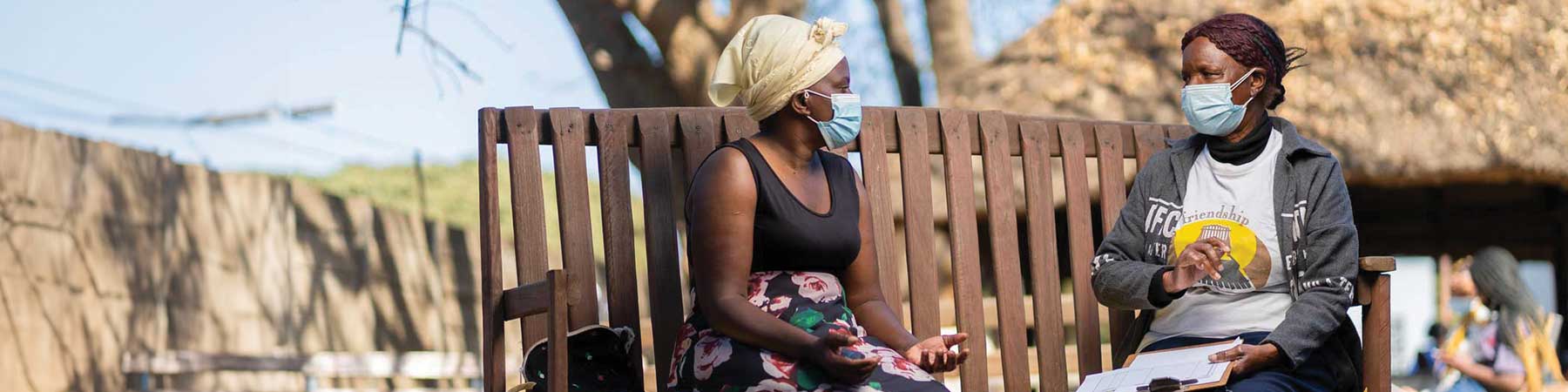
Your research asks the question if a model like the Friendship Bench developed in Zimbabwe can be localized into the Chicago context. You aim to train local people as community health workers. Is that correct?
That is exactly right. I was inspired by the Friendship Bench intervention because they train women in the community as community health workers to support folks with mental health needs. We want to first ask Black women in Chicago of their perspectives on peer support as a novel approach to supporting Black women and improve their mental wellness. There is also a desire to understand if a model that was developed in Zimbabwe can be translated to the local context of Chicago for Black women in predominantly Black communities.
Sandi Tenfelde, PhD
Depression and Health Equity
Health Equity and Social Determinants of Health
Boosting prenatal mental health equity in Chicago
Learn More
L. Mark Knab, MD
Postoperative Outcomes
Disease and Clinical Syndrome Prevention
Survey identifies social risks in cancer recovery
Learn More
Amy Bohnert, PhD
Stress, Racism and Sleep
Lifestyle Factors and Health
Study explores how discrimination impacts teen sleep
Learn MoreCan you share what has been accomplished so far?
In collaboration with Sista Afya Community Care (SACC), in February 2024 we conducted a focus group with 16 Black women to better understand the mental health needs and experiences of Black women in Chicago. In March, we convened about 25 local Black women – all committed to improving Black women’s mental health – to engage in a 3-day training on the Talk. Connect. Support model developed by Dr. Ruth Verhey from Zimbabwe. In April we worked to adapt the model which we now call Heal Together – a peer support model of care for Black women by Black women. We are currently piloting and evaluating the intervention with two peer supporters who provide support both virtually and in-person at other partnering community sites and organizations.
When you think of a long-term vision for this project what do you think that could entail?
What I’m most excited about is working with Black women in the community to see if and how this model of care can work because oftentimes researchers say, “This sounds good, this is evidence-based, so it will work, but it may not in our context.” And so I’m really excited to have a community partner, Sista Afya Community Care, and local Black women and mothers at the table so we can look at it together and say, does this make sense for us? And what parts of it do we need to build or add to really make it make sense for education, income, employment, housing security, food security, and access to nutritious food community engagement, policy changes, and advocacy efforts Opportunity to attain the highest level of Friendship Bench Ambuya Utano (Community Grandmother) having a problem-solving therapy session on the Friendship Bench in Harare, Zimbabwe. by Costa Juta our community and our needs? Once we adapt and evaluate the feasibility of a peer support model and approach to mental health care, I would love to see a trained cohort of Black women with lived experiences providing support and safe spaces for other Black women throughout Chicago.
Marion Malcome, PhD
Dr. Malcome: My research is focused on Black women and Black mothers who are experiencing poverty at the intersection of race, place and mental health. I think about the mental health impact of living and mothering in neighborhoods and communities with high levels of violence and limited opportunities for affordable housing and healthcare. My research suggests that many Black women living in those environments perceive and experience the neighborhood structure as oppressive and manifestations of structural racism. My work is intended to advance understanding of these neighborhood stressors to improve the mental health and wellbeing of Black women and Black mothers.
Your research asks the question if a model like the Friendship Bench developed in Zimbabwe can be localized into the Chicago context. You aim to train local people as community health workers. Is that correct?
That is exactly right. I was inspired by the Friendship Bench intervention because they train women in the community as community health workers to support folks with mental health needs. We want to first ask Black women in Chicago of their perspectives on peer support as a novel approach to supporting Black women and improve their mental wellness. There is also a desire to understand if a model that was developed in Zimbabwe can be translated to the local context of Chicago for Black women in predominantly Black communities.
Can you share what has been accomplished so far?
In collaboration with Sista Afya Community Care (SACC), in February 2024 we conducted a focus group with 16 Black women to better understand the mental health needs and experiences of Black women in Chicago. In March, we convened about 25 local Black women – all committed to improving Black women’s mental health – to engage in a 3-day training on the Talk. Connect. Support model developed by Dr. Ruth Verhey from Zimbabwe. In April we worked to adapt the model which we now call Heal Together – a peer support model of care for Black women by Black women. We are currently piloting and evaluating the intervention with two peer supporters who provide support both virtually and in-person at other partnering community sites and organizations.
When you think of a long-term vision for this project what do you think that could entail?
What I’m most excited about is working with Black women in the community to see if and how this model of care can work because oftentimes researchers say, “This sounds good, this is evidence-based, so it will work, but it may not in our context.” And so I’m really excited to have a community partner, Sista Afya Community Care, and local Black women and mothers at the table so we can look at it together and say, does this make sense for us? And what parts of it do we need to build or add to really make it make sense for education, income, employment, housing security, food security, and access to nutritious food community engagement, policy changes, and advocacy efforts Opportunity to attain the highest level of Friendship Bench Ambuya Utano (Community Grandmother) having a problem-solving therapy session on the Friendship Bench in Harare, Zimbabwe. by Costa Juta our community and our needs? Once we adapt and evaluate the feasibility of a peer support model and approach to mental health care, I would love to see a trained cohort of Black women with lived experiences providing support and safe spaces for other Black women throughout Chicago.