
Respiratory Distress and Heart Health
Disease and Clinical Syndrome Prevention
Respiratory Distress and Heart Health
Mohammad Samie Tootooni, PhD
During the early stages of the COVID-19 pandemic, CHOIR grant funding priorities pivoted to emphasize studies that could provide immediate benefit and actionable insights to improve patient outcomes in both clinical and non-clinical settings.
The work of Dr. Mohammad Samie Tootooni focused on the prediction of acute respiratory distress syndrome (ARDS) and ICU admission amongst COVID-19 patients. He served as a co-PI on a study that used artificial intelligence to assess radiological imaging and computed tomography scans. His research team’s paper, “Image and structured data analysis for prognostication of health outcomes in patients presenting to the ED during the COVID-19 pandemic” was published in the International Journal of Medical Informatics in February 2022.
The second CHOIR funded study that Dr. Tootooni leads is supporting data harmonization and integration of EKG (electrocardiogram) data dating from the early 2000s across various academic medical centers. As computational power and processing capabilities have improved exponentially over the last two decades, there is now the ability to ingest and code large swaths of previously unstructured data into databases that can be linked to the patient electronic health record (EHR).
Talar Markossian, PhD
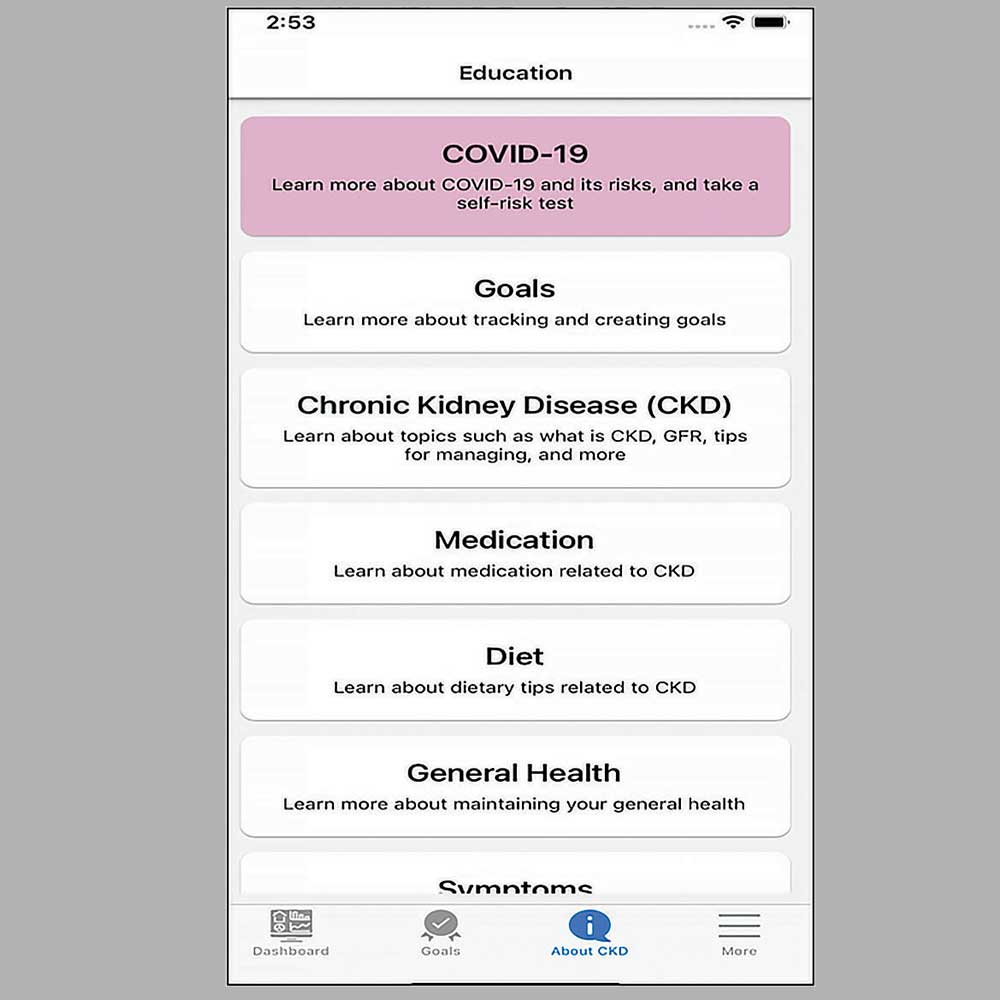
Chronic Kidney Disease Mobile App
Disease and Clinical Syndrome Prevention
App supports CKD self-management and patient communication
Learn More
L. Mark Knab, MD
Postoperative Outcomes
Disease and Clinical Syndrome Prevention
Survey identifies social risks in cancer recovery
Learn More
Patricia “Trish” Sheean, PhD
Body Composition, Nutrition and COVID
Lifestyle Factors and Health
ICU study links COVID outcomes to illness severity
Learn MoreDr. Tootooni: The project was about extracting EKG data that are not stored in the EHR. EKGs carry a lot of information about patient heart or cardiovascular health, but the information can be hard to read by a human. AI (artificial intelligence), on the other hand, can focus on it from different angles. The main idea was to extract what we have, as we found ourselves with uncoded data that was not ready for research.
Now that we know that we have computation power and we have very great models, we need data. The more data we have, the more accurate a model we can develop. We have some EKG data, but some of it was not connected with other patient data. For example, we may have the EKG, but we don’t know if the patient is male or female, or if the patient has comorbidities.
It’s an unknown for us. It’s hard to just look at the cardiovascular EKG without knowing what are the aspects driving the signal we are seeing. Initially the project was about, “let’s dig into our dataset, our data storage and make all of the EKGs in Loyola integrated.” So now we can have a big pool of all EKG data that we can use for further research. We did that. We got the CHOIR grant, and later on we wrote an R01 [a type of NIH-sponsored grant for health-related research]. After some modification we wrote another R01, which received the highest possible score from the NIH. Our research uses 2.5 million EKGs from Loyola, 1- 2 million from Wake Forest, and 1-2 million from the University of Tennessee. By combining all of this data in one location, we have created the largest EKG repository in the country.
We’ve been funded $2.5 million. I’m not the main PI, but I am leading Loyola efforts for the grant. I think that was a direct benefit from the CHOIR grant that we now are able to use.
Mohammad Samie Tootooni, PhD
During the early stages of the COVID-19 pandemic, CHOIR grant funding priorities pivoted to emphasize studies that could provide immediate benefit and actionable insights to improve patient outcomes in both clinical and non-clinical settings.
The work of Dr. Mohammad Samie Tootooni focused on the prediction of acute respiratory distress syndrome (ARDS) and ICU admission amongst COVID-19 patients. He served as a co-PI on a study that used artificial intelligence to assess radiological imaging and computed tomography scans. His research team’s paper, “Image and structured data analysis for prognostication of health outcomes in patients presenting to the ED during the COVID-19 pandemic” was published in the International Journal of Medical Informatics in February 2022.
The second CHOIR funded study that Dr. Tootooni leads is supporting data harmonization and integration of EKG (electrocardiogram) data dating from the early 2000s across various academic medical centers. As computational power and processing capabilities have improved exponentially over the last two decades, there is now the ability to ingest and code large swaths of previously unstructured data into databases that can be linked to the patient electronic health record (EHR).
Dr. Tootooni: The project was about extracting EKG data that are not stored in the EHR. EKGs carry a lot of information about patient heart or cardiovascular health, but the information can be hard to read by a human. AI (artificial intelligence), on the other hand, can focus on it from different angles. The main idea was to extract what we have, as we found ourselves with uncoded data that was not ready for research.
Now that we know that we have computation power and we have very great models, we need data. The more data we have, the more accurate a model we can develop. We have some EKG data, but some of it was not connected with other patient data. For example, we may have the EKG, but we don’t know if the patient is male or female, or if the patient has comorbidities.
It’s an unknown for us. It’s hard to just look at the cardiovascular EKG without knowing what are the aspects driving the signal we are seeing. Initially the project was about, “let’s dig into our dataset, our data storage and make all of the EKGs in Loyola integrated.” So now we can have a big pool of all EKG data that we can use for further research. We did that. We got the CHOIR grant, and later on we wrote an R01 [a type of NIH-sponsored grant for health-related research]. After some modification we wrote another R01, which received the highest possible score from the NIH. Our research uses 2.5 million EKGs from Loyola, 1- 2 million from Wake Forest, and 1-2 million from the University of Tennessee. By combining all of this data in one location, we have created the largest EKG repository in the country.
We’ve been funded $2.5 million. I’m not the main PI, but I am leading Loyola efforts for the grant. I think that was a direct benefit from the CHOIR grant that we now are able to use.