
The Paradox of Progress
Why AI Makes Human Connections More, Not Less, Valuable
By Matthew Kelly, CFA
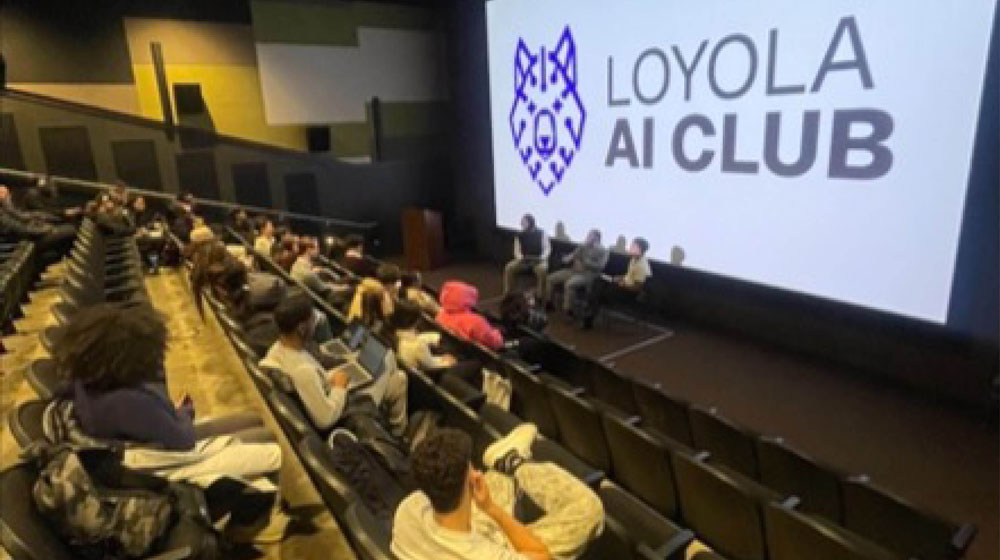
The intersection of artificial intelligence and human potential took center stage at a recent joint event hosted by Loyola University Chicago's AI Club and Black Cultural Center. As a featured speaker engaging with students and faculty in a dynamic fireside chat, I witnessed firsthand the curiosity, ambition, and thoughtful concerns about our AI-augmented future.
The Great Inversion: When Algorithms Commoditize Knowledge, Humanity Becomes Priceless
The professional landscape is undergoing a seismic shift. With AI adoption outpacing both the internet and personal computer revolutions of previous decades, students across disciplines are rightfully questioning what skills will remain relevant and how to position themselves for success. What emerged from our discussion was not fear of replacement, but excitement about transformation—provided students understand the new rules of engagement.
Beyond Adaptation: Four Powers That Thrive in AI's Shadow
As AI becomes increasingly integrated into the workplace, these four principles stood out as critical for professional success:
- Human Networks: The Invisible Infrastructure AI Cannot Map
In an era where AI Applicant Tracking Systems (ATS) screen resumes before human eyes ever see them, your network becomes your most powerful tool for bypassing algorithmic gatekeepers. Today's colleagues become tomorrow's internal referrals, providing direct paths to hiring managers that circumvent automated filters. The connections formed in professional communities—particularly in interdisciplinary environments like those fostered by Loyola's AI Club—create pathways through organizations that algorithms can't block. As AI increasingly determines who gets interviews, your human network provides the competitive advantage of personal advocacy that no resume optimization can match. - Curiosity: Where Algorithms End and Breakthroughs Begin
In a world where traditional credentials are increasingly scanned and sorted by algorithms, genuine intellectual curiosity becomes a powerful differentiator that AI cannot yet properly evaluate. This isn't just about asking questions, it's about developing a reputation for identifying unexpected connections across disciplines and spotting opportunities others may miss.
What makes curiosity so powerful in the age of AI is that it operates through an entirely different epistemological framework than machine learning. While AI excels at identifying patterns in existing data, human curiosity thrives in ambiguity and contradiction—precisely the spaces where breakthroughs occur. The curious mind doesn't just process what is known; it imagines what could be, operating in the hypothesis space rather than the data space. This means that as AI systems get better at optimizing within known parameters, human curiosity becomes increasingly valuable for defining entirely new parameters and possibilities.
The professionals who cultivate this capacity do not just ask better questions, they inhabit a different relationship with knowledge itself; one characterized by comfort with uncertainty and a willingness to explore the liminal spaces between established domains. These qualities, when expressed through professional communities, create a form of intellectual capital that exists entirely outside the evaluative frameworks of current AI systems. - The New Expertise: Orchestrating AI Rather Than Competing with It
AI has democratized access to powerful capabilities, but the real competitive advantage comes from how these tools are orchestrated and directed through human judgment. Individual AI tools are increasingly commoditized, available to anyone with an internet connection, but the strategic application of these tools guided by domain expertise and creative vision remains uniquely human.This represents a profound inversion of traditional expertise. For centuries, professional value has been derived primarily from specialized knowledge accumulated over years of study and practice. Today, as AI systems can instantly access and process vast repositories of specialized information, the premium shifts from knowledge possession to knowledge curation and application. The most valuable human contribution becomes deciding which questions to ask of our tools, which answers to trust, and how to integrate these answers into meaningful action.
This shift requires a new relationship with technology neither subservience to algorithmic recommendations nor rejection of computational assistance, but a dynamic partnership where human creativity, ethical judgment, and contextual understanding guide increasingly powerful tools. The professionals who thrive in this environment develop what might be called AI fluency. Not just technical proficiency with specific systems, but a deeper understanding of how to collaborate with algorithmic intelligence while maintaining human agency over outcomes and direction.
- The Rarest Resource: Authentic Connections in a Digital Desert
In an increasingly algorithmic marketplace, the ability to form genuine human connections becomes a distinct competitive advantage. While points 1-3 focus on how to leverage networks, curiosity, and AI tools, this principle addresses a more fundamental truth: authentic human connection itself is becoming the scarcest and most valuable professional resource.This scarcity stems from a paradoxical effect of technological advancement: as our tools for digital connection proliferate, our capacity for deep human engagement often diminishes. We find ourselves in a professional landscape abundant with communication channels but increasingly devoid of genuine understanding, empathy, and trust. In this environment, the ability to create psychological safety, to be fully present with another human being, to listen beyond transactional exchange become rare and therefore immensely valuable professional assets.
What makes this particularly powerful is that authentic connections operate through entirely different mechanisms than algorithmic efficiency. While AI optimizes for measurable outputs, human connection thrives in immeasurable dimensions of meaning, belonging, and purpose. This creates spaces where human agency remains paramount. Where we relate to each other, not as optimizable resources, but as beings capable of mutual recognition and co-creation. The professionals who cultivate this capacity don't just perform better in existing structures, they create entirely new structures organized around human values that algorithms cannot yet comprehend.
The Third Path: Neither Racing Against Machines Nor SurrenderingTo Them
These insights fundamentally reframe our relationship with artificial intelligence. Rather than viewing AI as either a tool to master or a threat to avoid, we might understand it as a catalyst for a deeper reassessment of human value. What emerges is not simply a set of tactical responses to technological change, but a profound reorientation toward what makes us distinctly human.
This reorientation requires moving beyond the false dichotomy of competition versus surrender; neither racing against machines nor passively accepting displacement. Instead, it invites us to occupy a third space where we cultivate those capabilities that exist outside the algorithmic domain: our capacity for meaningful connection, contextual judgment, ethical discernment, and imaginative exploration.
The vibrant discussion at the AI Club's event demonstrated that emerging professionals already intuitively understand this shift. Their questions revealed a sophisticated understanding that technological advancement does not obviate the human contribution, but rather transforms it, redirecting our energy from tasks that machines can optimize toward the creation of meaning that only humans can generate.
Rediscovering Humanity Through Technology's Mirror
The collaboration between the AI Club and Black Cultural Center exemplifies this evolving understanding of human-AI relations. By bringing together diverse perspectives and disciplines, the event created a space where technological possibility could be considered alongside human flourishing—neither subordinating one to the other but exploring their potential for mutual enhancement.
As we concluded the evening with networking and continued conversations, what emerged was not simply a tactical response to AI disruption, but a more radical possibility: that the rise of artificial intelligence might deepen our appreciation for human intelligence in all its forms. The capacity for empathy that leads us to consider impacts beyond metrics, the contextual judgment that recognizes when rules should be broken, the moral imagination that helps us envision more equitable futures. These are distinctly human capabilities that do not become obsolete, but rather essential, in an AI-augmented world.
The question before us is not simply how to adapt to technological change, but how to direct that change toward authentically human ends. This requires neither uncritical enthusiasm nor reflexive resistance to AI advancement, but a more nuanced engagement that preserves human agency while leveraging algorithmic capabilities. Based on the quality of dialogue at this event, a new generation of professionals is emerging with precisely this balanced perspective. One that not merely survives technological disruption but actively shapes it toward more humane and meaningful outcomes.

About the author
Matthew leads Alpha Corps, an advisory firm partnering with AI startups to drive enterprise adoption—guiding startups through complex sales, compliance, and regulatory challenges. His expertise spans AI strategy, operational transformation, and technology integration, with particular focus on building value propositions that resonate with C-suite decision makers in global enterprises. He is a coach for MIT xPRO AI for Senior Leaders and he serves on Loyola University Chicago’s AiBC Advisory Board, advising on AI in financial services.
Why AI Makes Human Connections More, Not Less, Valuable
By Matthew Kelly, CFA
The intersection of artificial intelligence and human potential took center stage at a recent joint event hosted by Loyola University Chicago's AI Club and Black Cultural Center. As a featured speaker engaging with students and faculty in a dynamic fireside chat, I witnessed firsthand the curiosity, ambition, and thoughtful concerns about our AI-augmented future.
The Great Inversion: When Algorithms Commoditize Knowledge, Humanity Becomes Priceless
The professional landscape is undergoing a seismic shift. With AI adoption outpacing both the internet and personal computer revolutions of previous decades, students across disciplines are rightfully questioning what skills will remain relevant and how to position themselves for success. What emerged from our discussion was not fear of replacement, but excitement about transformation—provided students understand the new rules of engagement.
Beyond Adaptation: Four Powers That Thrive in AI's Shadow
As AI becomes increasingly integrated into the workplace, these four principles stood out as critical for professional success:
- Human Networks: The Invisible Infrastructure AI Cannot Map
In an era where AI Applicant Tracking Systems (ATS) screen resumes before human eyes ever see them, your network becomes your most powerful tool for bypassing algorithmic gatekeepers. Today's colleagues become tomorrow's internal referrals, providing direct paths to hiring managers that circumvent automated filters. The connections formed in professional communities—particularly in interdisciplinary environments like those fostered by Loyola's AI Club—create pathways through organizations that algorithms can't block. As AI increasingly determines who gets interviews, your human network provides the competitive advantage of personal advocacy that no resume optimization can match. - Curiosity: Where Algorithms End and Breakthroughs Begin
In a world where traditional credentials are increasingly scanned and sorted by algorithms, genuine intellectual curiosity becomes a powerful differentiator that AI cannot yet properly evaluate. This isn't just about asking questions, it's about developing a reputation for identifying unexpected connections across disciplines and spotting opportunities others may miss.
What makes curiosity so powerful in the age of AI is that it operates through an entirely different epistemological framework than machine learning. While AI excels at identifying patterns in existing data, human curiosity thrives in ambiguity and contradiction—precisely the spaces where breakthroughs occur. The curious mind doesn't just process what is known; it imagines what could be, operating in the hypothesis space rather than the data space. This means that as AI systems get better at optimizing within known parameters, human curiosity becomes increasingly valuable for defining entirely new parameters and possibilities.
The professionals who cultivate this capacity do not just ask better questions, they inhabit a different relationship with knowledge itself; one characterized by comfort with uncertainty and a willingness to explore the liminal spaces between established domains. These qualities, when expressed through professional communities, create a form of intellectual capital that exists entirely outside the evaluative frameworks of current AI systems. - The New Expertise: Orchestrating AI Rather Than Competing with It
AI has democratized access to powerful capabilities, but the real competitive advantage comes from how these tools are orchestrated and directed through human judgment. Individual AI tools are increasingly commoditized, available to anyone with an internet connection, but the strategic application of these tools guided by domain expertise and creative vision remains uniquely human.This represents a profound inversion of traditional expertise. For centuries, professional value has been derived primarily from specialized knowledge accumulated over years of study and practice. Today, as AI systems can instantly access and process vast repositories of specialized information, the premium shifts from knowledge possession to knowledge curation and application. The most valuable human contribution becomes deciding which questions to ask of our tools, which answers to trust, and how to integrate these answers into meaningful action.
This shift requires a new relationship with technology neither subservience to algorithmic recommendations nor rejection of computational assistance, but a dynamic partnership where human creativity, ethical judgment, and contextual understanding guide increasingly powerful tools. The professionals who thrive in this environment develop what might be called AI fluency. Not just technical proficiency with specific systems, but a deeper understanding of how to collaborate with algorithmic intelligence while maintaining human agency over outcomes and direction.
- The Rarest Resource: Authentic Connections in a Digital Desert
In an increasingly algorithmic marketplace, the ability to form genuine human connections becomes a distinct competitive advantage. While points 1-3 focus on how to leverage networks, curiosity, and AI tools, this principle addresses a more fundamental truth: authentic human connection itself is becoming the scarcest and most valuable professional resource.This scarcity stems from a paradoxical effect of technological advancement: as our tools for digital connection proliferate, our capacity for deep human engagement often diminishes. We find ourselves in a professional landscape abundant with communication channels but increasingly devoid of genuine understanding, empathy, and trust. In this environment, the ability to create psychological safety, to be fully present with another human being, to listen beyond transactional exchange become rare and therefore immensely valuable professional assets.
What makes this particularly powerful is that authentic connections operate through entirely different mechanisms than algorithmic efficiency. While AI optimizes for measurable outputs, human connection thrives in immeasurable dimensions of meaning, belonging, and purpose. This creates spaces where human agency remains paramount. Where we relate to each other, not as optimizable resources, but as beings capable of mutual recognition and co-creation. The professionals who cultivate this capacity don't just perform better in existing structures, they create entirely new structures organized around human values that algorithms cannot yet comprehend.
The Third Path: Neither Racing Against Machines Nor SurrenderingTo Them
These insights fundamentally reframe our relationship with artificial intelligence. Rather than viewing AI as either a tool to master or a threat to avoid, we might understand it as a catalyst for a deeper reassessment of human value. What emerges is not simply a set of tactical responses to technological change, but a profound reorientation toward what makes us distinctly human.
This reorientation requires moving beyond the false dichotomy of competition versus surrender; neither racing against machines nor passively accepting displacement. Instead, it invites us to occupy a third space where we cultivate those capabilities that exist outside the algorithmic domain: our capacity for meaningful connection, contextual judgment, ethical discernment, and imaginative exploration.
The vibrant discussion at the AI Club's event demonstrated that emerging professionals already intuitively understand this shift. Their questions revealed a sophisticated understanding that technological advancement does not obviate the human contribution, but rather transforms it, redirecting our energy from tasks that machines can optimize toward the creation of meaning that only humans can generate.
Rediscovering Humanity Through Technology's Mirror
The collaboration between the AI Club and Black Cultural Center exemplifies this evolving understanding of human-AI relations. By bringing together diverse perspectives and disciplines, the event created a space where technological possibility could be considered alongside human flourishing—neither subordinating one to the other but exploring their potential for mutual enhancement.
As we concluded the evening with networking and continued conversations, what emerged was not simply a tactical response to AI disruption, but a more radical possibility: that the rise of artificial intelligence might deepen our appreciation for human intelligence in all its forms. The capacity for empathy that leads us to consider impacts beyond metrics, the contextual judgment that recognizes when rules should be broken, the moral imagination that helps us envision more equitable futures. These are distinctly human capabilities that do not become obsolete, but rather essential, in an AI-augmented world.
The question before us is not simply how to adapt to technological change, but how to direct that change toward authentically human ends. This requires neither uncritical enthusiasm nor reflexive resistance to AI advancement, but a more nuanced engagement that preserves human agency while leveraging algorithmic capabilities. Based on the quality of dialogue at this event, a new generation of professionals is emerging with precisely this balanced perspective. One that not merely survives technological disruption but actively shapes it toward more humane and meaningful outcomes.