
A universal story of work and dignity
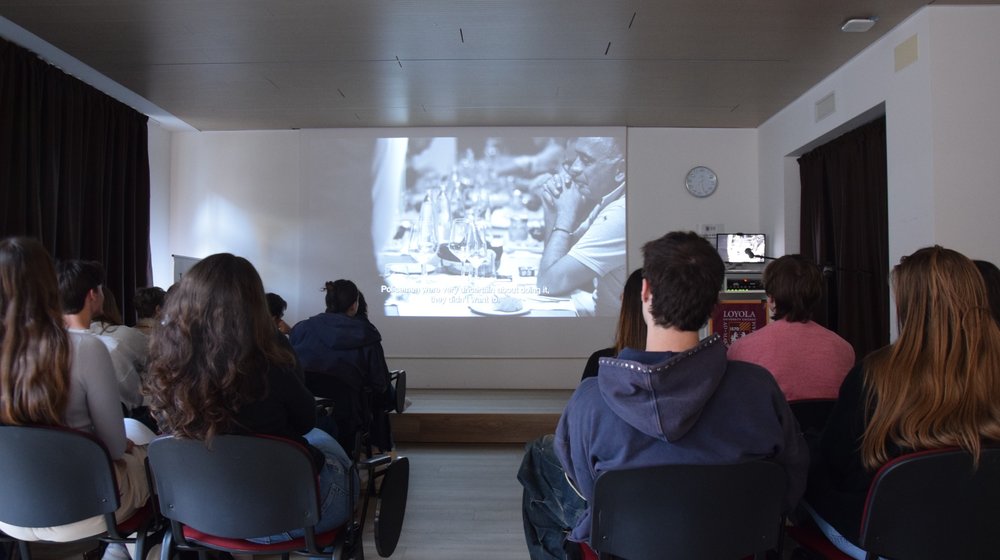
Students watching the movie "Benvenuti In Galera"
On Tuesday evening, 9 April, Italian film maker Michele Rho presented his film "Benvenuti in Galera" to the Rome Center community. Associate Dean for Academic Affairs, Dr Elisa Ascione introduced Rho and the audience settled in to watch his film which tells the story of several inmates who work at the restaurant "In Galera" (translated as "in prison"), the world's first restaurant inside a prison.
A number of faculty and staff were present at the screening, but the audience was mainly comprised of Dr Ascione's students enrolled in Italian Cultural History: Food and Wine and Dr Moreno Rocchi's students in Ethics.
Ascione's class uses food and wine as a gateway to understanding Italian culture and society, exploring themes such as inclusion/exclusion through agricultural and food projects that employ migrant laborers, people with disabilities, and other vulnerable groups. While Rocchi’s class aims to lead students to an autonomous judgment on issues related to human societies and ethical decision making with special reference to justice, happiness, and human rights. The documentary was part of a module in which the class discussed both the moral and the epistemic status of long prison sentences, in particular those that are closed to revision.
Instead of focusing on the past of the inmates, who are all incarcerated in Milan's Bollate Prison, the documentary looks at restaurant operation and its success both on an international level, as well as the re-integration project which gives inmates work experience during their incarceration which then supports their futures for when they are released.
The documentary touches on themes of incarceration, the condition of prisoners and their right to work and dignity. According to Rho, the film attempts "to break down these fears and mistrust through the stories of those trying to reclaim their lives through work". It engages with the prison reality while focusing on the human experience of the inmates and the challenges they face both inside of prison and then outside following their release.
The film also follows Silvia Polleri, who started a catering company in Bollate which eventually opened the restaurant In Galera. Polleri has employed more than 80 inmates and calls the restaurant a "productive and competitive enterprise".
A true place of work for the inmates, at the restaurant the men earn real wages and pay their tax contributions. The project is also "an innovative way for the external community to engage with the prison reality" since it builds a bridge between the prison and the outside world, hence the title "Welcome to Prison", as the restaurant welcomes both inmates and the public. It is clear the film is depicting how the restaurant is working to combat the rate of recidivism which - according to the film - in Italy is 70%, that is, 7/10 people who are released from prison end up incarcerated again.
After the film screening, students had the chance to ask the Milanese documentarian about his experience filming and his artistic choices. Rho spoke about his desire to tell this "universal story" because - in spite of the fact that different countries have different kinds of correctional systems - all countries have issues of re-integrating inmates back into society, he says.
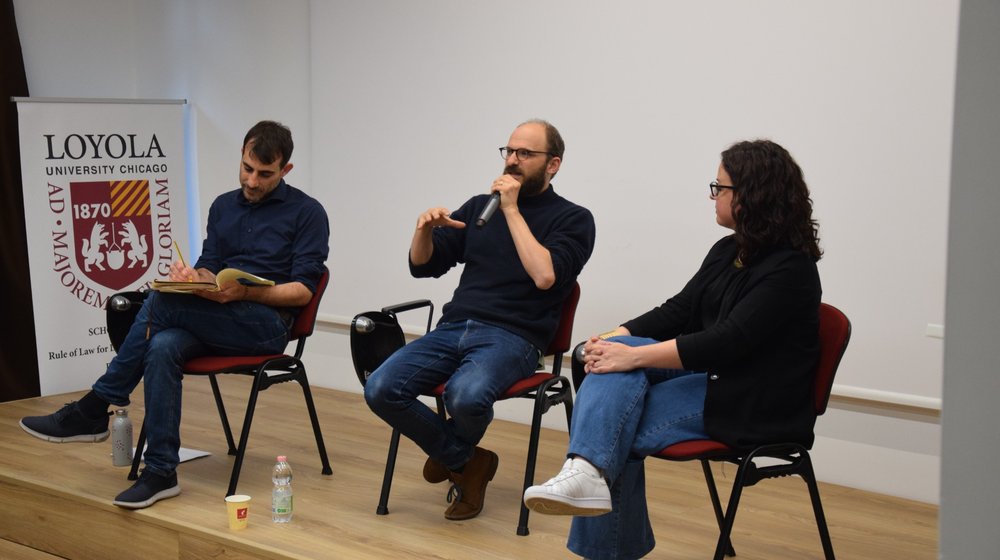
Rho also discussed how often in movies, prisons and prisoners are typically presented in ways which are uncomfortable, crude and frightening. Instead, the film maker had a deep desire to present elegant black and white images which illustrated the complexity of their reality and the many layers of problems around these themes. Rho noted his satisfaction that audiences even tend to laugh at the light-hearted moments between Polleri and the head chef, Davide, further demonstrating the humanity of the inmates.