
Encouraging critical thinking and debate
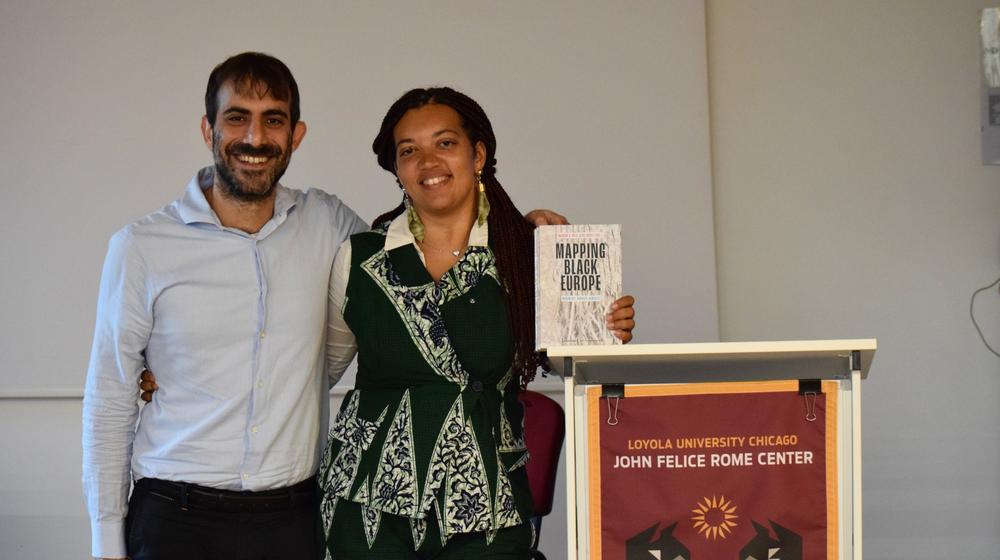
“Black communities have been making major contributions to Europe's social and cultural life and landscapes for centuries. However, their achievements largely remain unrecognized by the dominant societies, as their perspectives are excluded from traditional modes of marking public memory.” – Mapping Black Europe: Monuments, Markers, Memories
Kwanza Musi Dos Santos – author, social justice activist and diversity management consultant– discussed the book entitled: “Mapping Black Rome: Monuments, Markers, Memories” with the Rome Center community on Wednesday, September 24th.
One of eight contributors in the book, Musi Dos Santos wrote the chapter entitled “Black Rome” which examines existing monuments, memorials and urban markets in the city. In this way, the author was able to provide a more complex, detailed and complicated vision of Rome where our students have been residents for more a mere month.
The idea for the book, published in 2023 and edited by Natasha Kelly and Olive Vassell, was born in 2019 when Dr Kelly, an Afro-German professor and author, started gathering authors from African backgrounds who were raised in Europe or Afropeans. These black scholars and activists were called to write a collective book drawing on their research, activism and personal experience.
According to Musi Dos Santos, up until now Black Studies has largely originated in the United States. “Most of the literature that we have on the analysis of black lives in Europe come from American scholars”, she says. “This makes sense,” she continues, “because in the U.S., there are many universities that have Black Studies as a subject, as a major or minor, but here in Europe, it's very rare to find”.
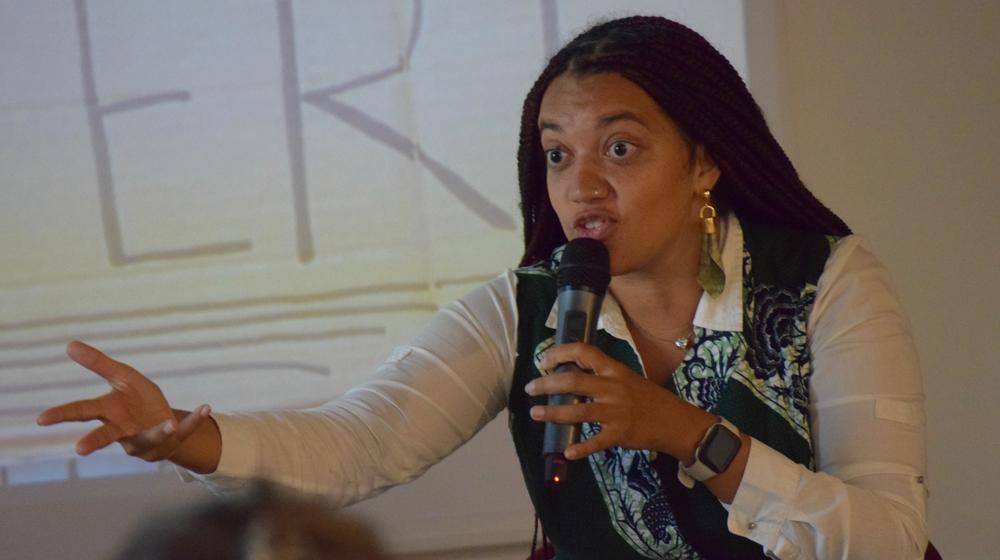
Before detailing these monuments and markers in Rome, Musi Dos Santos – who also offers colonial walking tours around Rome – gave the community a brief history of Italian colonialism. After discussing both pre- and post-fascism, the author and activist turned to two obelisks of Rome: the Obelisk of Axum and the Monument to the Fall on Dogali.
The Obelisk of Axum – taken from Ethiopia in 1937 at the end of Italian occupation and transported to Rome as a spoil of war – stood near the Circus Maximus in Rome until 1947 when, after 40 years of diplomatic negotiations, it was repatriated. Standing in its place today is a small memorial to the victims of 9/11, without any signage which describes the history of what once stood there and how it was sent back to its original home. The irony, according to Musi Dos Santos, is that the plaque is inscribed with the following statement: "Those who do not remember the past are condemned to repeat in the future".
The next memorial discussed was the recently-restored Monument to the Fall on Dogali, in present day Eritrea. It commemorates the fallen Italian soldiers in a battle which Italy actually lost. Instead, Musi Dos Santos says, the monument highlights “the fears and the violence and the aggressiveness of the Ethiopians”. The narrative was, she continues, that Italy didn't lose because they were not good enough at fighting, they lost because the Ethiopians were too fierce, too aggressive and too violent. And that's why, she says, Italy felt they had “to keep on colonizing them to teach them how to be more civilized, more calm, more assertive”.
In spite of the complicated history of these monuments, Musi Dos Santos had some good news: just two days before, her network of organizations around Italy received notice that the city will be dedicating the surrounding garden to Zerai Deres, a patriot from Ethiopia (present-day Eritrea) who worked as a translator for the Fascist regime. Upon arriving in Rome, Deres was surprised to see this obelisk from Africa, “celebrating the death of his brothers and sisters from Ethiopia as if the Italians had won the battle”. Deres began protesting and was arrested and sent to a psychiatric hospital where he eventually died. And so, Musi Dos Santos uses this as an example of how to re-think monuments with controversial legacies.
The author and activist spoke at length about reshaping urbans spaces because, she says, “we forget that the urban space doesn't belong to the institutions. It belongs to all of us. To citizens, to tourists, to kids.” “And so we have to build collectively a city that is friendly to each one of these subjectivities.”
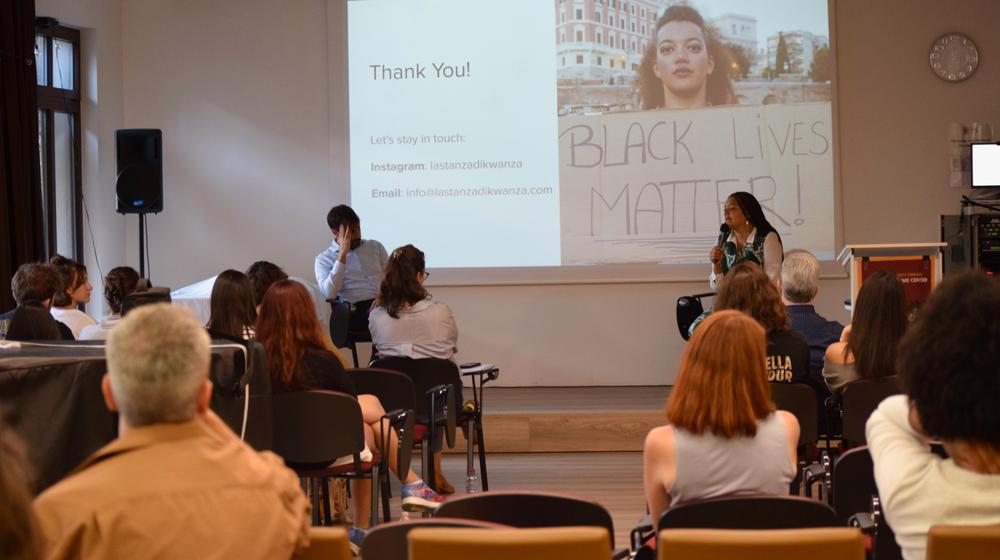
“When we look at monuments like the Dogali Monument, that is a very big part of our history. It's been there for many years and it represents part of our history. So, I don't think it should be erased. I don't think it shouldn't be taken away. I think it ought to be re-signified. I think that it needs to be somehow contextualized in the artistic way. I think art is the best element, expression that we can use in order to not sabotage, but somehow give it a different meaning”. We cannot “just take everything away and say, oh, nothing happened. It was never here”. We don’t need that denial or amnesia, Dos Santos explains “we have already too much of that.” But she continues, “we need to put the community in conversation with these monuments and with these markers”. On the other hand, there are instances in which certain monuments should go into museums, into “a space that is close, contextualized, protected somehow”. “It doesn't deserve to be celebrated in the street, in a public space where we all belong to. Where we all have the right to go and to pass.”
Among the student questions which arose after Musi Dos Santos’ lecture, one student asked about the echoes in Europe of the Black Lives Matter in America. The author quickly emphasized – as she does in the book – that “Black Italian resistance existed before 2020”. In fact, Dos Santos says that the activism in Italy started in the early 2000s, however, the media attention in Italy mobilized in 2020 with the BLM movement in the U.S.
In conclusion, Dr Moreno Rocchi, adjunct professor of philosophy, asked the activist’s advice on how to become more active and vigilant citizens. Musi Dos Santos credits her parents who trained her as grassroots activist. “My advice,” she says, “especially in this world, is to try to go beyond polarization”. “The world is very complex and it's very incoherent. And that's okay…. it's okay to disagree, it's okay to make mistakes, it's okay, to not know things”.
Musi Dos Santos then encouraged students to listen to different points of view and consult different sources. “Learn a language,” she said, “so you will be able to go and look for that same news in a different language, from a different perspective. And from a different narrative.” It is up to all of us “to encourage criticism, to encourage critical thinking, to encourage debate”.