
Tomorrow Begins Here
Loyola Students Help Amplify Kiribati Voices on Climate Change
The effects of climate change aren’t often tied to a face or a name. But one group of Loyola students set out to change that. The award-winning Tomorrow Begins Here documentary, a collaboration between students in the School of Communication and youth from the Pacific Island nation of Kiribati (kee-rah-bas), has been acquired for international distribution by the Australian Broadcasting Corporation.
We are able to think beyond what we thought we couldn't do, which is to let the world outside our own world hear and visualise our stories that make us who we are as Kiribati people Tiein Taebo, Co-Director of "Tomorrow Begins Here"
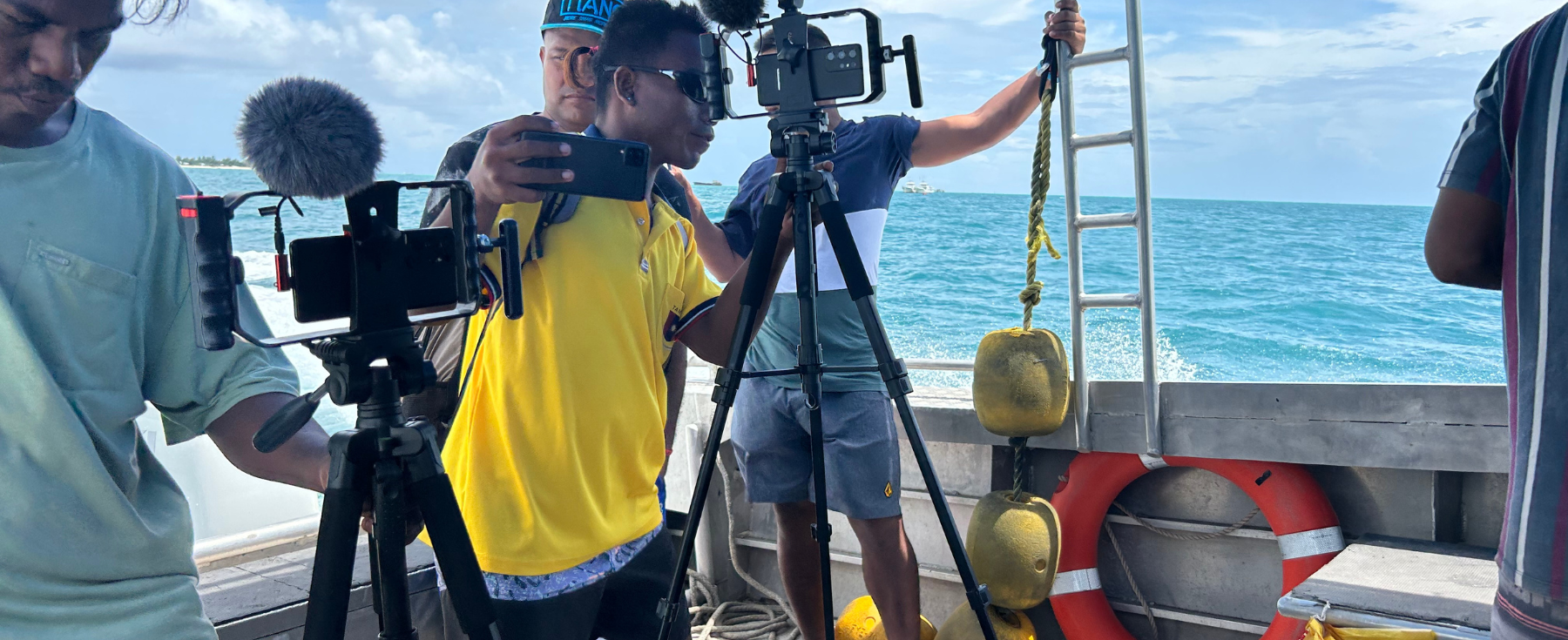
The documentary was the brainchild of Senior Professional in Residence John Goheen, who sought to tell the story of how Kiribati is being impacted by climate change through the eyes of its young adult residents. In the summer of 2024, Loyola students Michael Rogowski, junior Taylor Zielenbach, and graduate students Robert Kennedy and Sanjay Nambiar traveled with Goheen to several of Kiribati’s 33 atolls over the course of nearly a month. Their goal was to teach a dozen young adults about video production and storytelling using their smartphones.
Rogowski, a senior double major in criminal justice and film and digital media, said that it was important to structure the lessons using technology that was already accessible in Kiribati.
“They already had the stories they wanted to tell and kind-of the means to tell them, but I think what we did with them was unlock that last piece that made it come together as a whole,” said Rogowski.
One of those stories was from a student in his group, Mataele Lagafaoa. Rogowski recalled a touching moment between the two, when Lagafaoa opened up about his family practice of net fishing. The two ventured out a few hundred feet from the coast, where Lagafaoa demonstrated how to cast a net while revealing that this generational skill had become more dangerous and expensive due to pollution and rising sea levels sending fishermen further into the ocean. The interaction between the two led to a feature story on The Kiribati Project website, which includes details about the film and other short-form videos.
“They are trying to keep up with a rapidly changing world, while trying to preserve the cultural traditions that have been around for generations,” said Rogowski.
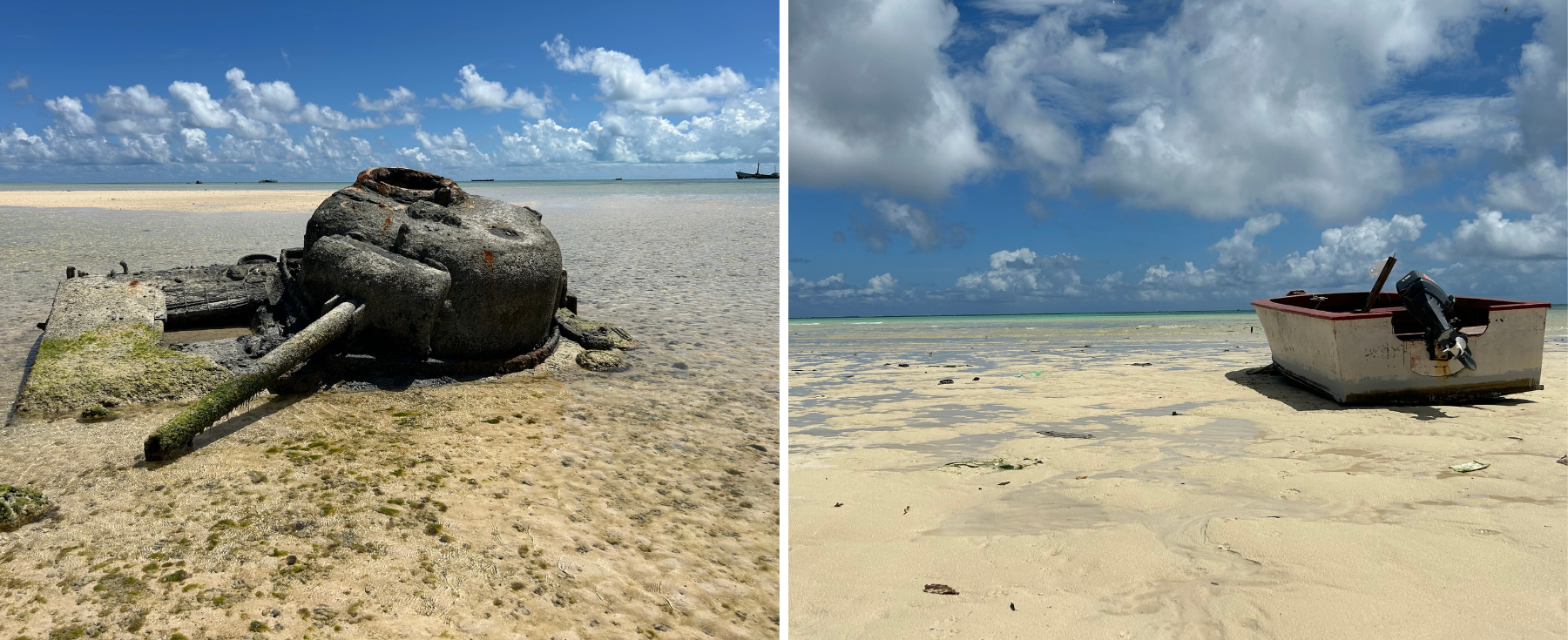
One the left, a rusted engine rests on an exposed shoreline in Kiribati, where shifting tides and environmental changes continue to reshape the landscape. On the right, a small fishing boat sits stranded on a shallow, receding shoreline, reflecting how rising seas and changing conditions are affecting traditional livelihoods.
Despite her initial fears of exploitation, Tiein Taebo, who served as co-director of the documentary and assisted with recruiting Kiribati youth, called it “special.” Recalling that there was a constant feedback loop with Goheen to ensure the stories were authentic. She said participating in the documentary shifted her perspective.
“We are able to think beyond what we thought we couldn't do, which is to let the world outside our own world hear and visualise our stories that make us who we are as Kiribati people,” said Taebo via e-mail interview.
For each of the Loyola students, the trip provided clarity. Rogowski cites it as the catalyst for the kind of law he’ll pursue in law school, aiming to help those who are “marginalized and forgotten.”
While junior Zielenbach credits the experience with providing insight on her major, switching from journalism to accounting, it also taught her to be more empathetic.
“I think it taught me a lot of empathy and selflessness and awareness about what’s going on in different parts of the world,” said Zielenbach.
And for Kennedy, a graduate of the international relations program, the work across the two cities reconfirmed his commitment to telling stories of marginalized communities. He also believes the documentary represents a potential shift in the future media landscape.
“My hope is that in the future we will live in a world where the people at the frontline of these issues are the ones that are driving the narrative,” he said.
The film will air on Australian Broadcasting Corporation International across the Asia-Pacific and Middle East, on Māori TV in New Zealand, and nationally in the United States through PBS. The first PBS airing will be during Earth Month on April 19 at 10 a.m. MST in the Denver, Colo. market.
The effects of climate change aren’t often tied to a face or a name. But one group of Loyola students set out to change that. The award-winning Tomorrow Begins Here documentary, a collaboration between students in the School of Communication and youth from the Pacific Island nation of Kiribati (kee-rah-bas), has been acquired for international distribution by the Australian Broadcasting Corporation.
The documentary was the brainchild of Senior Professional in Residence John Goheen, who sought to tell the story of how Kiribati is being impacted by climate change through the eyes of its young adult residents. In the summer of 2024, Loyola students Michael Rogowski, junior Taylor Zielenbach, and graduate students Robert Kennedy and Sanjay Nambiar traveled with Goheen to several of Kiribati’s 33 atolls over the course of nearly a month. Their goal was to teach a dozen young adults about video production and storytelling using their smartphones.
Rogowski, a senior double major in criminal justice and film and digital media, said that it was important to structure the lessons using technology that was already accessible in Kiribati.
“They already had the stories they wanted to tell and kind-of the means to tell them, but I think what we did with them was unlock that last piece that made it come together as a whole,” said Rogowski.
One of those stories was from a student in his group, Mataele Lagafaoa. Rogowski recalled a touching moment between the two, when Lagafaoa opened up about his family practice of net fishing. The two ventured out a few hundred feet from the coast, where Lagafaoa demonstrated how to cast a net while revealing that this generational skill had become more dangerous and expensive due to pollution and rising sea levels sending fishermen further into the ocean. The interaction between the two led to a feature story on The Kiribati Project website, which includes details about the film and other short-form videos.
“They are trying to keep up with a rapidly changing world, while trying to preserve the cultural traditions that have been around for generations,” said Rogowski.
Despite her initial fears of exploitation, Tiein Taebo, who served as co-director of the documentary and assisted with recruiting Kiribati youth, called it “special.” Recalling that there was a constant feedback loop with Goheen to ensure the stories were authentic. She said participating in the documentary shifted her perspective.
“We are able to think beyond what we thought we couldn't do, which is to let the world outside our own world hear and visualise our stories that make us who we are as Kiribati people,” said Taebo via e-mail interview.
For each of the Loyola students, the trip provided clarity. Rogowski cites it as the catalyst for the kind of law he’ll pursue in law school, aiming to help those who are “marginalized and forgotten.”
While junior Zielenbach credits the experience with providing insight on her major, switching from journalism to accounting, it also taught her to be more empathetic.
“I think it taught me a lot of empathy and selflessness and awareness about what’s going on in different parts of the world,” said Zielenbach.
And for Kennedy, a graduate of the international relations program, the work across the two cities reconfirmed his commitment to telling stories of marginalized communities. He also believes the documentary represents a potential shift in the future media landscape.
“My hope is that in the future we will live in a world where the people at the frontline of these issues are the ones that are driving the narrative,” he said.
The film will air on Australian Broadcasting Corporation International across the Asia-Pacific and Middle East, on Māori TV in New Zealand, and nationally in the United States through PBS. The first PBS airing will be during Earth Month on April 19 at 10 a.m. MST in the Denver, Colo. market.