
2026 Denkewalter Lecture
2026 Denkewalter Lecture
The Department of Chemistry & Biochemistry will host Professor Song Lin (Cornell University) on April 9, 2026
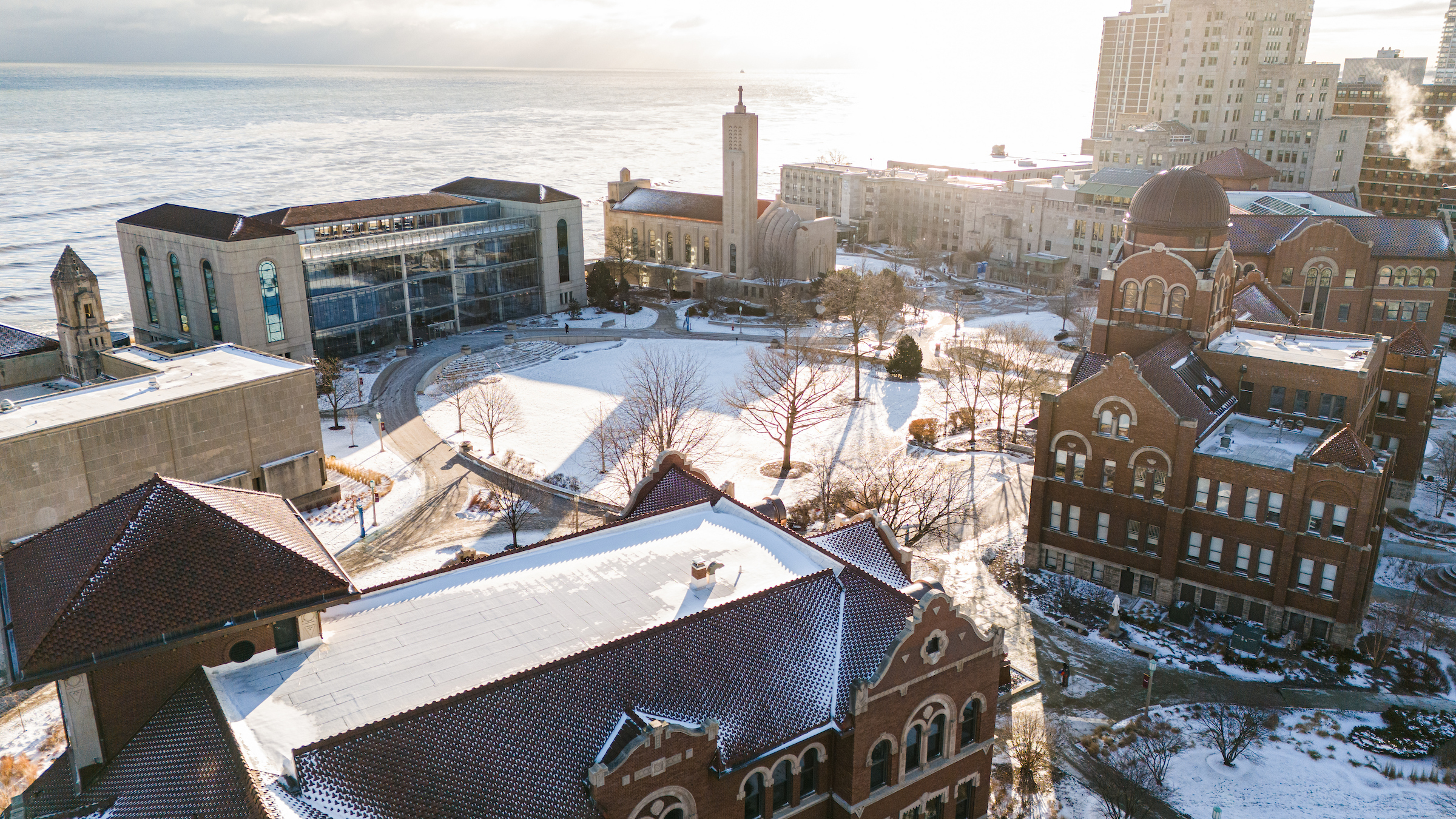
The Department of Chemistry & Biochemistry in Loyola University Chicago’s College of Arts and Sciences will host Professor Song Lin (Cornell University) as the 2026 Denkewalter Lecturer on April 9, 2026, in the Quinlan Life Sciences Building (Room 142) at 6 p.m. CT.
Lin's Lecture: New Methods and Technologies for Organic Electrosynthesis
Abstract: Owing to its many distinct characteristics, electrochemistry represents an attractive approach to discovering new organic reactions and improving the efficiency, selectivity, and sustainability of organic synthesis. In the past several years, we have developed a new approach that combines electrochemistry and redox-metal catalysis for the functionalization of alkenes to access a diverse array of vicinally functionalized structures. Moving beyond alkene difunctionalization, we recently expanded the scope of electrosynthesis to two-component and three-component cross electrophile coupling reactions for the formation of C–C, C–Si, and C–B bonds. In addition, using either electrooxidation or electroreduction, we achieved the site-selective functionalization of aliphatic and aromatic C–H bonds, respectively. This talk details our design principle underpinning the development of these new electrochemical transformations with a focus on applications in the synthesis of medicinally relevant compounds. In addition, this talk will discuss a parallel effort in the development of new electrochemical high-throughput reactors that can drastically improve the efficiency of reaction discovery and optimization.
There will be a poster session in the Life Sciences Building lobby at 5 p.m. CT prior to the lecture.
The Denkewalter Lecture is an opportunity for Loyola to host a prominent scientist who has recently received one or more major American Chemical Society (ACS) awards. Lin was the 2022 recipient of the National Fresenius Award, sponsored by Phi Lambda Upsilon, and the 2023 Arthur C. Cope Scholar Award recipient.
Learn more about Professor Lin and his lab.
About Robert G. Denkewalter
Robert G. Denkewalter attended Loyola University Chicago during his undergraduate career, whilst majoring in Chemistry. He continued his study and research at the University of Chicago, earning his Ph.D. in Chemistry.
After receiving his doctorate degree, Dr. Denkewalter joined the research laboratories of Merck Sharp & Dohme as a research chemist. In 1969, as executive director of research, he led a team in an effort to synthesize an enzymatic material possessing significant ribonuclease activity. Their goal was met with success and the material found immediate commercial application.
Seeking to reward Dr. Denkewalter for this achievement, the Merck Co. bestowed a monetary award in recognition. Dr. Denkewalter allocated the award to Loyola University Chicago in honor of Professor Frank Cassaretto—his former chemistry professor—in hopes that the award would be used to promote the sciences of chemistry and medicine at Loyola.
The Denkewalter Award has since supported the lecture series, which originally alternated between Loyola's Department of Chemistry and the College of Medicine. The lecture was started in 1970, with Dr. Denkewalter himself presenting the first lecture. Since 1978, the Denkewalter Lectureship has resided solely in the Department of Chemistry & Biochemistry. The Lectureship is awarded to a winner of a major ACS award.
About the College of Arts and Sciences
Founded in 1870, the College of Arts and Sciences is the oldest and largest of Loyola University Chicago’s 13 schools and colleges, serving as the academic home for nearly 8,000 students (roughly 50 percent of Loyola’s total student population). It is academically diverse with twenty academic departments that span an array of intellectual pursuits, ranging from the natural sciences and computational sciences to the humanities, the social sciences, and the fine and performing arts. It is also highly interdisciplinary with thirty-one interdisciplinary programs and seven interdisciplinary centers, including the mission-centric Jesuit Heritage Research Center and the Hank Center for the Catholic Intellectual Heritage. The College is home to over 450 full-time, award-winning faculty, who are committed to teaching and research excellence. They teach nearly 2,000 classes each semester, including 88 percent of all Core Curriculum classes taken by undergraduate students across the university. They also contribute to eleven doctoral programs whose graduates have helped propel Loyola starting in 2025 to R-1 research status (the highest research status a university can achieve). Our students and faculty are engaged internationally at our John Felice Rome Center in Italy, as well as at dozens of university-sponsored study abroad and research sites around the world. Home to the departments that anchor the university’s Core Curriculum, the College seeks to prepare all of Loyola’s students to think critically, to engage the world of the 21st century at ever-deepening levels, and to become caring and compassionate individuals. Our faculty, staff, and students view service to others not just as one option among many, but as a constitutive dimension of their very being. In the truest sense of the Jesuit ideal, our graduates strive to be “individuals for others.”
The Department of Chemistry & Biochemistry in Loyola University Chicago’s College of Arts and Sciences will host Professor Song Lin (Cornell University) as the 2026 Denkewalter Lecturer on April 9, 2026, in the Quinlan Life Sciences Building (Room 142) at 6 p.m. CT.
Lin's Lecture: New Methods and Technologies for Organic Electrosynthesis
Abstract: Owing to its many distinct characteristics, electrochemistry represents an attractive approach to discovering new organic reactions and improving the efficiency, selectivity, and sustainability of organic synthesis. In the past several years, we have developed a new approach that combines electrochemistry and redox-metal catalysis for the functionalization of alkenes to access a diverse array of vicinally functionalized structures. Moving beyond alkene difunctionalization, we recently expanded the scope of electrosynthesis to two-component and three-component cross electrophile coupling reactions for the formation of C–C, C–Si, and C–B bonds. In addition, using either electrooxidation or electroreduction, we achieved the site-selective functionalization of aliphatic and aromatic C–H bonds, respectively. This talk details our design principle underpinning the development of these new electrochemical transformations with a focus on applications in the synthesis of medicinally relevant compounds. In addition, this talk will discuss a parallel effort in the development of new electrochemical high-throughput reactors that can drastically improve the efficiency of reaction discovery and optimization.
There will be a poster session in the Life Sciences Building lobby at 5 p.m. CT prior to the lecture.
The Denkewalter Lecture is an opportunity for Loyola to host a prominent scientist who has recently received one or more major American Chemical Society (ACS) awards. Lin was the 2022 recipient of the National Fresenius Award, sponsored by Phi Lambda Upsilon, and the 2023 Arthur C. Cope Scholar Award recipient.
Learn more about Professor Lin and his lab.
About Robert G. Denkewalter
Robert G. Denkewalter attended Loyola University Chicago during his undergraduate career, whilst majoring in Chemistry. He continued his study and research at the University of Chicago, earning his Ph.D. in Chemistry.
After receiving his doctorate degree, Dr. Denkewalter joined the research laboratories of Merck Sharp & Dohme as a research chemist. In 1969, as executive director of research, he led a team in an effort to synthesize an enzymatic material possessing significant ribonuclease activity. Their goal was met with success and the material found immediate commercial application.
Seeking to reward Dr. Denkewalter for this achievement, the Merck Co. bestowed a monetary award in recognition. Dr. Denkewalter allocated the award to Loyola University Chicago in honor of Professor Frank Cassaretto—his former chemistry professor—in hopes that the award would be used to promote the sciences of chemistry and medicine at Loyola.
The Denkewalter Award has since supported the lecture series, which originally alternated between Loyola's Department of Chemistry and the College of Medicine. The lecture was started in 1970, with Dr. Denkewalter himself presenting the first lecture. Since 1978, the Denkewalter Lectureship has resided solely in the Department of Chemistry & Biochemistry. The Lectureship is awarded to a winner of a major ACS award.
About the College of Arts and Sciences
Founded in 1870, the College of Arts and Sciences is the oldest and largest of Loyola University Chicago’s 13 schools and colleges, serving as the academic home for nearly 8,000 students (roughly 50 percent of Loyola’s total student population). It is academically diverse with twenty academic departments that span an array of intellectual pursuits, ranging from the natural sciences and computational sciences to the humanities, the social sciences, and the fine and performing arts. It is also highly interdisciplinary with thirty-one interdisciplinary programs and seven interdisciplinary centers, including the mission-centric Jesuit Heritage Research Center and the Hank Center for the Catholic Intellectual Heritage. The College is home to over 450 full-time, award-winning faculty, who are committed to teaching and research excellence. They teach nearly 2,000 classes each semester, including 88 percent of all Core Curriculum classes taken by undergraduate students across the university. They also contribute to eleven doctoral programs whose graduates have helped propel Loyola starting in 2025 to R-1 research status (the highest research status a university can achieve). Our students and faculty are engaged internationally at our John Felice Rome Center in Italy, as well as at dozens of university-sponsored study abroad and research sites around the world. Home to the departments that anchor the university’s Core Curriculum, the College seeks to prepare all of Loyola’s students to think critically, to engage the world of the 21st century at ever-deepening levels, and to become caring and compassionate individuals. Our faculty, staff, and students view service to others not just as one option among many, but as a constitutive dimension of their very being. In the truest sense of the Jesuit ideal, our graduates strive to be “individuals for others.”