
Finn's Book 2026
Finn's Book Examines Courage and Cowardice in Ancient Warfare
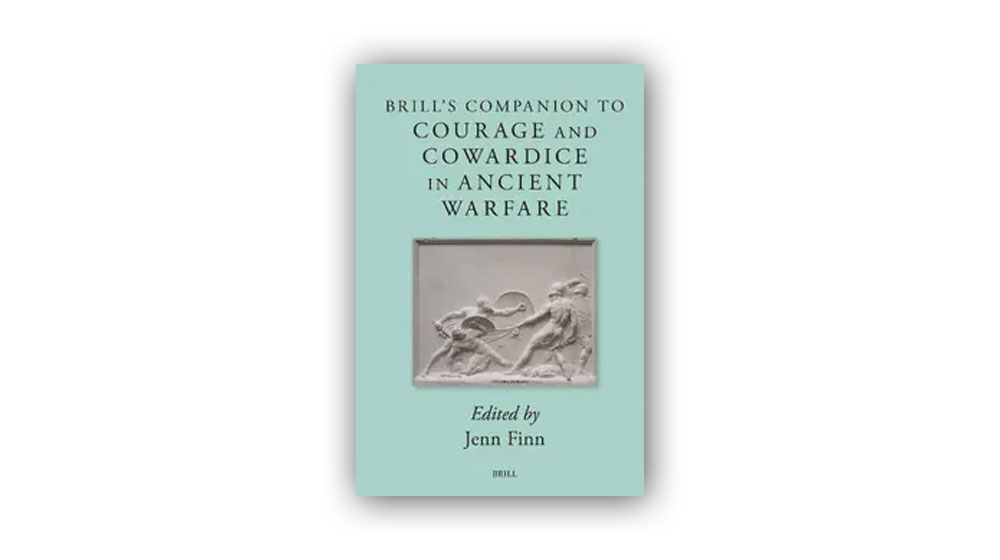
Jenn Finn, PhD, associate professor and chair of the Department of Classical Studies in Loyola University Chicago’s College of Arts and Sciences, is the volume editor of Brill’s Companion to Courage and Cowardice in Ancient Warfare, which Brill published in December 2025.
The book brings together scholars from around the world to examine how courage, cowardice, and fear were understood and experienced in ancient warfare. Drawing on evidence from across the ancient Mediterranean—including Greece, Rome, Egypt, Mesopotamia, and Israel—the volume uses interdisciplinary approaches such as history, philosophy, and literary analysis to challenge simplistic definitions of bravery and highlight the wide range of human responses to danger in combat.
"The goal of the book is to challenge the idea that there is a binary complex of ‘courage’ and ‘cowardice;’ rather, the contributors show there are several gradations on a continuum of courage,” said Finn. “We can see the type of nuance woven through a timeless history of human reactions and emotions in the stress of combat.”
"Congratulations to Dr. Finn on her latest scholarly achievement, which reaffirms how historical inquiry into themes from the classical era like courage and fear offer timeless insights into how we understand human behavior across cultures and eras,” said Peter J. Schraeder, Dean of the College of Arts and Sciences. “Her work, as chair of the Classical Studies department, also demonstrates the critical importance of Classical Studies at a Jesuit Catholic institution.”
As editor, Finn assembled essays that reveal how deeply the realities of war shaped the lives and emotions of people in the ancient world. Drawing on sources such as epic poetry, philosophical writing, inscriptions, and material culture, contributors explore how bravery and fear were defined, experienced, and rewarded, or punished, across different societies in antiquity.
Finn’s research interests include the ancient near east, Alexander the Great and ancient warfare. She was recently featured in a Netflix docudrama on Alexander the Great and has several publication and research listings.
Learn more about Finn and her most recent book.
About the College of Arts and Sciences
Founded in 1870, the College of Arts and Sciences is the oldest and largest of Loyola University Chicago’s 13 schools and colleges, serving as the academic home for nearly 8,000 students (roughly 50 percent of Loyola’s total student population). It is academically diverse with twenty academic departments that span an array of intellectual pursuits, ranging from the natural sciences and computational sciences to the humanities, the social sciences, and the fine and performing arts. It is also highly interdisciplinary with thirty-one interdisciplinary programs and seven interdisciplinary centers, including the mission-centric Jesuit Heritage Research Center and the Hank Center for the Catholic Intellectual Heritage. The College is home to over 450 full-time, award-winning faculty, who are committed to teaching and research excellence. They teach nearly 2,000 classes each semester, including 88 percent of all Core Curriculum classes taken by undergraduate students across the university. They also contribute to eleven doctoral programs whose graduates have helped propel Loyola starting in 2025 to R-1 research status (the highest research status a university can achieve). Our students and faculty are engaged internationally at our John Felice Rome Center in Italy, as well as at dozens of university-sponsored study abroad and research sites around the world. Home to the departments that anchor the university’s Core Curriculum, the College seeks to prepare all of Loyola’s students to think critically, to engage the world of the 21st century at ever-deepening levels, and to become caring and compassionate individuals. Our faculty, staff, and students view service to others not just as one option among many, but as a constitutive dimension of their very being. In the truest sense of the Jesuit ideal, our graduates strive to be “individuals for others.”
Jenn Finn, PhD, associate professor and chair of the Department of Classical Studies in Loyola University Chicago’s College of Arts and Sciences, is the volume editor of Brill’s Companion to Courage and Cowardice in Ancient Warfare, which Brill published in December 2025.
The book brings together scholars from around the world to examine how courage, cowardice, and fear were understood and experienced in ancient warfare. Drawing on evidence from across the ancient Mediterranean—including Greece, Rome, Egypt, Mesopotamia, and Israel—the volume uses interdisciplinary approaches such as history, philosophy, and literary analysis to challenge simplistic definitions of bravery and highlight the wide range of human responses to danger in combat.
"The goal of the book is to challenge the idea that there is a binary complex of ‘courage’ and ‘cowardice;’ rather, the contributors show there are several gradations on a continuum of courage,” said Finn. “We can see the type of nuance woven through a timeless history of human reactions and emotions in the stress of combat.”
"Congratulations to Dr. Finn on her latest scholarly achievement, which reaffirms how historical inquiry into themes from the classical era like courage and fear offer timeless insights into how we understand human behavior across cultures and eras,” said Peter J. Schraeder, Dean of the College of Arts and Sciences. “Her work, as chair of the Classical Studies department, also demonstrates the critical importance of Classical Studies at a Jesuit Catholic institution.”
As editor, Finn assembled essays that reveal how deeply the realities of war shaped the lives and emotions of people in the ancient world. Drawing on sources such as epic poetry, philosophical writing, inscriptions, and material culture, contributors explore how bravery and fear were defined, experienced, and rewarded, or punished, across different societies in antiquity.
Finn’s research interests include the ancient near east, Alexander the Great and ancient warfare. She was recently featured in a Netflix docudrama on Alexander the Great and has several publication and research listings.
Learn more about Finn and her most recent book.
About the College of Arts and Sciences
Founded in 1870, the College of Arts and Sciences is the oldest and largest of Loyola University Chicago’s 13 schools and colleges, serving as the academic home for nearly 8,000 students (roughly 50 percent of Loyola’s total student population). It is academically diverse with twenty academic departments that span an array of intellectual pursuits, ranging from the natural sciences and computational sciences to the humanities, the social sciences, and the fine and performing arts. It is also highly interdisciplinary with thirty-one interdisciplinary programs and seven interdisciplinary centers, including the mission-centric Jesuit Heritage Research Center and the Hank Center for the Catholic Intellectual Heritage. The College is home to over 450 full-time, award-winning faculty, who are committed to teaching and research excellence. They teach nearly 2,000 classes each semester, including 88 percent of all Core Curriculum classes taken by undergraduate students across the university. They also contribute to eleven doctoral programs whose graduates have helped propel Loyola starting in 2025 to R-1 research status (the highest research status a university can achieve). Our students and faculty are engaged internationally at our John Felice Rome Center in Italy, as well as at dozens of university-sponsored study abroad and research sites around the world. Home to the departments that anchor the university’s Core Curriculum, the College seeks to prepare all of Loyola’s students to think critically, to engage the world of the 21st century at ever-deepening levels, and to become caring and compassionate individuals. Our faculty, staff, and students view service to others not just as one option among many, but as a constitutive dimension of their very being. In the truest sense of the Jesuit ideal, our graduates strive to be “individuals for others.”