
Janangelo Publishes Book
Janangelo Publishes Book for Aspiring Two-Year College Faculty
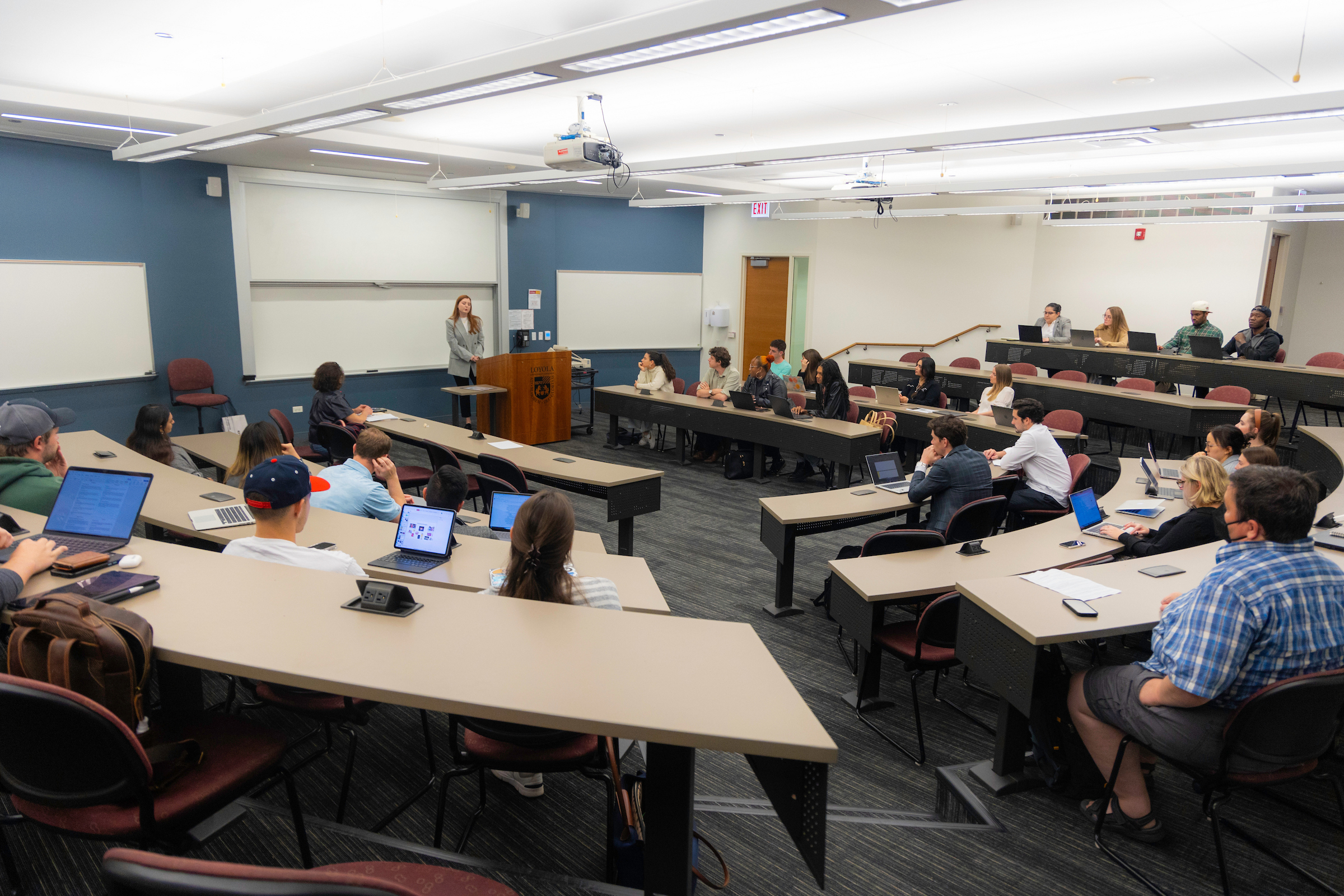
Joseph Janangelo, PhD, professor of English in Loyola University Chicago’s College of Arts and Sciences, recently co-edited, Two-Year College Teaching Careers: Preparing Graduate Students for Success, published by Peter Lang Publishing.
Janangelo, the past president of the Council of Writing Program Administrators (CWPA) and co-founder of the CWPA Mentoring Project, partnered with Erin Lehman, professor of English and faculty lead for the online School of Arts, Sciences, & Education at Ivy Tech Community College, on the project.
“We hope our book helps build an enhanced understanding of, and respect for, the important work of Two-Year College teaching,” said Janangelo. “We also hope to improve graduate education by preparing graduate students for a wider array of intellectually rewarding and challenging career opportunities.”
“This book reflects Dr. Janangelo’s deep commitment to inclusive, mission-driven teaching and to expanding how we prepare students for meaningful academic careers,” said Peter J. Schraeder, PhD, Dean of the College of Arts and Sciences. “This work elevates an often-underrecognized sector of higher education and affirms the impact and purpose of teaching in these settings.”
Designed as a “starter book” for aspiring two-year college (TYC) faculty, the volume brings together voices of graduate students, TYC faculty, and four-year college faculty who share their experiences and expertise with the goal of expanding graduate students’ career pathways and intellectual preparation.
The book offers an honest look at the realities of TYC teaching and professional life. The authors highlight both the opportunities and challenges of building meaningful, successful, and fulfilling careers in two-year college settings.
Two-Year College Teaching Careers invites readers to build on these insights and advance the important work of inclusive, imaginative teacher preparation and professional development.
In addition to this publication, Janangelo is the author or editor of several books, including Understanding WPA Readiness and Renewal: A Critical Look at Institutional Mission, Resituating Writing, and Theoretical and Critical Perspectives on Teacher Change.
Learn more about Janangelo here and his latest book.
About the College of Arts and Sciences
Founded in 1870, the College of Arts and Sciences is the oldest and largest of Loyola University Chicago’s 13 schools and colleges, serving as the academic home for nearly 8,000 students (roughly 50 percent of Loyola’s total student population). It is academically diverse with twenty academic departments that span an array of intellectual pursuits, ranging from the natural sciences and computational sciences to the humanities, the social sciences, and the fine and performing arts. It is also highly interdisciplinary with thirty-one interdisciplinary programs and seven interdisciplinary centers, including the mission-centric Jesuit Heritage Research Center and the Hank Center for the Catholic Intellectual Heritage. The College is home to over 450 full-time, award-winning faculty, who are committed to teaching and research excellence. They teach nearly 2,000 classes each semester, including 88 percent of all Core Curriculum classes taken by undergraduate students across the university. They also contribute to eleven doctoral programs whose graduates have helped propel Loyola starting in 2025 to R-1 research status (the highest research status a university can achieve). Our students and faculty are engaged internationally at our John Felice Rome Center in Italy, as well as at dozens of university-sponsored study abroad and research sites around the world. Home to the departments that anchor the university’s Core Curriculum, the College seeks to prepare all of Loyola’s students to think critically, to engage the world of the 21st century at ever-deepening levels, and to become caring and compassionate individuals. Our faculty, staff, and students view service to others not just as one option among many, but as a constitutive dimension of their very being. In the truest sense of the Jesuit ideal, our graduates strive to be “individuals for others.”
Joseph Janangelo, PhD, professor of English in Loyola University Chicago’s College of Arts and Sciences, recently co-edited, Two-Year College Teaching Careers: Preparing Graduate Students for Success, published by Peter Lang Publishing.
Janangelo, the past president of the Council of Writing Program Administrators (CWPA) and co-founder of the CWPA Mentoring Project, partnered with Erin Lehman, professor of English and faculty lead for the online School of Arts, Sciences, & Education at Ivy Tech Community College, on the project.
“We hope our book helps build an enhanced understanding of, and respect for, the important work of Two-Year College teaching,” said Janangelo. “We also hope to improve graduate education by preparing graduate students for a wider array of intellectually rewarding and challenging career opportunities.”
“This book reflects Dr. Janangelo’s deep commitment to inclusive, mission-driven teaching and to expanding how we prepare students for meaningful academic careers,” said Peter J. Schraeder, PhD, Dean of the College of Arts and Sciences. “This work elevates an often-underrecognized sector of higher education and affirms the impact and purpose of teaching in these settings.”
Designed as a “starter book” for aspiring two-year college (TYC) faculty, the volume brings together voices of graduate students, TYC faculty, and four-year college faculty who share their experiences and expertise with the goal of expanding graduate students’ career pathways and intellectual preparation.
The book offers an honest look at the realities of TYC teaching and professional life. The authors highlight both the opportunities and challenges of building meaningful, successful, and fulfilling careers in two-year college settings.
Two-Year College Teaching Careers invites readers to build on these insights and advance the important work of inclusive, imaginative teacher preparation and professional development.
In addition to this publication, Janangelo is the author or editor of several books, including Understanding WPA Readiness and Renewal: A Critical Look at Institutional Mission, Resituating Writing, and Theoretical and Critical Perspectives on Teacher Change.
Learn more about Janangelo here and his latest book.
About the College of Arts and Sciences
Founded in 1870, the College of Arts and Sciences is the oldest and largest of Loyola University Chicago’s 13 schools and colleges, serving as the academic home for nearly 8,000 students (roughly 50 percent of Loyola’s total student population). It is academically diverse with twenty academic departments that span an array of intellectual pursuits, ranging from the natural sciences and computational sciences to the humanities, the social sciences, and the fine and performing arts. It is also highly interdisciplinary with thirty-one interdisciplinary programs and seven interdisciplinary centers, including the mission-centric Jesuit Heritage Research Center and the Hank Center for the Catholic Intellectual Heritage. The College is home to over 450 full-time, award-winning faculty, who are committed to teaching and research excellence. They teach nearly 2,000 classes each semester, including 88 percent of all Core Curriculum classes taken by undergraduate students across the university. They also contribute to eleven doctoral programs whose graduates have helped propel Loyola starting in 2025 to R-1 research status (the highest research status a university can achieve). Our students and faculty are engaged internationally at our John Felice Rome Center in Italy, as well as at dozens of university-sponsored study abroad and research sites around the world. Home to the departments that anchor the university’s Core Curriculum, the College seeks to prepare all of Loyola’s students to think critically, to engage the world of the 21st century at ever-deepening levels, and to become caring and compassionate individuals. Our faculty, staff, and students view service to others not just as one option among many, but as a constitutive dimension of their very being. In the truest sense of the Jesuit ideal, our graduates strive to be “individuals for others.”