
Jesuit Heritage Research Signage
Bringing Jesuit Heritage to Life Across Loyola’s Campus
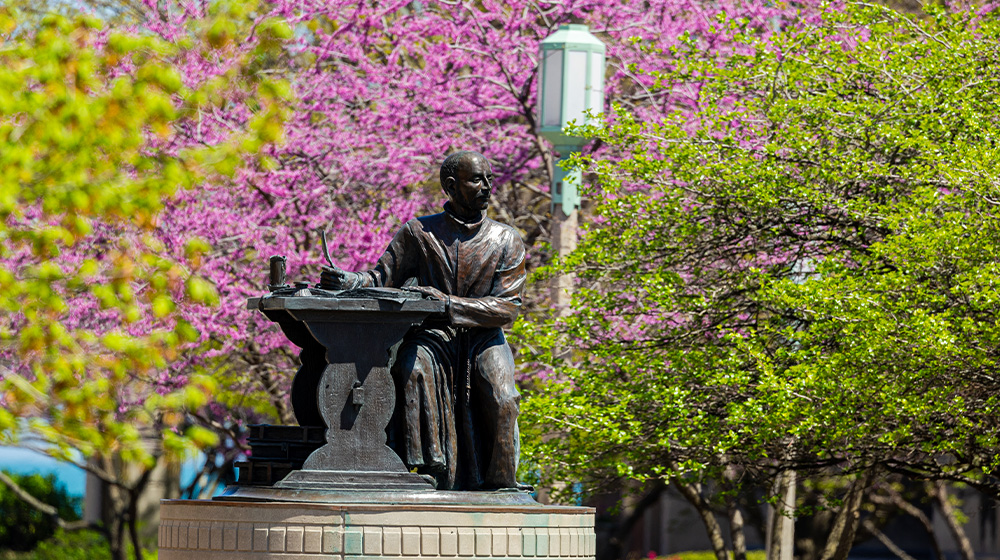
Fr. Stephen Schloesser, S.J., PhD, Professor of history and Director of the Jesuit Heritage Research Center (JHRC) in Loyola University Chicago’s College of Arts and Sciences, has led an ambitious effort to transform the campus into a living record of Jesuit history through the Jesuit Heritage Signage Project.
“By making Jesuit heritage visible across campus, this project deepens our community’s understanding of the mission and values that define Loyola,” said Peter J. Schraeder, PhD., Dean of the College of Arts and Sciences. “Fr. Schloesser’s leadership has transformed history and heritage into a shared, public experience for all Ramblers to explore and engage.”
The Jesuit heritage and mission are present throughout Loyola’s Lake Shore Campus, in the history of the buildings, monuments, and memorials.
Schloesser led a team of faculty, staff, and students from across the university in a collaborative effort that resulted in interpretive signs placed at numerous Lake Shore Campus sites, along with a digital map that allows users to embark on a self-guided tour, online or in person, of the heritage sites.
These signs highlight key figures, sites, and moments in Loyola’s past using historical photographs and research drawn from Loyola’s University Archives and Special Collections, the Women and Leadership Archives, and Jesuit partner archives.
This project allows the campus community and visitors alike to learn how 500 years of Jesuit tradition has influenced Loyola’s campus into what it is today.
As Schloesser shared in a recent Loyola Phoenix feature, the goal is to help the campus community see beyond the beauty of Loyola’s present-day landscape and recognize the history behind it and the people who built it.
The signage makes Loyola’s identity visible, inviting students, faculty, staff, and visitors to engage with the university’s Jesuit roots in everyday moments. Whether passing a statue, gathering outside a residence hall, or walking between classes, the campus itself becomes a classroom.
Housed in the College of Arts and Sciences, the JHRC serves as a hub connecting Loyola and the Chicagoland community with the Society of Jesus through collaborative research, preservation, and the continuation of the Jesuit tradition in a 21st-century, global context.
More about Fr. Schloesser.
About the College of Arts and Sciences
Founded in 1870, the College of Arts and Sciences is the oldest and largest of Loyola University Chicago’s 13 schools and colleges, serving as the academic home for nearly 8,000 students (roughly 50 percent of Loyola’s total student population). It is academically diverse with twenty academic departments that span an array of intellectual pursuits, ranging from the natural sciences and computational sciences to the humanities, the social sciences, and the fine and performing arts. It is also highly interdisciplinary with thirty-one interdisciplinary programs and seven interdisciplinary centers, including the mission-centric Jesuit Heritage Research Center and the Hank Center for the Catholic Intellectual Heritage. The College is home to over 450 full-time, award-winning faculty, who are committed to teaching and research excellence. They teach nearly 2,000 classes each semester, including 88 percent of all Core Curriculum classes taken by undergraduate students across the university. They also contribute to eleven doctoral programs whose graduates have helped propel Loyola starting in 2025 to R-1 research status (the highest research status a university can achieve). Our students and faculty are engaged internationally at our John Felice Rome Center in Italy, as well as at dozens of university-sponsored study abroad and research sites around the world. Home to the departments that anchor the university’s Core Curriculum, the College seeks to prepare all of Loyola’s students to think critically, to engage the world of the 21st century at ever-deepening levels, and to become caring and compassionate individuals. Our faculty, staff, and students view service to others not just as one option among many, but as a constitutive dimension of their very being. In the truest sense of the Jesuit ideal, our graduates strive to be “individuals for others.”
Fr. Stephen Schloesser, S.J., PhD, Professor of history and Director of the Jesuit Heritage Research Center (JHRC) in Loyola University Chicago’s College of Arts and Sciences, has led an ambitious effort to transform the campus into a living record of Jesuit history through the Jesuit Heritage Signage Project.
“By making Jesuit heritage visible across campus, this project deepens our community’s understanding of the mission and values that define Loyola,” said Peter J. Schraeder, PhD., Dean of the College of Arts and Sciences. “Fr. Schloesser’s leadership has transformed history and heritage into a shared, public experience for all Ramblers to explore and engage.”
The Jesuit heritage and mission are present throughout Loyola’s Lake Shore Campus, in the history of the buildings, monuments, and memorials.
Schloesser led a team of faculty, staff, and students from across the university in a collaborative effort that resulted in interpretive signs placed at numerous Lake Shore Campus sites, along with a digital map that allows users to embark on a self-guided tour, online or in person, of the heritage sites.
These signs highlight key figures, sites, and moments in Loyola’s past using historical photographs and research drawn from Loyola’s University Archives and Special Collections, the Women and Leadership Archives, and Jesuit partner archives.
This project allows the campus community and visitors alike to learn how 500 years of Jesuit tradition has influenced Loyola’s campus into what it is today.
As Schloesser shared in a recent Loyola Phoenix feature, the goal is to help the campus community see beyond the beauty of Loyola’s present-day landscape and recognize the history behind it and the people who built it.
The signage makes Loyola’s identity visible, inviting students, faculty, staff, and visitors to engage with the university’s Jesuit roots in everyday moments. Whether passing a statue, gathering outside a residence hall, or walking between classes, the campus itself becomes a classroom.
Housed in the College of Arts and Sciences, the JHRC serves as a hub connecting Loyola and the Chicagoland community with the Society of Jesus through collaborative research, preservation, and the continuation of the Jesuit tradition in a 21st-century, global context.
More about Fr. Schloesser.
About the College of Arts and Sciences
Founded in 1870, the College of Arts and Sciences is the oldest and largest of Loyola University Chicago’s 13 schools and colleges, serving as the academic home for nearly 8,000 students (roughly 50 percent of Loyola’s total student population). It is academically diverse with twenty academic departments that span an array of intellectual pursuits, ranging from the natural sciences and computational sciences to the humanities, the social sciences, and the fine and performing arts. It is also highly interdisciplinary with thirty-one interdisciplinary programs and seven interdisciplinary centers, including the mission-centric Jesuit Heritage Research Center and the Hank Center for the Catholic Intellectual Heritage. The College is home to over 450 full-time, award-winning faculty, who are committed to teaching and research excellence. They teach nearly 2,000 classes each semester, including 88 percent of all Core Curriculum classes taken by undergraduate students across the university. They also contribute to eleven doctoral programs whose graduates have helped propel Loyola starting in 2025 to R-1 research status (the highest research status a university can achieve). Our students and faculty are engaged internationally at our John Felice Rome Center in Italy, as well as at dozens of university-sponsored study abroad and research sites around the world. Home to the departments that anchor the university’s Core Curriculum, the College seeks to prepare all of Loyola’s students to think critically, to engage the world of the 21st century at ever-deepening levels, and to become caring and compassionate individuals. Our faculty, staff, and students view service to others not just as one option among many, but as a constitutive dimension of their very being. In the truest sense of the Jesuit ideal, our graduates strive to be “individuals for others.”