
Loyola Chicago Health Equity Quest tackles cardiovascular health
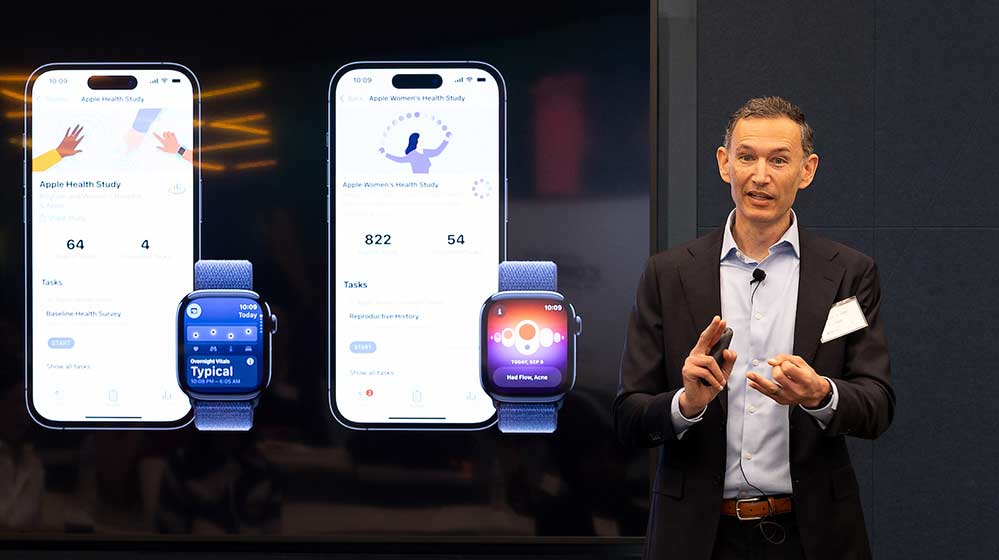
Dr. Rajiv Kumar (MD ’06), who currently works in medical affairs and research at Apple, urged collaboration among researchers, clinicians, health systems, and technology players to drive research-based health care innovation.
By Daniel P. Smith
December 12, 2025
The data underscores the urgency of the situation.
In the United States, cardiovascular disease is listed as the underlying cause of death in nearly 1 million deaths each year, according to the American Heart Association. In fact, it is the leading cause of death for both U.S. men and women, with its burden falling particularly heavy on underrepresented and underserved populations.
Innovation, however, presents an opportunity to combat those troubling figures and spur healthier, longer, and more fulfilling lives. From wearables to AI-powered diagnostics, a rush of emerging technologies is unlocking new ways to prevent, detect, and manage cardiovascular disease and provide hope to patients and their families.
Propelled by this urgency, an enterprising mindset, and a collaborative spirit, the fifth annual Loyola Chicago Health Equity Quest co-hosted by Loyola University Chicago’s Parkinson School of Health Sciences and Public Health and MATTER featured innovators, thought leaders, and advocates in heart health exploring how digital technologies might advance cardiovascular health and reduce disparities for historically underserved communities as well as young people, whose rates of cardiovascular disease continue climbing.
“The enjoyment of the highest attainable standard of health is one of the fundamental rights of every human being, and so it is our calling to make sure that technology, innovation, and insights reach all, so that we improve the light of all,” said Elaine Morrato, dean of the Parkinson School, in her opening remarks at the summit held at Chicago’s Merchandise Mart on November 13, 2025.
The in-person summit was also livestreamed: Attendees from around the world joined virtually, and Loyola students watched from the university’s Lake Shore and Health Sciences campuses.
Using tech to empower
Morrato’s inspired comments kicked off a lively event attended by a diverse audience – health care innovators, investors, health systems leaders, community organizations, and Loyola students among them – eager to examine how data, digital tools, and cross-sector collaboration might drive a more accessible, proactive, and sustainable approach to heart health.
In his keynote presentation, Dr. Rajiv Kumar, a Loyola Stritch School of Medicine alumnus (MD ’06) who currently works in medical affairs and research at Apple, urged collaboration among researchers, clinicians, health systems, and technology players to drive research-based health care innovation.
“We have to all work together and each has a different part, and if we try to duplicate each other’s parts, it’s going to go much, much slower,” Kumar said.
He promoted technology as a vehicle to improve outcomes, sharing how existing consumer technologies, such as iPhone and Apple Watch, might help individuals identify a potential health issue, such as high blood pressure, and prompt follow-up, like checking hypertension with a traditional cuff. Later, data points could be presented to a physician to inform interventions or voluntarily shared with researchers, who might then conduct rich studies examining issues such as early detection of atrial fibrillation or signs of hypertension.
Kumar cited the example of patients at a large academic medical center admitted for a new heart attack. Before discharge, staff provided the patients with a suite of products, including Apple Watch, iPhone, a weight scale, and a blood pressure cuff, to facilitate follow-up monitoring. Providing products to these patients stirred dramatic results, including a significant decline in readmission rates.
“Working together with the community, we want to continue to expedite and empower,” Kumar said.
Promoting collaboration and access
During the summit, Morrato led a virtual fireside chat with Dr. Mintu Turakhia. In addition to being a cardiologist and internationally renowned leader in cardiovascular health based at Stanford University’s School of Medicine, Turakhia is an executive with iRhythm Technologies, a leading digital health care company.
In a wide-ranging 50-minute conversation, Turakhia discussed everything from the design of digital technologies and insurance coverage to the evidence standards missing from regulated cardiac wearables and the hurdles to broader adoption of digital health tools.
Echoing Kumar, Turakhia stressed the importance of collaboration among researchers, technologists, data scientists, physicians, health systems leaders, public policy makers, and others to fuel relevant solutions.
“That is a superpower,” he said.
While Turakhia called COVID-19 “the true accelerant of digital medicine,” he also said the pandemic spotlighted gaps in trust, equity, and access. He called for technologies such as AI and wearables rigorously tested and “fit for purpose with issues of access, digital literacy, health literacy, and health equity.”
He predicted continued innovation in both consumer and medical-grade health devices as well as heightened global adoption given improved access to cellular data and Internet connectivity. He said innovation and increased access could scale the work and effectiveness of clinicians around the globe, provided the technology remains focused on tackling clinical questions and is centered around user needs.
“Pick a problem that you care about deeply and just stay with it,” Turakhia urged Loyola Chicago Health Equity Quest attendees. “Stick to the problem, be very multi-disciplinary, have a global view on things, and I think you can have a lot of impact.”
Pursuing a shared goal
Launched in 2022 by the Parkinson School’s Center for Health Innovation and Entrepreneurship (CHIE) in conjunction with MATTER, a Chicago-based health care incubator, the Loyola Chicago Health Equity Quest seeks to catalyze innovation around long-standing health inequities and improve population health. Past summits have addressed issues such as the societal impact of the pandemic, the health effects of rapid climate change, more sustainable health care delivery, and workplace mental health.
In addition to Kumar’s keynote talk and Turakhia’s fireside chat, the 2025 edition of the Loyola Chicago Health Equity Quest also included three separate panel discussions focused on technology’s potential to improve cardiovascular health outcomes and combat health disparities. Panelists representing health systems, academia, and industry discussed topics such as generative AI and wearables, closing the equity gap in wearables, and using data in real time to proactively support health. In the lead up to the Loyola Chicago Health Equity Quest, Parkinson School faculty also highlighted cardiovascular wellness as part of Loyola’s Wellness Fair for students on October 1, 2025.
Following the Loyola Chicago Health Equity Quest, Morrato described the summit as an important gathering to spark learning, solutions, and innovation that positively impacts humanity and addresses health disparities. She celebrated “an energy for improvement” and collective thinking around human health in ways that are “ethical, creative, but also futuristic.”
“It’s going to take multiple strategies, and we hope through meetings like this that we’re continuing to keep health equity on our minds,” Morrato said.
Sponsor and collaborators
We are grateful to Alight for sponsoring the 2025 Loyola Chicago Health Quest and for the following collaborators:
- American Heart Association
- Health Care Council of Chicago (HC3)
- Marcella Niehoff School of Nursing, Loyola University Chicago
- mHUB
- Parkinson School of Health Sciences and Public Health, Loyola University Chicago
- Stritch School of Medicine, Loyola University Chicago