Mutual Beneficiaries
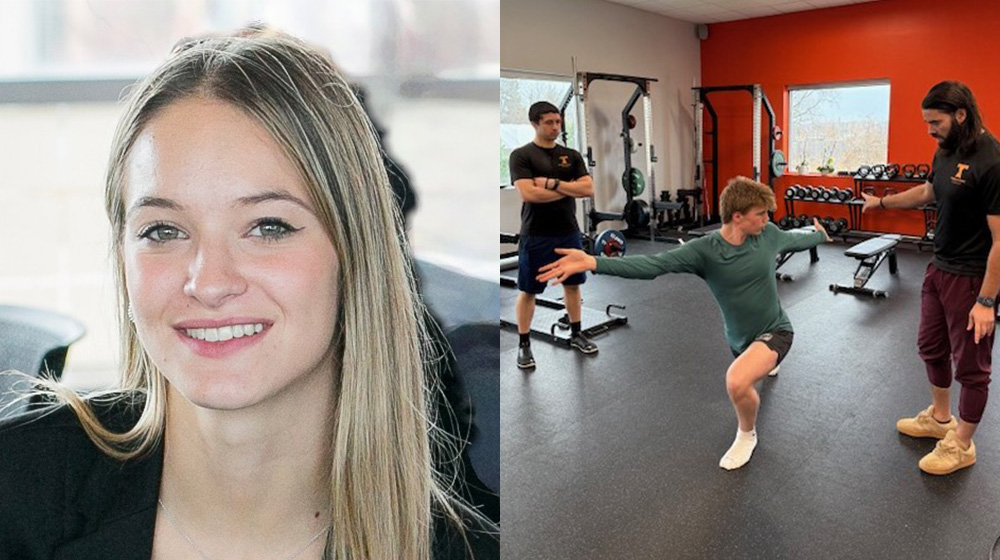
Francesca Perego Fresca Fantoni (left) and Ian Mack at Tomahawk Science (right)
BY DANIEL P. SMITH
As her late mother battled cancer, Francesca Perego Fresca Fantoni spent considerable time in hospital environments during her childhood. Taxing and emotional as the collective experiences were, Perego’s visits generated an appreciation for physicians’ dedication to patient care and led Perego to pursue a pre-med track upon entering Loyola University Chicago in 2021.
“Becoming a doctor seemed the best way to make a difference,” Perego says.
As she connected with Loyola faculty and learned about various aspects of the health care landscape, however, Perego discovered another path to serving others. Drawn to the idea of optimizing patient care processes and improving health care systems for both providers and patients, Perego traded her pre-med ambitions for a spot in the Healthcare Administration program at the Parkinson School of Health Sciences and Public Health.
“That shift allowed me to align my passion for health care with my strengths in leadership, problem-solving, and operations,” Perego says.
And now, Perego, a senior slated to graduate in May, is more energized about her professional prospects than ever before thanks to an academic internship in the Department of Medical Imaging at the Ann & Robert H. Lurie Children’s Hospital of Chicago.
“Each day, my internship reinforces my interest in health care operations and emphasizes the importance of efficiency and patient-centered care in clinical settings,” says Perego, who received a $1,500 ASPIRE award from Loyola’s Center for Engaged Learning, Teaching, & Scholarship (CELTS), Student Government, and Office of Financial Aid to ease the financial burden of participating in the unpaid internship at Lurie.
An introduction into the professional world
Perego’s words invigorate Dr. Cynthia Stewart, director of experiential learning at the Parkinson School.
Each semester, Stewart steers academic internships for Parkinson undergraduates and practicums for the school’s graduate students from a list of some 250 community partners. Placement sites range from established operations like Northwestern Memorial Hospital, Blue Cross Blue Shield, and the American Lung Association to private fitness studios, long-term care facilities, and school-based health centers scattered across the Chicago area.
During the 2024-2025 academic year, for example, Stewart coordinated experiential learning for 78 Parkinson undergraduates representing three academic programs (healthcare administration, exercise science, and public health). In these “high-impact practices” as Stewart calls them, students apply classroom knowledge in a professional setting and gain hands-on experience to sharpen their skills and strengthen their professional purpose.
“For many of our students, these experiential opportunities are lightbulb moments helping them discover what the professional world is like and providing a richer sense of where and how they might contribute,” Stewart says, adding that experiential opportunities also help students find mentors, build their professional networks, and, in some cases, land full-time employment.
Since starting her internship at Lurie in January 2025, Perego has worked on several projects involving data analysis, reporting, and workflow optimization. In one particular project designed to improve the transparency of physician schedules reporting, Perego analyzed patterns, identified gaps, and created a reporting tool to track physicians’ key performance indicators as well as department-wide metrics. The new resource aims to help physicians better understand their individual engagement and performance.
“I’ve enjoyed being immersed in a hospital setting and seeing firsthand how administrative roles contribute to patient care. The experience has strengthened my analytical and problem-solving skills, particularly in process improvement and data-driven decision-making,” says Perego, who hopes to work in health care administration after graduation and someday open an oncology clinic in her mother’s memory.
Boosting organizational efforts
Since the start of 2024, Tomahawk Science founder Ian Mack has opened the doors of his Chicago-based sports science and performance training company to Parkinson undergraduates studying exercise science. Three students have participated in academic internships, helping with the design and execution of individualized rehabilitation programs as well as personalized and team training programs across a range of sports, including hockey, basketball, baseball, soccer, and golf.
Mack values his relationship with Parkinson, especially with a dozen Parkinson-affiliated individuals currently supporting his upstart company’s training, therapy, and research initiatives, including alumni in full-time positions and students involved in experiential learning.
“Tomahawk Science gets to work with a high caliber of student and the students themselves are able to gain knowledge, experience, connections, and job opportunities inside the sport, medicine, and rehabilitation fields,” Mack says.
Other experiential learning partners share similar sentiments, particularly celebrating the fresh eyes, diligent work ethic, and critical thinking skills Parkinson students bring to the workplace. Students regularly help partners expand their capacity, optimize systems, and enhance operations. One local nonprofit described Parkinson interns as “a beautiful addition to our work.”
“There’s no question our students benefit from these experiential learning opportunities, but we often hear our partners talk about the value these students create as well,” Stewart says. “Our partners appreciate the assistance and energy students bring as well as the exposure their organizations get to a capable and motivated talent pool.”