
Food Equity Program
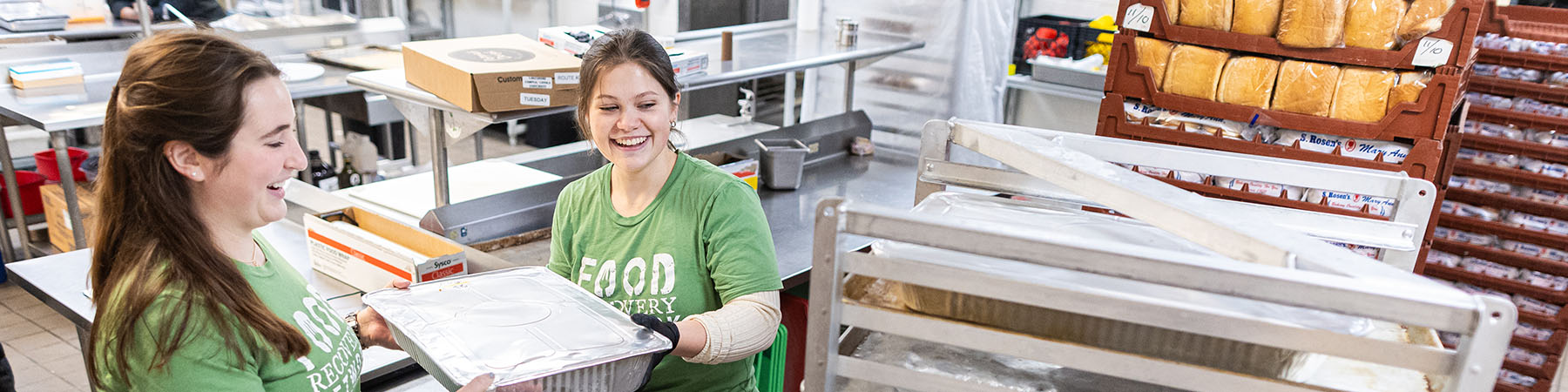
Loyola’s Food Equity Program engages students in reducing food waste and combating food insecurity in Chicago. In the fall 2025 semester alone, program participants recovered more than 15,000 pounds of food for donation, providing the equivalent of 12,500 meals for people in need.
Program Benefits
The Food Equity Program has social, environmental, and educational benefits.
- Donating recovered food advances food equity in Chicago.
- Diverting perfectly good food from landfills reduces greenhouse gas emissions and avoids the environmental impacts of producing food that is never eaten.
- Student participants learn about local food systems and gain experience with leadership, teamwork, project management, and community outreach.
The Food Equity Program and the associated Food Recovery Network promote food justice while reducing the environmental impacts of food waste.
In 2016, students established the Loyola chapter of the Food Recovery Network (FRN), a student organization dedicated to diverting food waste on college campuses. Members collaborate with the campus food service vendor to recover extra food from dining halls and events and deliver it to neighborhood food pantries. FRN also collaborates with the School of Environmental Sustainability (SES) Urban Agriculture Program to donate fresh produce grown on campus.
In 2023, donor contributions enabled SES to establish the Food Equity Program and create two paid student coordinator positions to expand food justice efforts and support the program year-round. The student coordinators work closely with FRN, helping to organize more than 100 student volunteers.
The paid positions enabled the Food Equity Program to expand beyond Loyola’s campus. The student coordinators developed agreements to support food recovery and collection at local farmers markets, helping to ensure that all community members have access to fresh, local, and sustainably grown food items regardless of income. The partnership also makes it easier and more efficient for market vendors to contribute food directly to food pantries. Current farmers market partners include Horner Park Farmers Market, Glenwood Farmers Market, Edgewater Farmers Market and Indoor Market, and the Uptown Farmers Market.
The primary community partner receiving donations is A Just Harvest, an active and well-established Rogers Park Food Pantry that has collaborated with Loyola for more than 10 years. A Just Harvest provides a valuable service to the community, particularly by helping feed seniors on fixed incomes, temporarily unhoused individuals, veterans, unemployed individuals, and workers whose jobs do not pay enough to cover basic needs. The group also supports children of all ages, including providing snacks to local after-school programs.
Get Involved
Students in all Loyola schools and programs can get involved in the Food Recovery Network (FRN), including undergraduates and graduate students. Email frnluc@gmail.com for more information.
The paid coordinator positions are designed for undergraduate students who have gained experience working with FRN. Check the SES internships page for position postings.
To learn how to become a program partner or supporter, contact Kevin Erickson at kerickson2@luc.edu
In 2016, students established the Loyola chapter of the Food Recovery Network (FRN), a student organization dedicated to diverting food waste on college campuses. Members collaborate with the campus food service vendor to recover extra food from dining halls and events and deliver it to neighborhood food pantries. FRN also collaborates with the School of Environmental Sustainability (SES) Urban Agriculture Program to donate fresh produce grown on campus.
In 2023, donor contributions enabled SES to establish the Food Equity Program and create two paid student coordinator positions to expand food justice efforts and support the program year-round. The student coordinators work closely with FRN, helping to organize more than 100 student volunteers.
The paid positions enabled the Food Equity Program to expand beyond Loyola’s campus. The student coordinators developed agreements to support food recovery and collection at local farmers markets, helping to ensure that all community members have access to fresh, local, and sustainably grown food items regardless of income. The partnership also makes it easier and more efficient for market vendors to contribute food directly to food pantries. Current farmers market partners include Horner Park Farmers Market, Glenwood Farmers Market, Edgewater Farmers Market and Indoor Market, and the Uptown Farmers Market.
The primary community partner receiving donations is A Just Harvest, an active and well-established Rogers Park Food Pantry that has collaborated with Loyola for more than 10 years. A Just Harvest provides a valuable service to the community, particularly by helping feed seniors on fixed incomes, temporarily unhoused individuals, veterans, unemployed individuals, and workers whose jobs do not pay enough to cover basic needs. The group also supports children of all ages, including providing snacks to local after-school programs.
Get Involved
Students in all Loyola schools and programs can get involved in the Food Recovery Network (FRN), including undergraduates and graduate students. Email frnluc@gmail.com for more information.
The paid coordinator positions are designed for undergraduate students who have gained experience working with FRN. Check the SES internships page for position postings.
To learn how to become a program partner or supporter, contact Kevin Erickson at kerickson2@luc.edu