
Emily Braun
A Loyola graduate advancing sustainable agriculture research
After growing up in suburban New Lenox, Illinois, Emily Braun knew she wanted to go to college in Chicago. She was looking for a school in the city with a strong program in environmental science or a related field. A visit to Loyola's beautiful Lake Shore Campus quickly sold her on the University and its growing Institute of Environmental Sustainability (now the School of Environmental Sustainability). She graduated from Loyola in 2014 with a BS in environmental science, and later went on to earn a master's degree in crop sciences from the University of Illinois Urbana-Champaign (UIUC).
Today, Braun applies the values and skills she developed at Loyola in her work as a sustainability theme data specialist at the UIUC Center for Advanced Bioenergy and Bioproducts Innovation (CABBI). She shared her thoughts about how her Loyola experience prepared her for a rewarding and meaningful career.
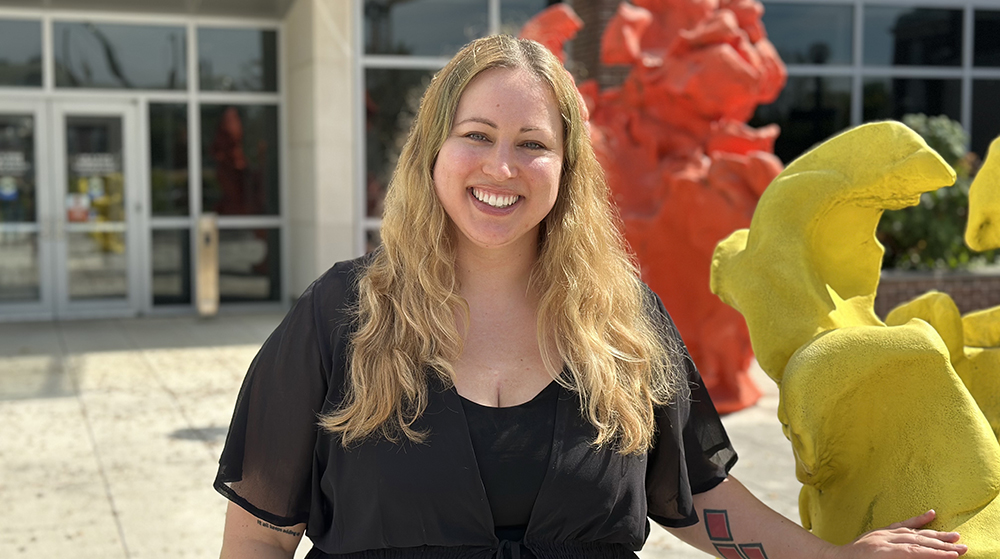
Emily Braun applies the values and skills she developed at Loyola in her work as a sustainability theme data specialist at the Center for Advanced Bioenergy and Bioproducts Innovation. The Center is housed within the Institute for Sustainability, Energy, and Environment and the Carl R. Woese Institute for Genomic Biology at the University of Illinois Ubana-Champaign.
How has your career developed since graduating from Loyola?
After graduating, I worked as a professional intern in the Horticulture Department at Walt Disney World, specifically on the Animal Kingdom properties. There, I gained practical experience in plant care and management while learning about the diverse plant species of Central Florida and their applications in Disney's landscaping. I then joined the Urban Agriculture Research Lab at the University of Illinois at Urbana-Champaign (UIUC) as a graduate research assistant while pursuing a master's degree in crop sciences. As a graduate student, I studied abrasive weed management as a novel weed control technique for organic farmers. My thesis served as the basis for a paper published in HortScience in 2019, titled "Abrasive Grit Application in Organic Red Pepper: An Opportunity for Integrating Nitrogen and Weed Management."
After graduate school, I worked as an extension educator in Controlled Environment Agriculture/Urban Agriculture for the Purdue Cooperative Extension in Indianapolis. I developed outreach opportunities to foster connections between local farmers and gardeners and researchers at Purdue and taught a class that provided support to beginning urban farmers interested in starting urban agriculture projects. Then, four years ago, I started my current position as a sustainability theme data specialist at the Center for Advanced Bioenergy and Bioproducts Innovation (CABBI) at UIUC. CABBI is housed within the Institute for Sustainability, Energy, and Environment and the Carl R. Woese Institute for Genomic Biology.
What type of work do you do in your current job?
CABBI is a large organization with many partner institutions and a large roster of researchers, so we generate a lot of data. As the sustainability theme data specialist, I support CABBI's sustainability researchers by connecting them to the data they need, whether they are calibrating large ecosystem models, developing new research plans, or analyzing results.
I also work to make data sharing and collaboration between research groups easier through developing tools, such as the CABBI Sustainability Data Hub. The Hub provides researchers with access to geographic dataset visualization, a database for field trial data and relevant field management information, as well as gridded data downloads. I also created management timelines for CABBI Hub sites, including a series of legacy plots that were planted in 2008 and are still in use today.
I spend every day reviewing research data and helping researchers, and I love it!
How did your experience at Loyola influence your career interests or goals?
Between the classes I took and the people I met, being at Loyola helped strengthen my goal to help people in any way I can. Right now, I do this by providing support to bioenergy researchers who are working toward more sustainable forms of energy. However, in every career move I've made since graduation, I have strived to affect meaningful change in any way I can.
How did your education in SES prepare you to work in your chosen field?
The importance SES places on research really stayed with me, which is why I ultimately wanted to find my way back to research, even if I'm not in the field or lab. I had the opportunity to take classes where we designed research projects, participated in data collection, and wrote reports on our findings. These experiences helped lay the groundwork for my endeavors in graduate school and prepared me to assist researchers in the work I do now. At SES, I also honed my ability to view both the big picture and the small details when it comes to my place in the world, making me a more well-rounded person.
What are some of your highlights from your time at SES/IES?
Some of my favorite experiences as a student at Loyola and SES include being part of the Student Operation for Avian Relief (SOAR) and taking the Solutions to Environmental Problems (STEP) course on food systems, which fostered my interest in our global and local food systems. I also appreciated taking history and sociology electives to expand my worldview. Outside of academics, I played in Rice Bowl for Kapwa (a student organization) as a defensive tackle, which was some of the most fun I had in college. I also loved spending time near the lake.
What advice would you give to current or prospective SES students?
I encourage current students to get involved on campus and meet new people who come from different backgrounds than their own. Try as many different activities as you can to discover what you enjoy doing for fun, for work, and for school. Also, take the time to explore Chicago beyond the immediate vicinity of the Lake Shore campus.
October 2025
How has your career developed since graduating from Loyola?
After graduating, I worked as a professional intern in the Horticulture Department at Walt Disney World, specifically on the Animal Kingdom properties. There, I gained practical experience in plant care and management while learning about the diverse plant species of Central Florida and their applications in Disney's landscaping. I then joined the Urban Agriculture Research Lab at the University of Illinois at Urbana-Champaign (UIUC) as a graduate research assistant while pursuing a master's degree in crop sciences. As a graduate student, I studied abrasive weed management as a novel weed control technique for organic farmers. My thesis served as the basis for a paper published in HortScience in 2019, titled "Abrasive Grit Application in Organic Red Pepper: An Opportunity for Integrating Nitrogen and Weed Management."
After graduate school, I worked as an extension educator in Controlled Environment Agriculture/Urban Agriculture for the Purdue Cooperative Extension in Indianapolis. I developed outreach opportunities to foster connections between local farmers and gardeners and researchers at Purdue and taught a class that provided support to beginning urban farmers interested in starting urban agriculture projects. Then, four years ago, I started my current position as a sustainability theme data specialist at the Center for Advanced Bioenergy and Bioproducts Innovation (CABBI) at UIUC. CABBI is housed within the Institute for Sustainability, Energy, and Environment and the Carl R. Woese Institute for Genomic Biology.
What type of work do you do in your current job?
CABBI is a large organization with many partner institutions and a large roster of researchers, so we generate a lot of data. As the sustainability theme data specialist, I support CABBI's sustainability researchers by connecting them to the data they need, whether they are calibrating large ecosystem models, developing new research plans, or analyzing results.
I also work to make data sharing and collaboration between research groups easier through developing tools, such as the CABBI Sustainability Data Hub. The Hub provides researchers with access to geographic dataset visualization, a database for field trial data and relevant field management information, as well as gridded data downloads. I also created management timelines for CABBI Hub sites, including a series of legacy plots that were planted in 2008 and are still in use today.
I spend every day reviewing research data and helping researchers, and I love it!
How did your experience at Loyola influence your career interests or goals?
Between the classes I took and the people I met, being at Loyola helped strengthen my goal to help people in any way I can. Right now, I do this by providing support to bioenergy researchers who are working toward more sustainable forms of energy. However, in every career move I've made since graduation, I have strived to affect meaningful change in any way I can.
How did your education in SES prepare you to work in your chosen field?
The importance SES places on research really stayed with me, which is why I ultimately wanted to find my way back to research, even if I'm not in the field or lab. I had the opportunity to take classes where we designed research projects, participated in data collection, and wrote reports on our findings. These experiences helped lay the groundwork for my endeavors in graduate school and prepared me to assist researchers in the work I do now. At SES, I also honed my ability to view both the big picture and the small details when it comes to my place in the world, making me a more well-rounded person.
What are some of your highlights from your time at SES/IES?
Some of my favorite experiences as a student at Loyola and SES include being part of the Student Operation for Avian Relief (SOAR) and taking the Solutions to Environmental Problems (STEP) course on food systems, which fostered my interest in our global and local food systems. I also appreciated taking history and sociology electives to expand my worldview. Outside of academics, I played in Rice Bowl for Kapwa (a student organization) as a defensive tackle, which was some of the most fun I had in college. I also loved spending time near the lake.
What advice would you give to current or prospective SES students?
I encourage current students to get involved on campus and meet new people who come from different backgrounds than their own. Try as many different activities as you can to discover what you enjoy doing for fun, for work, and for school. Also, take the time to explore Chicago beyond the immediate vicinity of the Lake Shore campus.
October 2025