
Food system research
Loyola Researchers Offer Insights for Enhancing Collaborations to Support Food Security
Loyola researchers examined how Chicago-area organizations collaborated to address food insecurity during the COVID-19 pandemic. Their findings emphasize the importance of relationship-building and equitable resource-sharing in withstanding food system disruptions, whether due to a pandemic, climate change impacts, or rapidly shifting political and economic conditions.

Collaboration helped organizations meet the increased demand for food assistance during the COVID-19 pandemic.
Associate Professor Tania Schusler, PhD, and SES graduate program alum Dikshya Dahal (MS '23) published their research this June in the journal Frontiers in Sustainable Food Systems. Dahal is currently a PhD student in the Department of Sociology. The study examined social networks that supported nonprofit organizations in responding to the pandemic-induced increase in food insecurity.
The researchers analyzed firsthand responses from 48 nonprofit organizations in the Chicago area and conducted focus groups with representatives from 20 organizations to gain insight into their experiences. They used a method called Social Network Analysis to quantify and map connections between collaborating groups.
"This study is the first to our knowledge that combines quantitative data to map social network patterns with qualitative data, providing an in-depth understanding of network actors' experiences responding to food system disruptions during the COVID-19 pandemic," said Schusler.
Schusler and Dahal identified organizations for the study through the Chicago Region Food System Fund, which was established in June 2020 to bolster the local food system and address hunger and food business disruptions. The fund awarded grants to Chicago-region organizations engaged in food-related pandemic responses. Many of these organizations served social groups that experience disproportionately high rates of food insecurity, including the LGBTQ+ community, communities of color, working-class families, immigrants, seniors, and people with disabilities.
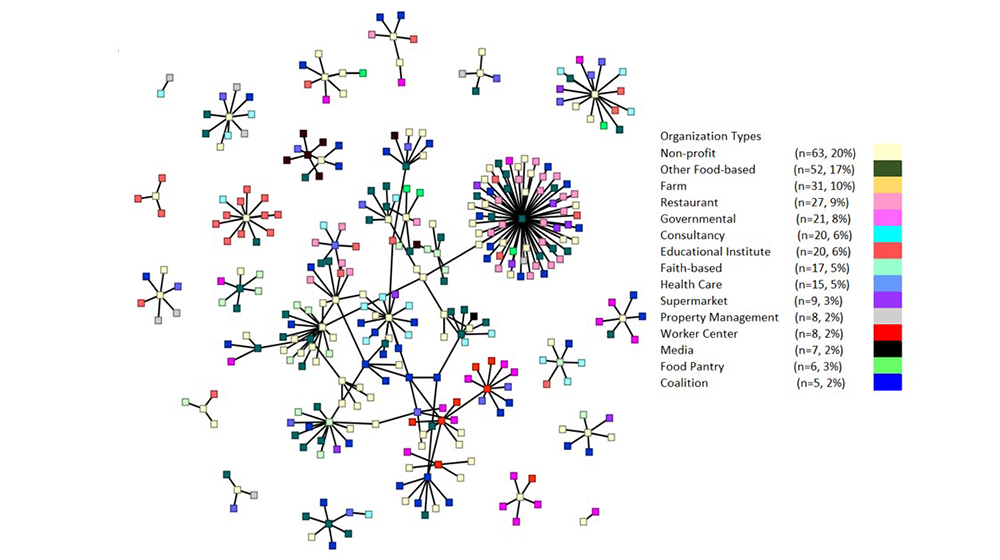
Schusler and Dahal used Social Network Analysis to quantify and map connections between collaborating groups.
The organizations in the study included coalitions, nonprofit organizations, educational institutions, farms, food pantries, government agencies, food-based businesses, and others. The researchers found that partnerships between these groups played a crucial role in organizations' abilities to adapt their programs and operations in response to the pandemic.
"Through collaboration, many organizations helped to meet the increased demand for food assistance caused by the pandemic through a variety of creative approaches such as coordinating logistics to deliver food boxes, operating community food pantries, connecting local farms to food pantries, and surveying or listening to community members to provide food suitable to their cultural traditions, staple diets, dietary restrictions, and physical resources for cooking," they wrote.
The analysis revealed several insights that could guide efforts to build effective partnerships for responding to future crises.
Organizational representatives reported that cross-sector collaborations were especially critical for achieving integrated outcomes. For example, a cross-sector partnership might involve a health care organization, a food pantry, and a food business.
The study also shed light on the challenges and drawbacks of partnerships. Focus group participants reported that not all partnerships were beneficial. Those involving inequitable power relationships tended to harm smaller, community-based partners. For example, a small community-based group might find itself doing the majority of the work on a project even though a larger partner organization received the bulk of the funding.
In contrast, the characteristics of successful and productive partnerships included strong personal relationships, equitable distribution of resources, and clear roles and responsibilities. Successful collaborators also built trust, maintained clear communication, promoted transparency, and ensured accountability.
The study's results provide valuable insights for individuals, organizations, and funders working to reorganize food systems to achieve greater sustainability, equity, and resilience. Groups can apply the lessons learned to build strong partnerships and improve the food system's ability to withstand future disruptions.
-July 2025
Associate Professor Tania Schusler, PhD, and SES graduate program alum Dikshya Dahal (MS '23) published their research this June in the journal Frontiers in Sustainable Food Systems. Dahal is currently a PhD student in the Department of Sociology. The study examined social networks that supported nonprofit organizations in responding to the pandemic-induced increase in food insecurity.
The researchers analyzed firsthand responses from 48 nonprofit organizations in the Chicago area and conducted focus groups with representatives from 20 organizations to gain insight into their experiences. They used a method called Social Network Analysis to quantify and map connections between collaborating groups.
"This study is the first to our knowledge that combines quantitative data to map social network patterns with qualitative data, providing an in-depth understanding of network actors' experiences responding to food system disruptions during the COVID-19 pandemic," said Schusler.
Schusler and Dahal identified organizations for the study through the Chicago Region Food System Fund, which was established in June 2020 to bolster the local food system and address hunger and food business disruptions. The fund awarded grants to Chicago-region organizations engaged in food-related pandemic responses. Many of these organizations served social groups that experience disproportionately high rates of food insecurity, including the LGBTQ+ community, communities of color, working-class families, immigrants, seniors, and people with disabilities.
The organizations in the study included coalitions, nonprofit organizations, educational institutions, farms, food pantries, government agencies, food-based businesses, and others. The researchers found that partnerships between these groups played a crucial role in organizations' abilities to adapt their programs and operations in response to the pandemic.
"Through collaboration, many organizations helped to meet the increased demand for food assistance caused by the pandemic through a variety of creative approaches such as coordinating logistics to deliver food boxes, operating community food pantries, connecting local farms to food pantries, and surveying or listening to community members to provide food suitable to their cultural traditions, staple diets, dietary restrictions, and physical resources for cooking," they wrote.
The analysis revealed several insights that could guide efforts to build effective partnerships for responding to future crises.
Organizational representatives reported that cross-sector collaborations were especially critical for achieving integrated outcomes. For example, a cross-sector partnership might involve a health care organization, a food pantry, and a food business.
The study also shed light on the challenges and drawbacks of partnerships. Focus group participants reported that not all partnerships were beneficial. Those involving inequitable power relationships tended to harm smaller, community-based partners. For example, a small community-based group might find itself doing the majority of the work on a project even though a larger partner organization received the bulk of the funding.
In contrast, the characteristics of successful and productive partnerships included strong personal relationships, equitable distribution of resources, and clear roles and responsibilities. Successful collaborators also built trust, maintained clear communication, promoted transparency, and ensured accountability.
The study's results provide valuable insights for individuals, organizations, and funders working to reorganize food systems to achieve greater sustainability, equity, and resilience. Groups can apply the lessons learned to build strong partnerships and improve the food system's ability to withstand future disruptions.
-July 2025