
Walker-internship
An internship with impact: Loyola senior gains real-world experience advancing sustainability and food justice
As an intern with the Glenwood Sunday Market in Chicago’s Rogers Park neighborhood, Loyola senior Jameson Walker spent the summer helping expand access to healthy, locally grown food. Walker is a senior majoring in environmental policy who came to Loyola from Avon, Indiana. He shared his thoughts about how his summer internship helped prepare him to pursue his career goals.
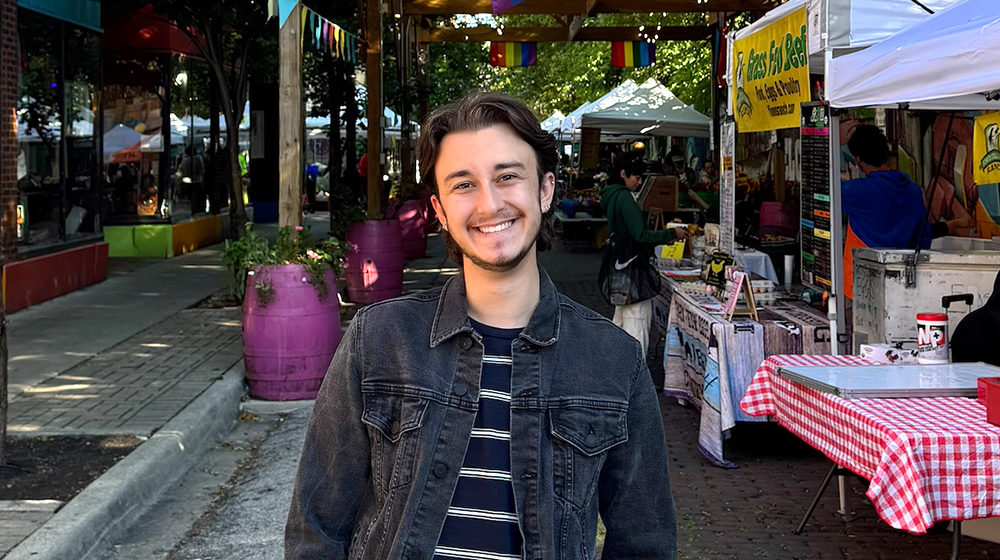
SES senior Jameson Walker enjoyed connecting with community members as an intern with the Glenwood Sunday Market.
Why did you decide to come to Loyola and SES?
I chose to come to Loyola because I had a great feeling about the campus community! Initially, I was a global studies major. However, I started to consider pursuing my interest in sustainability after I took The Scientific Basis of Environmental Issues as a core class with Brother Mark Mackey in my first semester. The following semester, I took Global Environmental Politics with Dr. Luigi Sensi (highly recommend), and that sealed the deal. I have loved being a part of the SES ever since!
How did you get involved with your student internship?
I got involved with my student internship with the Glenwood Sunday Market by applying through the SES internship placement program. Previously, I had spent about a year applying to dozens of positions on LinkedIn and Handshake, getting some interviews but ultimately no offers. The SES internship program enabled me to gain sustainability work experience before starting my career. As a senior graduating in December, this has really increased my confidence going into job hunting!
What sorts of activities are involved in the internship?
As an intern for the Glenwood Sunday Market, my main job is running the Food Access Program! At the market, if a community member is on SNAP benefits (food stamps) and wants to use their EBT card to purchase food items from the market, we have a program that more than doubles their spending power by matching their swipe in produce vouchers. It then gives them an additional $10 toward their overall total. For example, a $10 EBT swipe becomes $30 to spend at the market. To make this program happen, I handle accounting and data management, work the food access table at the market, and apply for grants to expand the program and maintain our neighbors' access to those funds.
But my overall favorite part of the internship is market day! Each Sunday, I work the market itself, checking in with vendors and customers, and making sure that everything runs smoothly. Other than that, I work on various marketing materials for the market, such as newsletters and social media planning.
What have you learned from the internship?
I have learned so much! The biggest thing I've gained is a much greater appreciation for and understanding of my community. Throughout the summer, the market provided a space for me to build relationships with my neighbors, get to know regulars, and make friends with local farmers. I feel in-the-know about community events and organizations, and every time I'm at the market, I feel enveloped in connection.
I have also learned a lot about urban agriculture and the food justice world! I'd studied sustainable food systems in SES, but getting to live what a sustainable food system actually looks like, even on a micro-level, has been really inspiring and invigorating! I feel a lot of hope about our ability to use food as a tool for social justice and living in harmony with the Earth, and about markets as spaces for connection and community.
How did the experience prepare you for future jobs or impact your career plans?
Before doing my internship, I felt very nervous about entering the job market. Of course, I still feel nervous, but I know that I have skills and experience to back me up, and most importantly, I have a good sense and confidence about what matters to me in a work environment. Because of my work with GSM, I realized I want a role that incorporates some aspect of community engagement. The market really brings me to life every week in a way that strictly desk work wouldn't fulfill me.
Entering my job hunt, my experience with the market has informed my decision to look for sustainable nonprofit roles, jobs in environmental grant-writing, and jobs with a community focus.
What are your plans after graduation?
I'm hoping to stick around in Chicago, and I just started the job hunt for my first full-time job! My long-term goal is to pursue a master's in Germany and eventually immigrate there to work on sustainable transformation.
What advice would you give to other students who are thinking about doing internships?
I know it's much easier said than done to get internship experience, but I would say that it's absolutely worth it if you have any interest at all. My main advice would be to stay calm and confident during your search. One of my biggest hurdles to getting an internship was still believing that I deserved the opportunity, even in the face of what feels like loads of rejection. Applying in the first place, even if you don't get roles immediately, is part of the learning process. It will help when you're looking for your first full-time role since you'll learn how to navigate the process!
Overall, having an outlet to apply the knowledge you're learning is also so important! Studying environmental policy can sometimes feel incredibly theoretical, but doing an internship allowed me to apply that knowledge and feel more confident in my base of knowledge in ways that I didn't expect.
September 2025
Why did you decide to come to Loyola and SES?
I chose to come to Loyola because I had a great feeling about the campus community! Initially, I was a global studies major. However, I started to consider pursuing my interest in sustainability after I took The Scientific Basis of Environmental Issues as a core class with Brother Mark Mackey in my first semester. The following semester, I took Global Environmental Politics with Dr. Luigi Sensi (highly recommend), and that sealed the deal. I have loved being a part of the SES ever since!
How did you get involved with your student internship?
I got involved with my student internship with the Glenwood Sunday Market by applying through the SES internship placement program. Previously, I had spent about a year applying to dozens of positions on LinkedIn and Handshake, getting some interviews but ultimately no offers. The SES internship program enabled me to gain sustainability work experience before starting my career. As a senior graduating in December, this has really increased my confidence going into job hunting!
What sorts of activities are involved in the internship?
As an intern for the Glenwood Sunday Market, my main job is running the Food Access Program! At the market, if a community member is on SNAP benefits (food stamps) and wants to use their EBT card to purchase food items from the market, we have a program that more than doubles their spending power by matching their swipe in produce vouchers. It then gives them an additional $10 toward their overall total. For example, a $10 EBT swipe becomes $30 to spend at the market. To make this program happen, I handle accounting and data management, work the food access table at the market, and apply for grants to expand the program and maintain our neighbors' access to those funds.
But my overall favorite part of the internship is market day! Each Sunday, I work the market itself, checking in with vendors and customers, and making sure that everything runs smoothly. Other than that, I work on various marketing materials for the market, such as newsletters and social media planning.
What have you learned from the internship?
I have learned so much! The biggest thing I've gained is a much greater appreciation for and understanding of my community. Throughout the summer, the market provided a space for me to build relationships with my neighbors, get to know regulars, and make friends with local farmers. I feel in-the-know about community events and organizations, and every time I'm at the market, I feel enveloped in connection.
I have also learned a lot about urban agriculture and the food justice world! I'd studied sustainable food systems in SES, but getting to live what a sustainable food system actually looks like, even on a micro-level, has been really inspiring and invigorating! I feel a lot of hope about our ability to use food as a tool for social justice and living in harmony with the Earth, and about markets as spaces for connection and community.
How did the experience prepare you for future jobs or impact your career plans?
Before doing my internship, I felt very nervous about entering the job market. Of course, I still feel nervous, but I know that I have skills and experience to back me up, and most importantly, I have a good sense and confidence about what matters to me in a work environment. Because of my work with GSM, I realized I want a role that incorporates some aspect of community engagement. The market really brings me to life every week in a way that strictly desk work wouldn't fulfill me.
Entering my job hunt, my experience with the market has informed my decision to look for sustainable nonprofit roles, jobs in environmental grant-writing, and jobs with a community focus.
What are your plans after graduation?
I'm hoping to stick around in Chicago, and I just started the job hunt for my first full-time job! My long-term goal is to pursue a master's in Germany and eventually immigrate there to work on sustainable transformation.
What advice would you give to other students who are thinking about doing internships?
I know it's much easier said than done to get internship experience, but I would say that it's absolutely worth it if you have any interest at all. My main advice would be to stay calm and confident during your search. One of my biggest hurdles to getting an internship was still believing that I deserved the opportunity, even in the face of what feels like loads of rejection. Applying in the first place, even if you don't get roles immediately, is part of the learning process. It will help when you're looking for your first full-time role since you'll learn how to navigate the process!
Overall, having an outlet to apply the knowledge you're learning is also so important! Studying environmental policy can sometimes feel incredibly theoretical, but doing an internship allowed me to apply that knowledge and feel more confident in my base of knowledge in ways that I didn't expect.
September 2025