
Taking action for small businesses
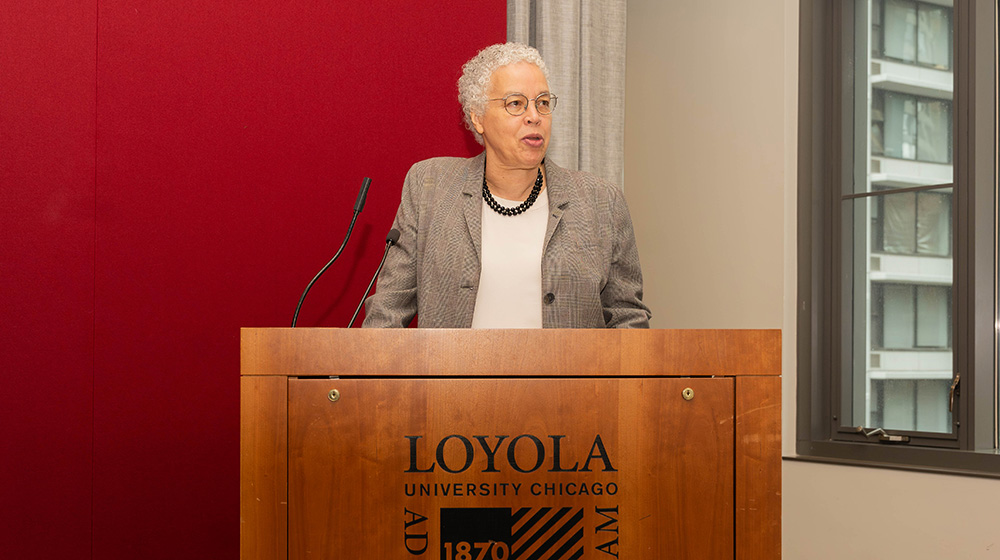
At the Capacity Building for Capacity Builders workshop facilitated by the Quinlan School of Business, Cook County Board of Commissioners President Toni Preckwinkle shared that Cook County would be investing $1.4 million to help small businesses.
Chicago’s small business ecosystem gathered at the Quinlan School of Business for the second annual Capacity Building for Capacity Builders workshop in May 2025. In a full-day convening, leaders from business serving organizations (BSOs) and small businesses from across Chicagoland discussed the current state of support for small and minority-owned businesses and actionable ways to move forward.
“By convening BSOs, private sector executives, and public leaders, Quinlan is striving to be a difference maker for Chicago,” said Michael Behnam, dean of the Quinlan School of Business. “We are proud to play our part in addressing the challenges faced by small businesses and supporting organizations.”
Capacity Building for Capacity Builders is one of the key activities of the Quinlan School of Business’s Social Impact Initiative, which is supported by a $625,000 grant from the U.S. Small Business Administration. The three-year initiative is collecting data on equity gaps faced by minority-owned businesses and developing equitable outreach strategies. It will result in the creation of a dashboard enabling Chicago’s small businesses to easily access support services.
“Bringing together the people and organizations dedicated to growing small businesses across Chicagoland has brought inspiration, collaboration, and innovations that are making a difference,” said Peter Norlander, associate professor of management and project lead for the Social Impact Initiative.
Key takeaways
As the day progressed, common themes developed in sessions tailored to staff and executives. Below are some key takeaways.
Investing in small businesses
Keynote speaker Toni Preckwinkle, president of the Cook County Board of Commissioners, shared new investments in small businesses at the Capacity Building workshop. Preckwinkle told attendees that $1.4 million would be available to community financial institutions, helping them lend to small businesses.
“We developed this innovative program to address documented gaps in the access-to-capital landscape for small businesses,” Preckwinkle said in a subsequent press release. “This program will help community financial institutions address that.”
Understanding the state of BSOs
In a session led by Garvester Kelley and Robin Newberger of the Chicago Federal Reserve, BSO leaders collaborated to understand their current challenges and create solutions.
In a group poll, BSOs representatives said that their greatest concern was access to capital and changing government regulations. Their responses gave valuable into how BSOs and small businesses can be supported.
Most effective services:
- Technical support
- Mentoring
- Group learning
- Trust and relationship building
Most popular practices:
- Peer-mentor ecosystem building
- Individually or culturally tailored support
Teams of Quinlan students, faculty, and staff gathered statistics to help understand the current state of small business in Chicago. These insights help BSOs understand where they are now and which practices can help them accomplish their goals with small businesses.
Connecting with difference makers
The Capacity Building for Capacity Builders workshop was held in tandem with the Advisors Academy, a program led by the Women’s Business Development Center to train business advisors who work at BSOs. Front-line business coaches who assist small businesses received training on core business advising skills, guiding them on how to become effective mentors and supports for their small business clients.
“We were delighted that programs such as Advisors Academy were integrated into this day in a way that strengthens and amplifies what each of us are doing,” said Norlander. “The Advisors Academy collaboration across multiple BSOs aimed at improving business advising is exactly the type of work we want to promote and encourage.”
In addition to learning in the classroom, the schedules for both the Capacity Building workshop and Advisors Academy were arranged so attendees from both could network at the same time. As the day continued, attendees found opportunities to learn from peers from across the city and region.
“It is a collaboration to catalyze collaboration,” said Clark McCain, managing director of strategic partnerships at the Women’s Business Development Center. “At last year’s Capacity Builders convening, we introduced the idea and crowd-sourced recommendations for its development. This year, we operated the program during the Capacity Builders convening, giving attendees a chance to sample what has been built since last year’s event."
Sharing resources
Domini Gamble of Cook County Small Business Source and Brad McConnell of Allies for Community Business led case studies exploring and guiding real-world small businesses through the challenge of navigating the available resources. They asked participants to use their knowledge to identify relevant support and resources, as well as how they would facilitate networking and peer learning.
The challenges posed reflected what small businesses often face. One example is a small coffee cart struggling to find funding for startup costs and needing more business knowledge. Other scenarios focused on finding marketing support and keeping up with digital transformations. The session finished with a presentation of resources, including those provided by Cook County Small Business Source. Those include:
- Recovery grants and loans from the Small Business Association
- One-on-one advising from Cook County Small Business Source
- Allies for Community Businesses